The 2,000-Year-Old Green Serpentine Mask of Teotihuacán: A Symbol of Ancient Power and Ritual
Beneath the monumental Pyramid of the Sun in Teotihuacán, archaeologists unearthed a striking artifact—a 2,000-year-old green serpentine stone mask. Unlike personal adornments placed with the dead, this extraordinary object served a different purpose: a sacred offering tied to the city’s powerful spiritual beliefs and architectural sanctification rituals. The discovery provides profound insight into the worldview, artistry, and ceremonial complexity of one of Mesoamerica’s greatest civilizations.
The Pyramid of the Sun: Heart of a Sacred City
Teotihuacán, located in the Valley of Mexico, was one of the largest and most influential pre-Columbian cities in the Americas. At its zenith between the 1st and 7th centuries CE, it stood as a shining center of religion, trade, and urban innovation. The Pyramid of the Sun, towering approximately 65 meters high, is the largest structure in the city and one of the most ambitious constructions in the ancient world.
Archaeological research has long shown that the pyramid was not merely architectural—it was fundamentally ceremonial. The structure’s orientation aligns with astronomical events such as the setting sun on specific dates, reflecting the builders’ cosmic awareness. Offerings buried within its foundations suggest that each stage of construction was accompanied by elaborate rituals to consecrate and energize the monument with divine power.
The Discovery: Unearthing a Sacred Offering
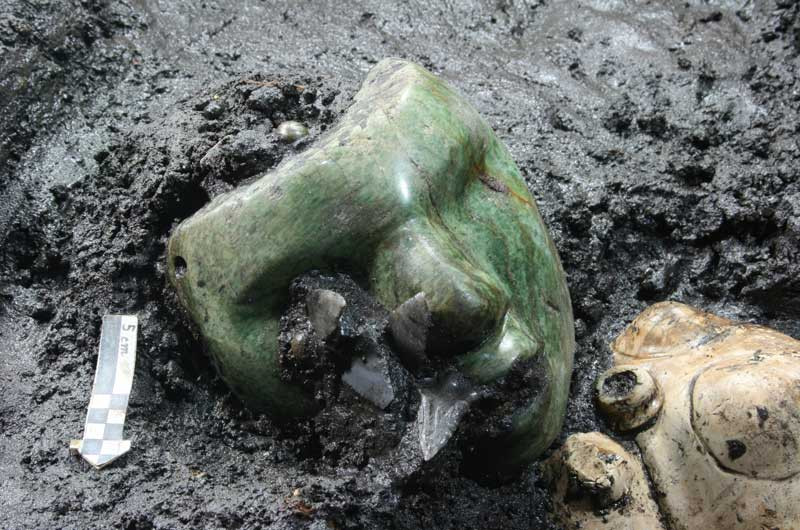
During excavations at the pyramid’s base, a team of archaeologists unearthed a fascinating deposit of ceremonial objects. Among these was the remarkable green serpentine mask, polished to perfection and carved with subtle human features. The find was accompanied by obsidian blades, shell fragments, clay figurines, and pottery, forming a complex ritual assemblage.
Unlike funerary masks used to honor the deceased, this serpentine mask appears to have been deliberately placed as an offering during the pyramid’s construction. Its presence suggests it was part of a foundation ritual—a sacred gesture intended to invoke divine favor and spiritually protect the building. The offering, sealed deep within the structure, symbolized a bridge between the earthly and the cosmic realms.
Serpentine Stone: Symbol of Fertility and Rebirth
Serpentine, with its deep green hue, held great significance in Mesoamerican cosmology. The color green was associated with vegetation, life, and renewal, connecting human existence to the natural cycles of fertility and rebirth. Stones of this color were thought to embody the essence of the earth itself, drawing upon energies that sustained both nature and civilization.
Crafting a ritual mask from serpentine was therefore a deliberate and symbolic choice. The artisans of Teotihuacán imbued the object with spiritual meaning, transforming the stone into an offering representing life force and continuity. By placing such an object beneath the Pyramid of the Sun, they may have sought to infuse the massive structure with the vital energies of the earth and cosmos.
Artistic Mastery of Teotihuacán’s Craftsmen
The green serpentine mask stands as a testament to the mastery of Teotihuacán’s artisans. The carving reveals refined workmanship—the almond-shaped eyes, strong cheek contours, and balanced proportions indicate both skill and intentional stylization. Such masks were shaped not as individual likenesses, but as timeless embodiments of human divinity.
Archaeological studies suggest that artisans in Teotihuacán used an array of stoneworking tools and polishing techniques to achieve remarkable smoothness and symmetry. The uniformity of material and the care invested in its creation confirm that the mask was more than ornamentation—it was an object of transcendent importance, made for sacred deposit rather than display.
Ritual Context: Sacred Deposits Beneath the Pyramid
This discovery is part of a pattern observed across major Mesoamerican sites, where sacred offerings were placed beneath temples at key stages of construction. In Teotihuacán, these ritual caches often contained materials linked to the four elemental directions—symbolizing water, earth, fire, and air—and were intended to harmonize the structure with cosmic forces.
The presence of obsidian blades in this particular offering likely represents symbolic bloodletting or sacrifice. While the figurines may have depicted gods or human intercessors. By integrating these objects into the pyramid’s core, builders consecrated the structure as a living embodiment of the cosmos. The green serpentine mask, at the center of this assemblage, may have represented the divine face of creation itself.
The Pyramid of the Sun’s Sacred Function
Beyond its architectural splendor, the Pyramid of the Sun functioned as a spiritual nucleus for Teotihuacán’s inhabitants. Pilgrims ascended its terraces to participate in solar rituals, honoring deities linked to fertility, the underworld, and celestial balance. The city’s name, often interpreted as “the place where gods were born,” reflects its sacred reputation across the Mesoamerican world.
The discovery of the serpentine mask reveals how deeply ritual practice was woven into the city’s development. Every layer of the pyramid may have represented a spiritual ascent. A physical manifestation of the Teotihuacanos’ attempt to bridge human existence with the divine order of the universe.
Interpreting the Symbolism: Creation and Cosmos
Archaeologists and iconographers interpret the mask as an artifact embodying Mesoamerican concepts of duality and rebirth. Its burial aligns with the city’s cosmic orientation and ritual emphasis on cyclical time. In many ancient belief systems, constructing monumental architecture was itself a reenactment of creation. The pyramid symbolized the primordial mountain rising from chaos, while the buried offerings served to recreate the moment of genesis.
In this context, the serpentine mask, born of earth and stone. Becomes a symbolic face of the gods—renewing life through ritual sacrifice and architectural devotion.
A Window into Early Teotihuacán Civilization
Dating the artifacts to the pyramid’s earliest construction phase confirms that ritual depositions were central from the city’s inception. These findings help researchers trace the evolution of Teotihuacán’s urban planning, religion, and state ideology. The blend of artistry and spirituality suggests a society that viewed construction not merely as urban progress. But as sacred alignment with the divine cosmos.
Ongoing excavations continue to illuminate the complexity of Teotihuacán’s social world. Discoveries such as this green serpentine mask remind us that beneath. Each monumental structure lies a deeper layer of meaning, inscribed in stone and ceremony.
Legacy of the Green Serpentine Mask
Today, the green serpentine mask stands as one of the most evocative artifacts ever found at Teotihuacán. It embodies the city’s devotion to spiritual renewal. Its unparalleled craftsmanship, and its vision of humanity’s place within a living, sacred universe.
Through this discovery, we gain not only a tangible relic of ancient ritual. But also a renewed appreciation for the people who built one of the grandest and most mysterious cities of the ancient Americas. Beneath its towering pyramids, Teotihuacán continues to whisper the story of creation, rebirth, and the eternal bond between human hands and cosmic destiny.
ALSO READ: The Astonishing Journey of the Titanosaur Dinosaur Egg Fossil in London