The Shaman of Bad Dürrenberg: A Mesolithic Mystery from Ancient Germany
The Shaman of Bad Dürrenberg is among the most fascinating prehistoric burials ever uncovered in Europe. Dating back 8,600 to 9,000 years, her grave reveals striking insights into early ritual practices, social structures, and the symbolic thinking of Mesolithic peoples. Discovered in the small German town of Bad Dürrenberg, her remains and the extraordinary artifacts surrounding her reflect the role of a spiritual figure—perhaps a healer, a ritual specialist, or an ancestral mediator in her community.
Discovery of the Burial
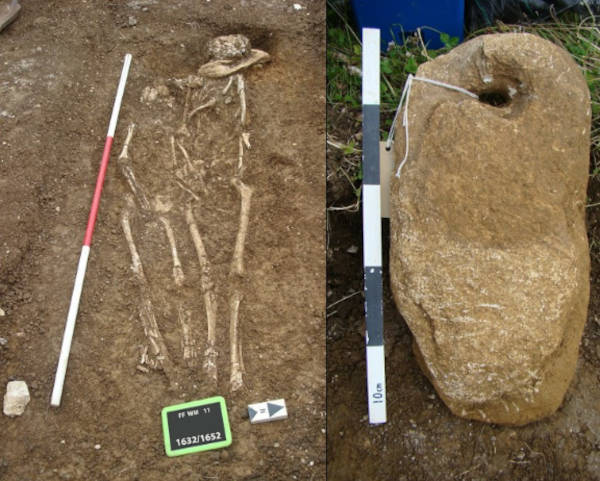
In 1934, during construction work near the spa town of Bad Dürrenberg in Saxony-Anhalt, Germany, workers uncovered human bones. Archaeologists quickly recognized the site’s significance. Excavations revealed the skeletal remains of a woman aged roughly 25 to 35 years, carefully buried within a pit accompanied by a striking collection of animal remains, tools, and adornments.
The remains were studied extensively over subsequent decades, and the find is now displayed at the Landesmuseum für Vorgeschichte in Halle (State Museum of Prehistory). Modern analysis using radiocarbon dating placed the burial between 8,600 and 9,000 years ago, during the transitional Mesolithic period when hunter-gatherer societies flourished across Europe before the full onset of Neolithic farming.
The Woman and Her World
The woman’s skeleton shows signs of physical hardship and possible disability. Evidence suggests that she suffered from spinal deformity or chronic illness, yet her elaborate grave implies she held a revered or specialized role within her community. Her life likely combined elements of healing, spiritual mediation, and ritual performance.
At the time of her burial, northwest Europe was dominated by dense forests, rivers, and rich wetlands teeming with fish, game, and plant resources. Communities lived in small, mobile groups, sustained by seasonal hunting and gathering. Ritual specialists—what modern researchers often call shamans—played vital roles as healers, visionaries, and connectors between the human and spirit worlds.
A Mesolithic Headdress of Animal Spirits
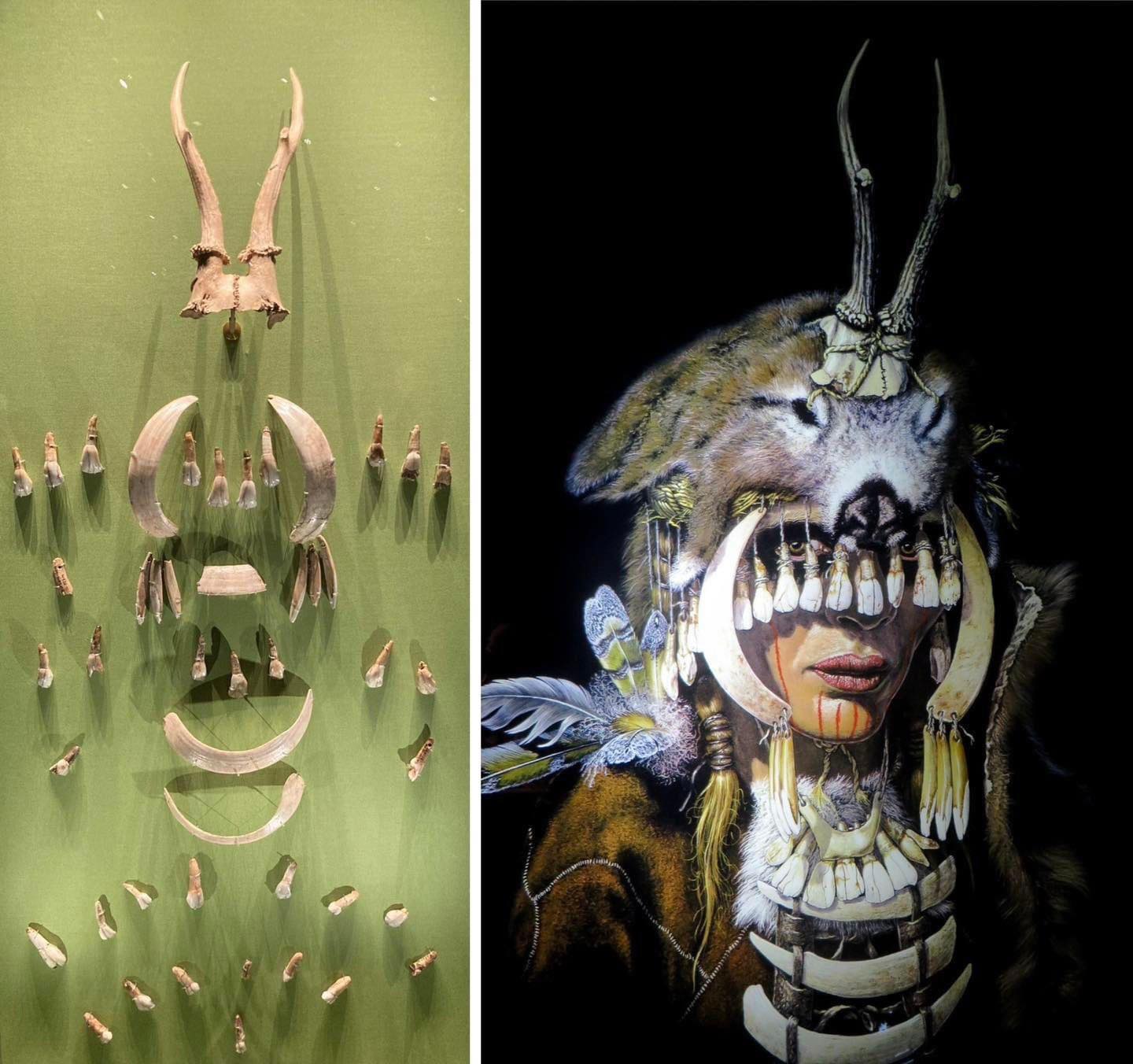
Perhaps the most astonishing feature of the burial is the woman’s headdress. Around her skull were arranged animal bones, teeth, and ornaments fashioned from crane, wild boar, deer, and turtle. The objects include:
-
Deer antler components shaped and fitted together, possibly to form a frame for an ornate headpiece.
-
Teeth and tusk fragments from wild boars, likely used as decorative or symbolic attachments.
-
Bird bones, especially from cranes, which may have been attached as feathers or plumes.
-
Turtle shell fragments, rare in northern contexts, suggesting a deeper symbolic or ritual import.
The design implies that the head-dress may have formed a composite mask or headdress representing various animal spirits. Such imagery resonates with shamanic traditions worldwide, where donning mixed-animal accessories symbolizes transformation or spirit-journeying.
Animal Symbolism and Spiritual Identity
Each species in the headdress carries deep symbolic potential:
-
Deer are often associated with life, regeneration, and fertility in prehistoric iconography. Their antlers suggest cycles of death and rebirth.
-
Wild boars embody strength, aggression, and courage.
-
Cranes are linked with the heavens and migration, representing travel between worlds.
-
Turtles symbolize endurance, longevity, and connection to the earth.
To combine these creatures on a single headdress implies a synthesis of their powers. The shaman, in wearing this headdress, might have embodied the world’s living forces—an intermediary uniting sky, earth, water, and the animal realm.
Ritual Accoutrements and Grave Goods
Beyond the headdress, archaeologists identified several ritual objects around the burial. These include:
-
Flint tools, possibly used in ceremony or healing work.
-
Pigment traces, perhaps remains of ochre or charcoal used in body painting.
-
Animal bones with deliberate placements, suggesting symbolic offerings.
-
Remnants of small wooden or organic items that had decayed but left impressions in the soil.
Together, these finds highlight a complex burial rite emphasizing transformation, communication with spirits, and the maintenance of balance between humans and the natural world.
The Child’s Remains: A Shared Burial
Intriguingly, near the woman’s head lay bones belonging to a young child—possibly a newborn or infant. Their connection remains debated. Some scholars propose the child may have died during childbirth, making the burial both maternal and shamanic. Others interpret it as a symbolic union between life and death, reinforcing the woman’s role as a liminal figure capable of guiding souls.
This dual burial underscores the ritual depth of the site. Rather than being a mere funeral, it might have served as a ceremonial event marking transformation within the spirit realm.
Interpreting the Shaman’s Role
The interpretation of the woman as a shaman stems from several clues:
-
Complex burial symbolism: Extraordinary grave goods and careful placement suggest ritual importance.
-
Animal adornments: The composite headdress echoes universal shamanic imagery.
-
Physical condition: Disabilities or illnesses often appear in ethnographic parallels as attributes of spiritual visionaries, whose altered relationships to the physical world allowed spiritual insight.
-
Status indicators: The amount of material wealth invested in the burial implies high social esteem.
Through these elements, the Shaman of Bad Dürrenberg emerges as one of Europe’s earliest identifiable ritual specialists—a person mediating between natural and supernatural realms.
Scientific Studies and Modern Discoveries
Recent research using CT scans and isotopic analysis has deepened understanding of the individual’s life. Chemical signatures from her bones reveal a diet typical of Mesolithic hunter-gatherers: freshwater fish, wild game, and foraged plants. Microscopic studies of her teeth also indicate sustained use of particular plant fibers, possibly linked to medicinal or ritual practices.
DNA studies are ongoing, seeking to place her within the genetic mosaic of early post-glacial Europe. Early results indicate affinities with Western European hunter-gatherer populations.
Archaeologists are now revisiting the burial site and similar contexts with new methods, hoping to reconstruct not only the woman’s individual life but also the spiritual landscape of her community.
The Legacy of the Shaman of Bad Dürrenberg
Today, the Shaman of Bad Dürrenberg stands as one of the most evocative figures of European prehistory. Her burial reveals a level of symbolic sophistication that challenges assumptions about Mesolithic societies. These people were not only skilled hunters but also thinkers, artists, and believers in unseen forces shaping their world.
The headdress, in particular, bridges deep human themes—the relationship between life and death, humans and animals, nature and the sacred. Through her, modern archaeology glimpses the beginnings of religious thought and ritual symbolism on the European continent.
Visiting the Burial at the State Museum of Prehistory, Halle
The carefully reconstructed burial is now on display at the Landesmuseum für Vorgeschichte in Halle, Germany, renowned for its world-class exhibits such as the Nebra Sky Disc. The display recreates the burial setting, allowing visitors to witness the headdress and associated artifacts up close. Digital reconstructions even show how the woman might have looked wearing her animal adornments.
For students, archaeologists, and visitors alike, the Shaman of Bad Dürrenberg continues to spark curiosity about the human past, spirituality, and the enduring quest to understand our ancient ancestors’ beliefs.