The Skidi Pawnee Star Map: Ancient Plains Astronomy and Cultural Legacy
The Skidi Pawnee and Their Celestial Traditions
Centuries before Western astronomy reached the Great Plains, the Skidi Pawnee people charted the heavens with remarkable precision. As one of the four bands of the Pawnee Nation, the Skidi lived primarily along the Loup and Platte Rivers, across present-day Nebraska and Kansas. Their settlements sat beneath vast night skies, where the shimmering constellations became both compass and scripture.
The Skidi Pawnee were deeply observant sky watchers. To them, the stars were more than distant suns—they were ancestral presences, storytellers, and spiritual guides. Their knowledge of celestial cycles shaped migration routes, hunting seasons, and the timing of essential rituals. In this worldview, science and spirituality were inseparable, and the cosmos was a living partner in earthly existence.
The 300-Year-Old Leather Star Map
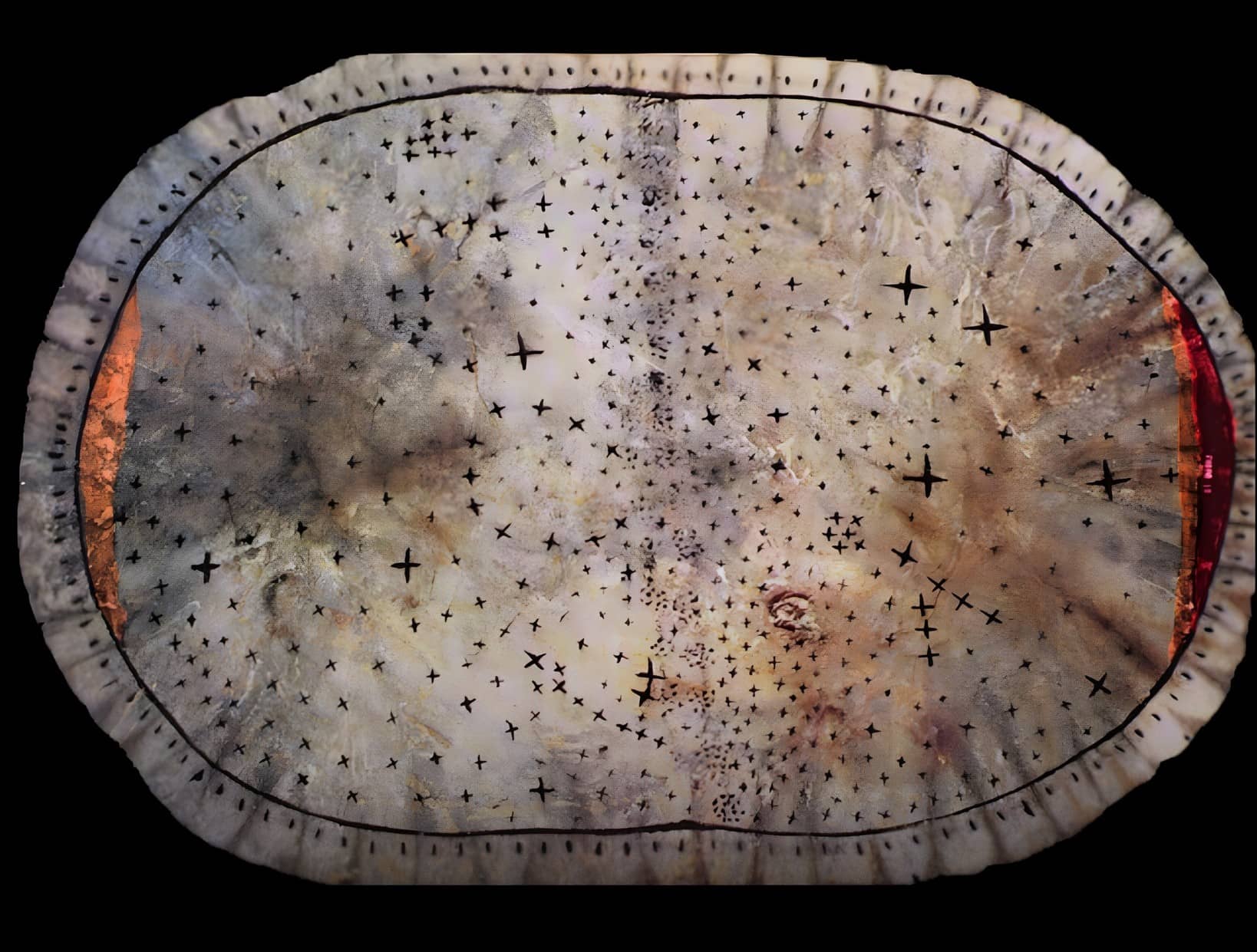
Among the most significant artifacts of Skidi astronomy is a 300-year-old leather star map, a circular piece marked meticulously with symbols representing constellations and celestial formations visible across the Plains. This artifact is not simply a chart of stars—it is a spiritual record, a portable codex of the night sky painted by Pawnee astronomers whose observations rivaled those of contemporary European stargazers.
Each mark and pattern carved or painted onto the hide carried rich meaning. Scholars who have examined the map suggest that its design aligns with key constellations such as the Morning Star (associated with Venus), the Pleiades, and the Milky Way, known in Pawnee tradition as the “Path of Departed Spirits.” These cosmic symbols mirrored sacred narratives that guided both practical actions and spiritual teachings.
A Celestial Tool for Daily Life
The Skidi Pawnee star map was not merely decorative or symbolic. It served as a functional astronomical instrument, integral to agricultural timing, hunting expeditions, and navigation. The rising and setting of particular stars marked the migration of bison herds, the approach of planting seasons, and the occurrence of ritual ceremonies that harmonized human activity with cosmic order.
For example, the heliacal rising of specific stars was used to determine when to plant corn, a staple of Pawnee life. The Skidi believed that prosperity flowed from aligning one’s tasks with the rhythms of the heavens. In this sense, the star map functioned as both calendar and compass—a means of sustaining life through precise cosmic symbiosis.
Spiritual and Ceremonial Connections
The map also held deep religious meaning. In Skidi cosmology, the universe was structured into multiple layers, with celestial beings guiding human destiny. The Pawnee recognized male and female deities associated with different stars, whose interplay represented the balance of creation and destruction, fertility and renewal.
The Morning Star, in particular, played a vital role in Skidi rituals. Representing masculine energy and the dawn of life, it was paired with the Evening Star, symbolizing femininity and fertility. The alignment of these celestial entities dictated the timing of seasonal ceremonies, some of which have been carefully preserved through oral traditions to this day.
Thus, the star map represented not only cosmic geography but also moral order. Each celestial figure embedded in the hide conveyed lessons of unity, sacrifice, and balance—values that sustained community bonds and spiritual purpose.
Craftsmanship and Symbolic Design
Creating the star map required precision, patience, and artistic mastery. The Pawnee artisans who fashioned it possessed both astronomical insight and leatherworking skill. The hide was tanned, smoothed, and treated with natural pigments—possibly using charcoal, ochre, and plant dyes. Through careful arrangement, dots and lines were placed in patterns corresponding to night sky formations as they appeared through different seasons.
The circular shape itself symbolized continuity—the endless cycle of life, time, and celestial motion. Modern researchers studying the artifact note that it reflects a worldview shaped not by linear progress but by recurrence and renewal. This cosmological design distinguished the Pawnee approach from contemporary Western astronomical charts, which typically pursued mathematical abstraction over sacred meaning.
The Skidi Star Map in Comparative Perspective
Across the world, ancient cultures developed parallel systems of sky observation, from Babylonian tablets to Mayan codices. Yet the Skidi Pawnee star map is unique in its integration of scientific observation and spiritual expression within a living cultural system.
Unlike purely observational maps, the Skidi version cannot be separated from the oral traditions that animate it. Each constellation corresponds to a story; each story conveys a teaching; and each teaching reinforces community interdependence. This seamless integration of knowledge systems highlights the advanced intellectual world of the Pawnee—one in which astronomy, cosmology, and ethics were deeply intertwined.

Preservation and Scholarly Importance
Today, the original star map resides under careful conservation in museum and tribal collections. Its preservation holds immense value, not just for historians or archaeologists, but for contemporary Pawnee descendants who continue to honor their ancestral wisdom.
Through ongoing collaboration between Native communities and researchers, new interpretations of the map’s symbols are emerging. Digital imaging and astronomical modeling have helped scholars align the markings with specific constellations and seasonal events, revealing that the Pawnee created a dynamic and highly accurate representation of the northern prairie sky as it appeared around the 1700s.
The study of the star map has also reshaped understandings of North American science. It challenges stereotypes that Indigenous astronomy was limited to myth, showing instead that Native peoples employed complex observational techniques grounded in ecological awareness and mathematical reasoning.
Cultural Reawakening and Modern Relevance
In recent years, Pawnee cultural revival movements have embraced the star map as a symbol of identity and endurance. Tribal educators use the artifact to teach astronomy, language, and spiritual values to younger generations. Ceremonial practices inspired by traditional star knowledge continue to connect modern Pawnee individuals with their ancestors’ night-sky wisdom.
This resurgence underscores an important truth: the Skidi Pawnee star map is not a relic of a vanished past but a living thread linking Indigenous scientific thought with contemporary cultural renewal. Its lessons of harmony—between land and sky, humanity and cosmos—resonate strongly amid today’s ecological and spiritual crises.
A Testament to Human Ingenuity and Wonder
Viewed in its full context, the Skidi Pawnee star map stands as both an artistic marvel and a scientific achievement. It captures the essence of a people who looked upward not just to measure time or direction. But to honor the universe as a sacred companion in life’s journey.
Preserving and studying this rare artifact deepens our understanding of human creativity and the universal impulse to seek meaning in the stars. For the Pawnee and for all who encounter their legacy, the map offers a timeless invitation. To see the cosmos not as something distant and cold. But as a living mirror reflecting our stories, values, and dreams.
ALSO READ: The Voynich Manuscript: The Unsolved Mystery of a 15th-Century Codex