The Mystery of the Ancient Granite Drill Core at Giza
In 1881, British archaeologist William Flinders Petrie made one of the most puzzling finds in Egyptian archaeology: a drill core made from pink Aswan granite, discovered near the Great Pyramid of Giza. This seemingly small cylindrical fragment continues to ignite debate because of its extraordinary precision—suggesting an ancient mastery of engineering far beyond what copper tools should have been capable of.
Discovery of a Forgotten Artifact
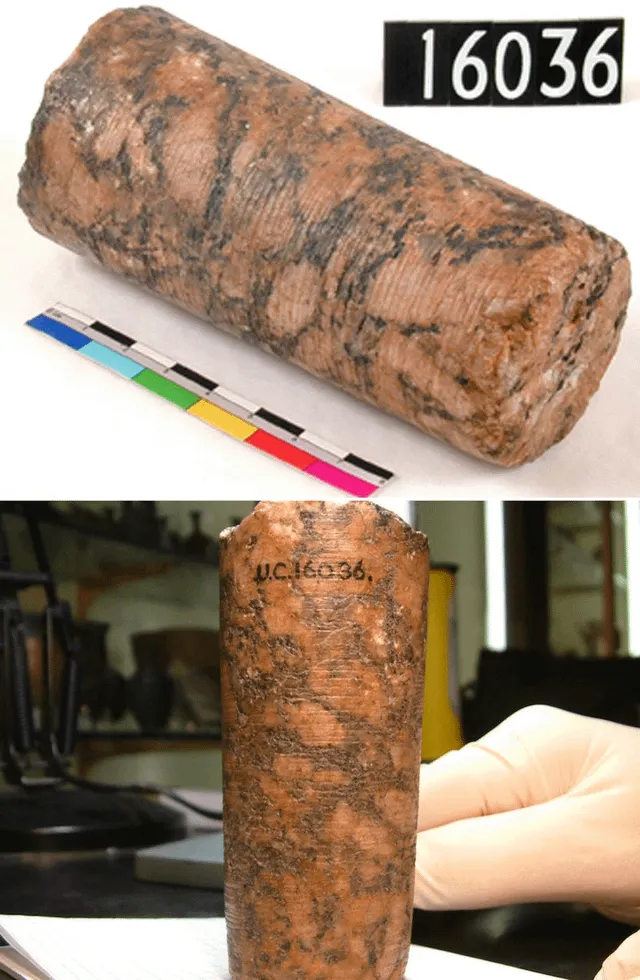
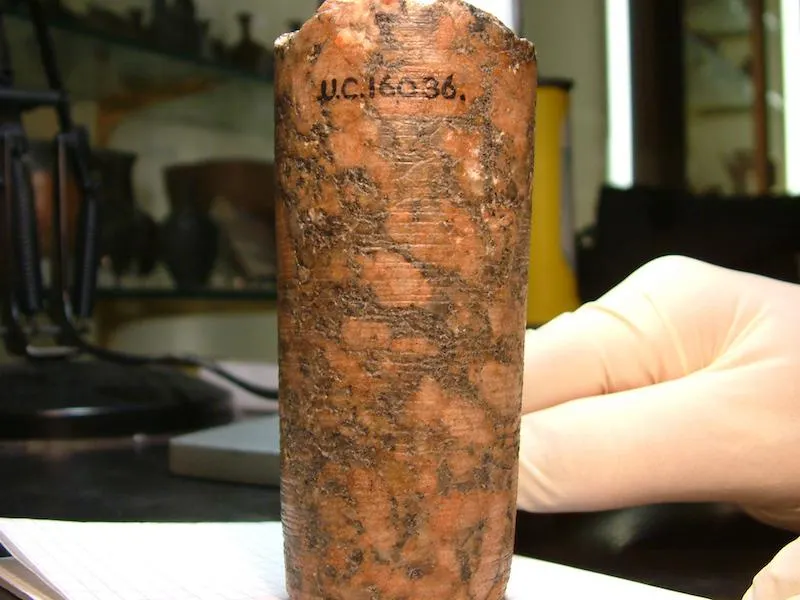
Petrie’s meticulous excavation around the Giza Plateau turned up many artifacts, but few commanded as much intrigue as the granite core. It was a small piece of pink granite, roughly cylindrical, with spiral grooves etched into its surface. Petrie measured the angles and spacing of these grooves and concluded that they exhibited remarkable precision—comparable to modern machine drilling.
This drill core, often referred to as “Petrie’s Core No. 7,” was later documented in his work The Pyramids and Temples of Gizeh (1883). To Petrie, the pattern wasn’t random. The spiral markings revealed a helical motion—evidence that a rotating drill under uniform pressure had cut through the stone. He noted that the grooves appeared deeper in certain sections, implying that the tool not only rotated but also fed into the granite at an unexpectedly rapid rate, outpacing what soft copper tools were capable of achieving.
The Problem with Copper Tools
Mainstream Egyptology attributes ancient stone-cutting technology primarily to copper chisels, wooden mallets, stone hammers, and abrasive sand. These materials were indeed used extensively across Egypt’s Old Kingdom (around 2600 BCE). Yet pink granite, sourced from Aswan, is among the hardest natural stones, registering around 6 to 7 on the Mohs scale—harder than copper, which rates at only about 3.
This mismatch leads to several critical questions:
-
How could ancient builders have drilled deep, uniform holes into such hard material using copper?
-
Could the abrasives (such as quartz sand) have compensated for the weakness of copper?
-
Were there techniques or tool designs unknown to modern researchers?
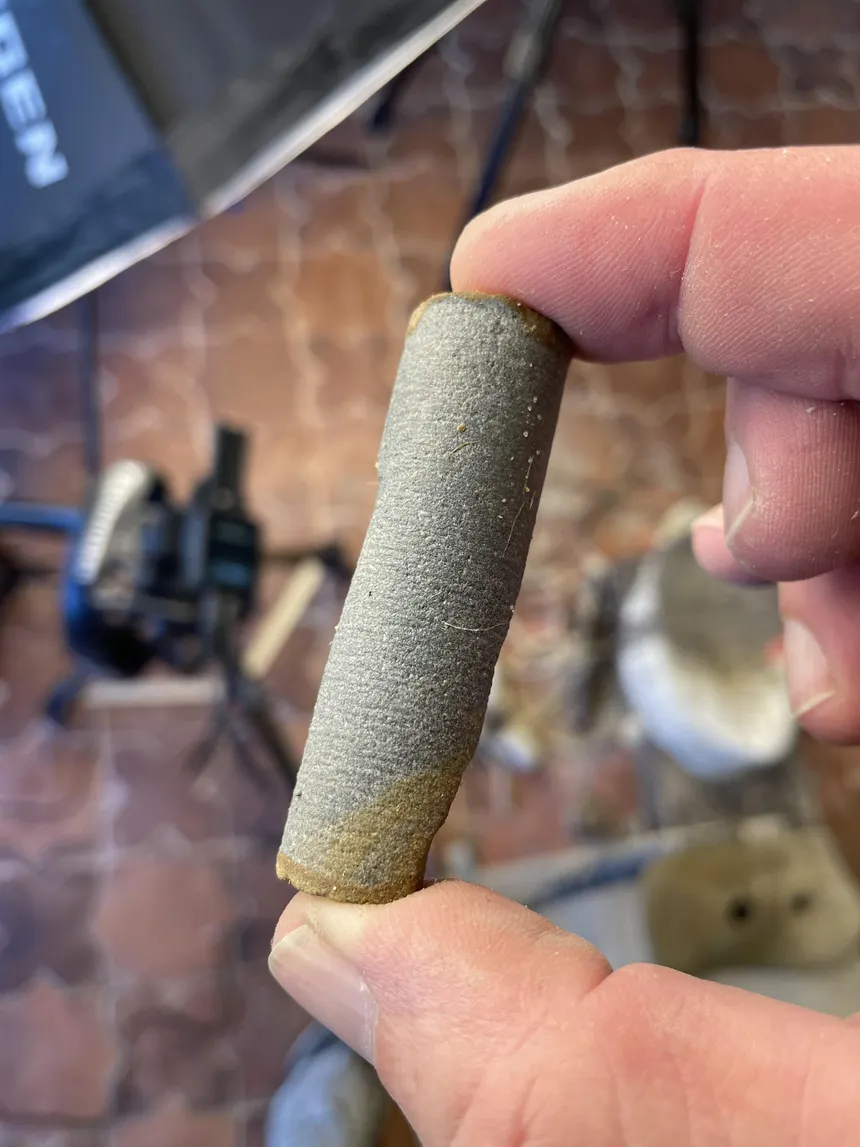
Laboratory experiments attempting to replicate the results using copper-tube drills and abrasives have achieved only partial success. While grooves can be formed, the efficiency, depth, and spiral consistency seen in Petrie’s core remain unmatched by simple abrasive methods.
Petrie’s Observations and Conclusions
Petrie analyzed the cut marks and proposed that the spiral feed rate—the depth per revolution of the drill—was nearly 1/100 inch, an order of magnitude faster than what standard hand-fed pressure could cause. This implied a combination of advanced control and high downward force. His conclusion was that the ancient Egyptians may have employed a method yet to be rediscovered, possibly involving:
-
A hard-tipped drill head made of an unknown material (perhaps bronze with embedded quartz or corundum).
-
A mechanical drilling rig operated with uniform pressure (similar to a lathe or weighted drill).
-
Knowledge of vibrational or rotational dynamics enabling high cutting precision.
Although his contemporaries were skeptical, Petrie stood firm, suggesting that the core represented evidence of “high precision tooling” from ancient times.
Alternative Theories and Debates
Over the past century, numerous researchers, engineers, and fringe theorists have sought to explain the anomaly. These perspectives can generally be grouped into two camps: the conventional and the non-conventional.
Conventional Explanations
Modern Egyptologists and material scientists argue that the grooves are consistent with bow drills or tubular copper drills using abrasive slurry made from quartz sand. The spiral marks could result from uneven feed pressure or movement during drilling. According to this interpretation, the “precision” results from natural variation and tool vibration rather than an intentional machine-like process.
Several replication studies, particularly those by Denys Stocks in the 1990s, demonstrated that copper tubes with sand slurry could indeed cut granite when operated over long periods. However, Stocks himself acknowledged that producing deep, rapid cuts like Petrie’s core required extensive time and labor—thousands of rotations per hole.
Non-Conventional Explanations
Alternative theorists maintain that the precision, depth, and spiral uniformity in the granite core cannot be explained by simple hand tools. Some researchers, such as engineer Christopher Dunn, argue that the spiral feed rate indicates the use of power-assisted drilling technology—possibly ancient mechanical or even lost vibrational tools.
Dunn’s work highlights several features supporting this idea:
-
The helical groove’s consistent pitch along the stone suggests stable, continuous mechanical motion.
-
The feed rate far exceeds that of copper-abrasive drilling.
-
Microscopic analysis reveals smoothness consistent with rotary or ultrasonic cutting.
Although this interpretation is controversial, it opens valuable discussions about the limits of our understanding of early technological innovation. Was there a forgotten era of experimental engineering in Egypt’s Old Kingdom? Or are we misinterpreting the results of remarkable but simple human labor?
The Technical Precision of Ancient Builders
Even beyond the drill core, ancient Egyptian stonework shows signs of astonishing accuracy. The casing stones of the Great Pyramid and the interiors of granite sarcophagi found at places like the Serapeum of Saqqara demonstrate flatness and angular precision within fractions of a millimeter. Such achievements hint at highly sophisticated understandings of measurement, geometry, and craftsmanship—whether or not advanced tools were involved.
For the drilling of granite specifically, even a slight spiral feed rate inconsistency would accumulate into visible distortions. Yet Petrie’s core showed none of these irregularities. This reinforces the notion that the ancient artisans applied methods allowing consistent rotational motion and downward pressure—a level of control uncommon in pre-Industrial contexts.
Implications for Archaeology and Engineering
Petrie’s discovery continues to inspire engineers, archaeologists, and technologists to revisit assumptions about ancient capabilities. If copper and abrasive sand could not effectively reproduce the granite core’s features under reasonable conditions, what then explains the result?
Several implications can be drawn:
-
Ancient Experimentation: Egyptian workshops may have conducted advanced experiments with composite materials, such as copper drills hardened by other alloys or gemstones.
-
Scale of Tool Use: Drilling might not have been done manually; instead, multiple operators or mechanical systems (levers, bow drills, counterweights) enhanced pressure uniformity.
-
Lost Methods of Material Science: Some techniques involving water, vibration, or resonance might have played roles we have yet to rediscover.
-
Symbolic Precision: Alternately, the consistent spiral grooves might carry aesthetic or symbolic meaning, reflecting more than just functional engineering.
Petrie’s Enduring Legacy
Flinders Petrie remains one of archaeology’s founding figures, known for his surveying precision and methodological rigor. Unlike speculative interpreters, his conclusions were grounded in detailed measurements and empirical observation. He never claimed that the Egyptians possessed futuristic machinery—only that they had achieved levels of refinement deserving scientific respect.
Today, Petrie’s granite core stands as a challenge and inspiration. It compels modern scholars to reexamine both material assumptions and human ingenuity. Whether the object is viewed as evidence of lost technology or as proof of ancient craftsmanship pushed to its utmost limit. It bridges the scientific with the mysterious.
The Continuing Mystery
More than 140 years after its discovery, the pink granite drill core remains at the center of one of archaeology’s most fascinating debates. Each new study reminds us that ancient Egypt’s builders were not merely laborers with primitive tools. They were sophisticated experimenters working with precision still respected by modern engineers.
As technology advances, digital scanning and micro-analysis may finally unravel the enigma. That Petrie first glimpsed in the desert sands of Giza. Until then, his granite core remains a timeless symbol of both ancient mastery and the limits of modern understanding.
ALSO READ: The Tărtăria Tablets: Europe’s Mysterious Ancient Script