Monstrous Discovery on the Jurassic Coast: The 150-Million-Year-Old Pliosaur Skull Revealing a New Apex Predator
Unearthing a Jurassic Giant
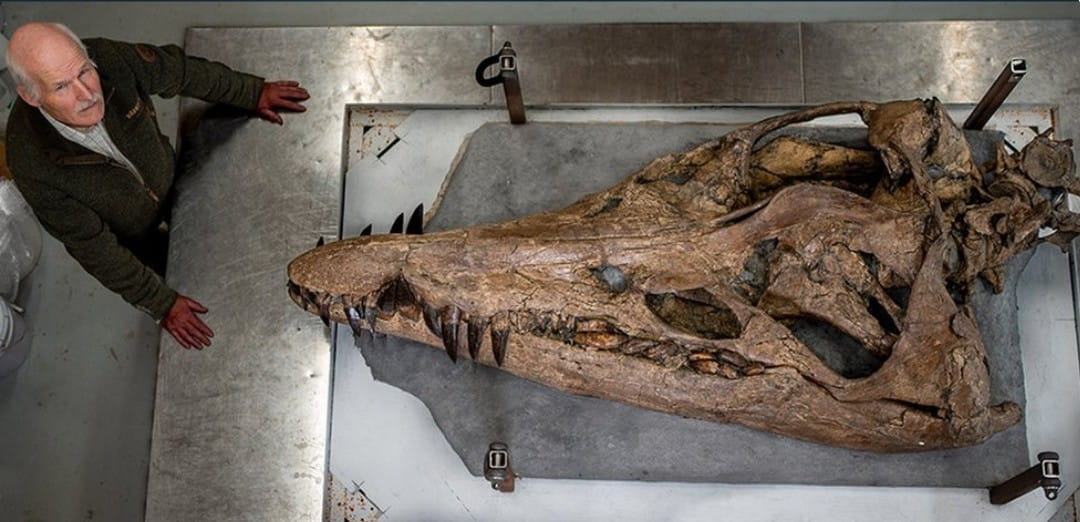
The Dorset coastline, part of England’s world-famous Jurassic Coast, has once again delivered a discovery of monumental significance. Embedded in a sheer limestone cliff, paleontologists uncovered a remarkably preserved pliosaur skull measuring an astonishing 6.5 feet in length. This colossal fossil, belonging to an unknown species of marine reptile, has been hailed as one of the most complete and scientifically valuable pliosaur specimens ever found in Britain.
Nicknamed the “T. rex of the Oceans,” this marine titan once reigned supreme 150 million years ago, ruling prehistoric seas teeming with ancient life. Its skull, lined with over 130 razor-sharp teeth, reveals a predator designed for power, speed, and precision.
A Discovery Against All Odds
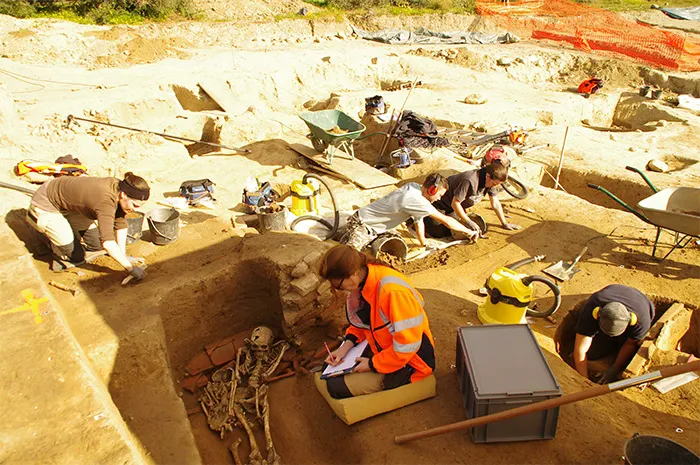
The excavation site was a near-vertical cliff face towering over the Dorset coastline. Paleontologists had first spotted unusual bone fragments weathering out of the rock after storm activity. To recover the fossil, a team of expert climbers and scientists mounted a complex operation, carefully chiseling a multi-ton block of limestone away from the cliff before airlifting it to safety.
Once freed from the stone, the skull stunned researchers with its near-perfect preservation. The delicate anatomy — from the ridged teeth to the muscle attachment sites — allows scientists to reconstruct not only how the animal looked but also how it lived and hunted in the Jurassic seas. The quality of this fossil is so exceptional that even microscopic details, like serrations along the teeth, remain visible.
Anatomy of a Sea Monster
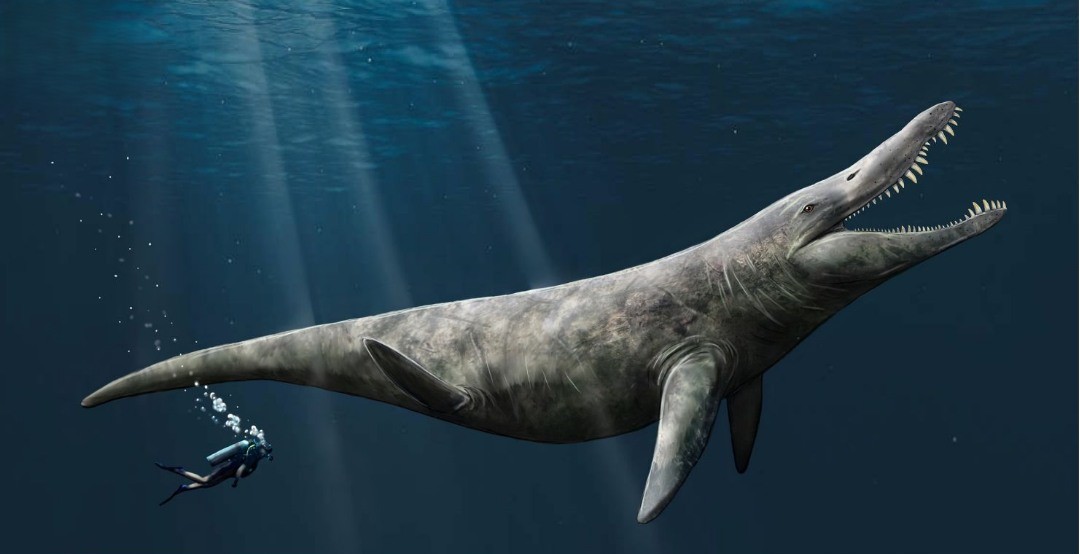
Pliosaurs were a formidable branch of the marine reptile family tree — short-necked cousins of the plesiosaurs. Unlike their long-necked relatives, pliosaurs had massive heads, compact bodies, and four muscular, paddle-like limbs that allowed them to propel through water with astonishing bursts of speed. Their combination of agility and brute force made them the apex predators of their time.
This Dorset specimen displays anatomical differences that suggest it may belong to a previously unknown species. The unique configuration of its jaws and tooth pattern sets it apart from other known pliosaurs, indicating a new lineage adapted to prey on specific marine creatures. The power locked within that 6.5-foot skull highlights an evolutionary masterpiece — a predator with a bite force estimated to be twice that of a modern saltwater crocodile.
Life in the Jurassic Seas
During the Late Jurassic period, the seas covering what is now southern England were thriving ecosystems filled with marine reptiles, ammonites, giant squid, and shoals of fish. The newly discovered pliosaur was one of the dominant hunters in this vast oceanic world.
With powerful jaws capable of crushing bone and shell alike, it likely fed on ichthyosaurs, smaller pliosaurs, and cephalopods. Paleontologists believe its hunting strategy combined stealth, explosive acceleration, and precision strikes — a lethal combination that put it firmly at the top of the food chain.
Understanding how this predator fit into its ecosystem gives crucial insight into the evolutionary pathways that shaped marine life in the Mesozoic era. Each new specimen, particularly one as intact as this, acts as a window into an ocean long vanished beneath shifting continents and changing climates.
The Challenge of Preservation and Study
Extracting a fossil from a seaside cliff poses huge logistical and preservation challenges. The Jurassic Coast, while rich in fossils, is constantly battered by storms and erosion. This natural process reveals fossil layers but also threatens to destroy them before scientists can recover the remains.
In this case, quick coordination between fossil hunters, local authorities, and paleontological experts ensured the preservation of a globally significant specimen. Once transported to a laboratory, the skull underwent months of meticulous cleaning, stabilization, and analysis. Each fragment was mapped and documented, and a 3D digital scan was created to allow future researchers to study the fossil in detail without risking damage to the original.
Redefining Pliosaur Evolution
Preliminary comparisons reveal this pliosaur differs from previously identified species, such as Pliosaurus kevani or Pliosaurus funkei. The jaw proportions, skull ridges, and dental arrangement all suggest that this was a new apex hunter uniquely adapted to its environment.
If confirmed as a distinct species, it will expand the pliosaur family tree and shed light on the evolutionary diversity of these marine reptiles. Scientists hope DNA trace analysis and advanced CT scans will uncover more about how these predators evolved and interacted within their ecosystems.
Each new pliosaur discovery sharpens the picture of Jurassic marine biodiversity. Revealing not just monstrous predators but also complex ecological webs that supported them.
A Window Into Earth’s Deep Past
The unearthing of this fossil is more than a dramatic story of claws and teeth. It represents the power of geological time and the enduring partnership between natural forces and human curiosity. The Jurasssic Coast, a UNESCO World Heritage Site, remains an open-air archive of Earth’s evolutionary history. Where every landslide, tide, and storm potentially brings new revelations.

For scientists and enthusiasts alike, the Dorset pliosaur reminds us of how much still lies hidden beneath layers of stone. Waiting to be uncovered by the steady hands of researchers and the turning of the Earth itself.
The “T. rex of the Oceans” in Popular Imagination
The public fascination with pliosaurs stems from their fearsome design and the mystery that shrouds their existence. Popularly dubbed the “T. rex of the Oceans,” this newly found species reignites that imagination. Providing tangible evidence of just how massive and deadly these marine reptiles were.
Museums are already making plans to exhibit replicas and digital reconstructions of the skull. Offering visitors a glimpse of what it might have been like to face this predator in the ancient seas. The vivid combination of science, spectacle, and storytelling ensures this discovery will inspire both paleontologists and the public for years to come.
Preserving the Legacy of the Jurassic Coast
The discovery underscores the critical importance of preserving fossil sites like the Jurassic Coast. Where ongoing erosion continues to expose new treasures. Responsible excavation not only protects these irreplaceable fossils but also allows scientists to document them in their geological context.
Local institutions and conservationists emphasize that community awareness and sustainable tourism will ensure both scientific study and natural wonder continue hand in hand.
Conclusion: Echoes from a Lost Sea
The Dorset pliosaur skull is more than an extraordinary fossil; it is a bridge across time. Embedded for millions of years in solid rock, then uncovered through equal parts fortune and scientific precision. It tells the story of Earth as it once was — fierce, vibrant, and ever-changing.
As paleontologists continue their study, this discovery may redefine our understanding of marine evolution in the Jurassic world. It stands as a spectacular reminder that beneath every cliff and shoreline, history waits — silent but indestructible — to be revealed once again by curiosity and science.
ALSO READ: Unveiling the Chimu Mummy: A Glimpse into Peru’s Overlooked Legacy