Unearthing a Giant: The Prehistoric Discovery That Redefined Earth’s Scale of Life
Unearthing the Colossal Secret of the Desert
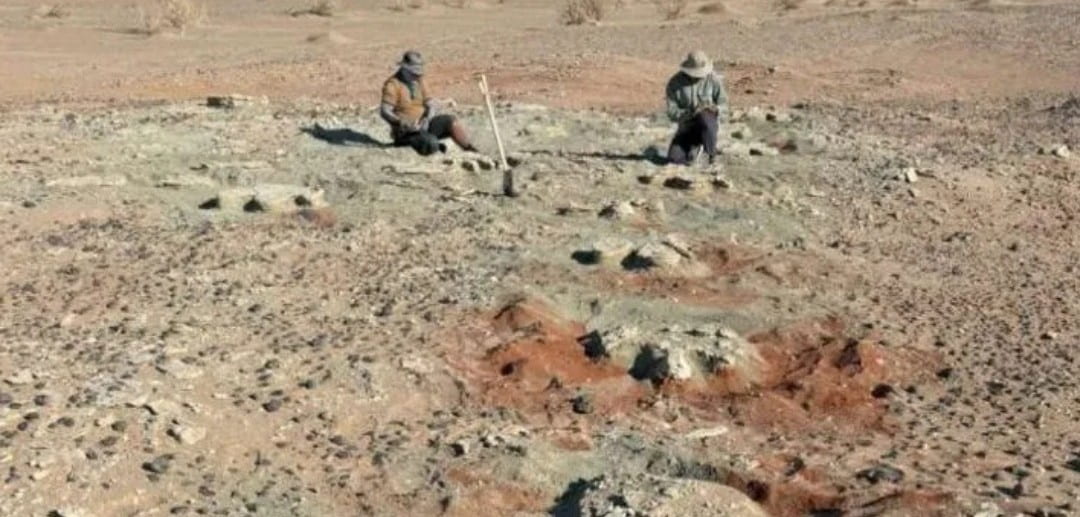
It began like any ordinary field dig — a remote desert, a small research team, and a patch of wind-carved dunes concealing an untouched past. But when sunlight caught a pale curve glinting through the dust, history shifted. Beneath those grains lay a fragment of bone — dense, curved, and impossibly large. Within hours, the team knew they were standing on something monumental.
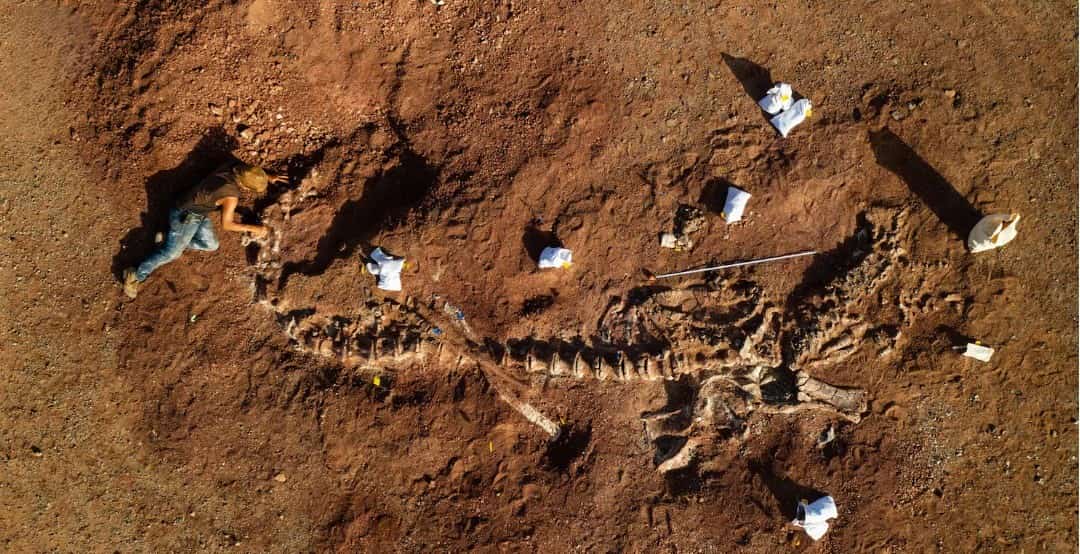
What they uncovered over the following weeks was no ordinary fossil. The bones that emerged from the earth belonged to a creature so large it tested the limits of biological possibility — vertebrae as wide as barrels, femurs longer than trucks, and a skull fragment heavy enough to require machinery for extraction. This was not merely a discovery; it was a reckoning with the past — a reminder that life has always been bolder than human imagination.
A Window into a Lost World
Geological analysis of the sediment layers surrounding the find revealed an unexpected truth: this barren region was not always a desert. Millions of years ago, it teemed with lush vegetation, sprawling wetlands, and colossal herbivores that roamed freely under a warmer, oxygen-rich atmosphere.
The newly uncovered skeleton appears to have lived in an environment where abundance fueled gigantism. Fossilized ferns, aquatic plant impressions, and prehistoric pollen trapped in nearby clay hint at a thriving ecosystem. Just as the massive sauropods once ruled Cretaceous floodplains, this discovery suggests life in the region reached similarly astonishing proportions.
Each layer of sediment acts as a diary of climate transitions — from humid forests to parched wasteland. These shifts provide context not only for the creature’s evolution but also for the eventual decline of such titanic life forms.
Anatomy of a Giant
Paleontologists estimate that, when alive, the creature stretched over 40 meters (130 feet) in length and may have weighed close to 100 tons. The proportions surpass even the largest known terrestrial animals, compelling scientists to revisit fundamental assumptions about muscle distribution, circulatory capacity, and bone density.
What makes this particular skeleton extraordinary is its blend of familiar and alien traits. The limb bones resemble those of sauropods, yet contain internal air cavities similar to modern birds — a feature that would reduce weight while maintaining strength. Its skull fragments suggest a wide muzzle, possibly adapted for low browsing in swampy terrain.
Such hybrid characteristics point to an evolutionary experiment — an organism finely tuned to thrive in a planet far warmer and wetter than ours.
Rewriting the Limits of Evolution
How large can evolution dare to go? That question now echoes across the scientific community. The discovery challenges long-held theories about the physiological boundaries of life on land. Traditional models show that size is limited by resource availability, metabolism, and gravity’s strain on bones and tissues. Yet this fossil defies those models, hinting at either localized ecological factors or even atmospheric differences that once allowed larger body plans to flourish.
Some researchers speculate that oxygen levels and atmospheric pressure during this era could have supported greater metabolic efficiency, letting massive creatures survive without overheating. Others believe the creature’s sheer size offered evolutionary advantages — protection from predators, extended reach for feeding, and dominance in mate selection.
Whatever its purpose, this ancient behemoth has reopened inquiries into how Earth’s life forms repeatedly tested and transcended physical boundaries.
The Science Beneath the Sand
Fossil recovery in desert environments poses unique challenges. Shifting sands, temperature extremes, and erosion can quickly damage delicate specimens. To preserve structural integrity, archaeologists and paleontologists work with extreme precision — often spending weeks stabilizing a single bone before removal.
Every bone fragment uncovered is digitally scanned, mapped, and recorded in three-dimensional grids. This careful documentation allows reconstructing the full skeleton virtually, aiding both research and public education without risking damage to the originals. Drone imaging and ground-penetrating radar have revealed a broader fossil bed beneath the immediate dig site, suggesting the creature may not have lived — or died — alone.
Further excavations are expected to yield additional individuals or species, providing context to this ecological mystery.
A Challenge to Modern Imagination
Standing beside the fossil pit, even the most experienced scientists admit to feeling humbled. Scale distorts perspective — what was once theoretical is now tangible. The staggering dimensions of the bones invite awe and, more profoundly, reflection. For all humanity’s progress, nature remains the greatest architect, capable of shaping worlds and bodies beyond comprehension.
The team’s lead paleontologist described the experience as “listening to deep time speak.” Each brushstroke reveals not just anatomy but a story — of climate, adaptation, and survival on a planet always in motion. As the excavation continues, this prehistoric giant becomes a symbol of life’s resilience across epochs of change.
Implications for Earth’s Future
Understanding these ancient giants also informs our own ecological challenges. The same climate processes that once supported megafauna remind us how sensitive ecosystems are to temperature and atmospheric transformation. Studying how these creatures thrived — and why they vanished — can shed light on how modern biodiversity might respond to ongoing environmental shifts.
By tracing isotopes in fossilized bones, researchers can reconstruct ancient rainfall, vegetation, and temperature ranges. These clues serve as natural mirrors, reflecting Earth’s cycles of boom and collapse. The past, in this way, becomes both a warning and a guide.
Rediscovering the Desert’s Hidden Memory
Today, the dig site is a patchwork of trenches, tents, and instruments — a temporary city dedicated to revelation. Yet beneath its bustle lies a profound silence, broken only by the desert wind. This ancient giant, once lord of a forgotten swamp, now rests again within human hands.
As each bone is lifted, measured, and preserved, humanity stands at the threshold of understanding an age long gone. The desert, once thought barren, is proving to be history’s most patient storyteller. Its sands hold not emptiness, but memory — whispering back the forgotten tales of Earth’s most ambitious creations.
ALSO READ: 3000-Year-Old Bronze Sword Discovered in Germany: A Window Into Bronze Age Civilization