The Enigmatic Artifact of Lake Titicaca
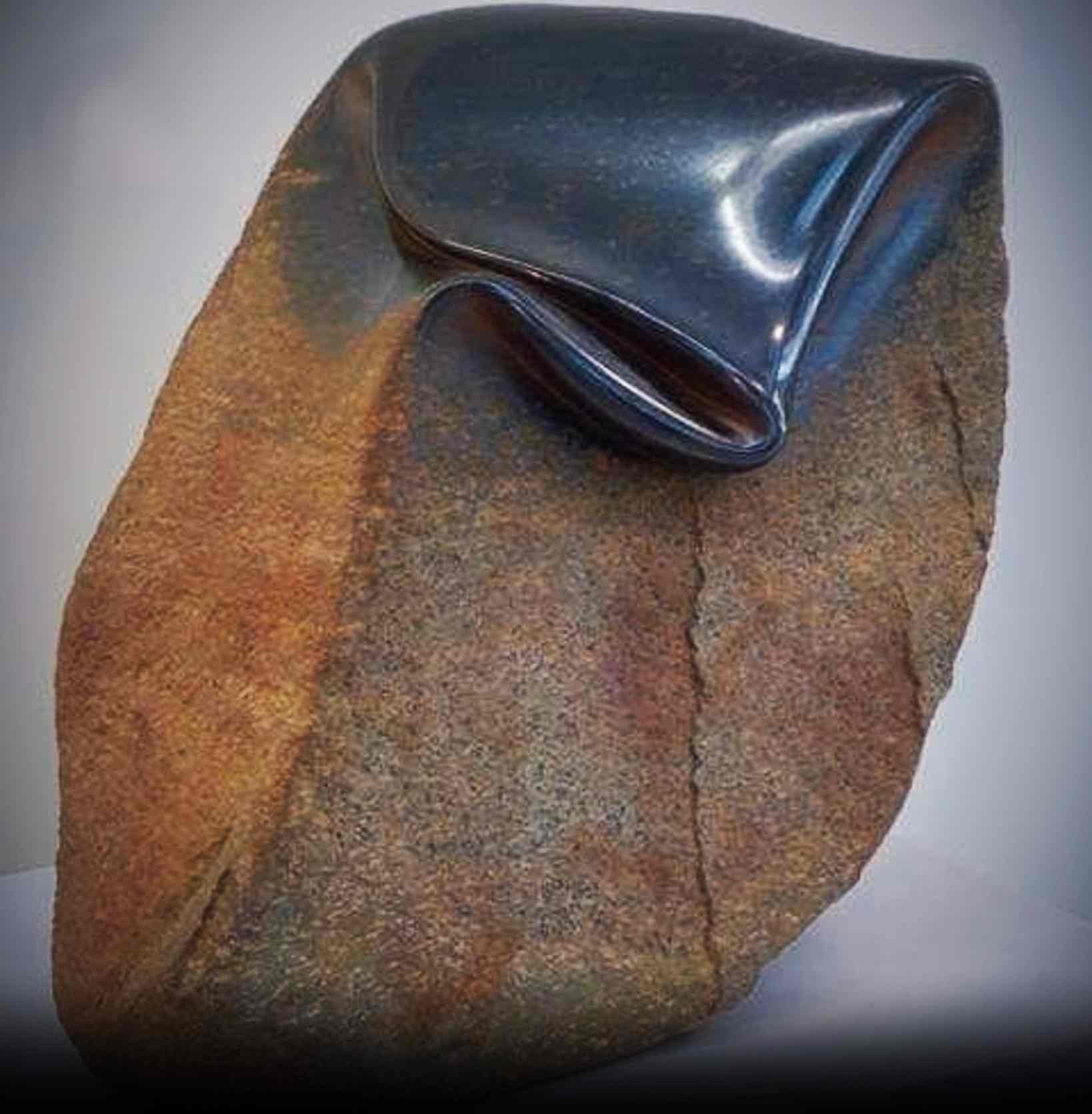
High in the Andes Mountains, near the mystical expanse of Lake Titicaca, researchers uncovered a basalt artifact unlike anything previously documented in Andean archaeology. The object’s surface appears melted and folded, resembling glass-like waves rather than chiseled or carved stone. When viewed in sunlight, its sheen reflects a smooth, almost artificial polish that defies conventional geological explanation.
What makes this artifact so intriguing is not just its unusual form—but the mystery of how it came to be. Unlike traditionally crafted stones shaped by human tools, this specimen bears no signs of hammering, chiseling, or abrasion. Instead, the surface appears as though it had once been softened by intense heat and subsequently cooled into smooth curves—conditions typically requiring temperatures above 1,200°C.
For archaeologists and geologists alike, the existence of such an object within a region renowned for pre-Columbian craftsmanship but lacking advanced metallurgy or high-temperature furnaces presents a captivating enigma.
A Lake of Myths and Mysteries
Lake Titicaca, straddling the borders of modern-day Peru and Bolivia, is often referred to as the “sacred lake of the Andes.” At an altitude of over 3,800 meters, it is the highest navigable lake in the world and deeply embedded in Andean cosmology. According to Inca mythology, it was from these waters that the sun, moon, and first humans emerged—making it a cornerstone of creation myths across the region.
The surrounding landscape is dotted with archaeological treasures: the temple ruins of Tiwanaku, the Puma Punku stone complex, and numerous intricately carved andesite blocks fitted with precision that continues to astonish engineers. Within this context of cultural and spiritual significance, the discovery of a stone that appears to have been liquefied has only deepened the sense of mystery surrounding the region.
Whether natural or artificial, the artifact’s existence near such a symbolic site suggests a connection—whether symbolic, ritualistic, or geological—to the lake’s ancient legacy.
The Physical Description: Melted or Molded?
Basalt, a dense volcanic rock rich in iron and magnesium, is formed when lava cools rapidly. Under natural circumstances, it solidifies into hard, fine-grained structures resistant to erosion. For basalt to appear molten or fused into glass-like surfaces, it must be reheated to an extreme degree—typically found only in industrial furnaces or volcanic magma flows.
Researchers describe the artifact’s features as a collection of smooth folds, flowing ridges, and bulbous formations, almost as if the rock had once been semi-fluid. The texture resembles obsidian or slag glass, yet its mineral structure under microscope remains that of basalt.
Petrographic analysis suggests localized melting and rapid cooling, a process not replicable by any known pre-Columbian method. Ancient Andean cultures, despite their remarkable stoneworking abilities, were primarily engaged in cold-stone sculpting techniques using hammerstones, pecking, and abrasion with sand and water. None of these can produce temperature-induced metamorphosis visible on this artifact.
Scientific Theories: Natural vs. Artificial Formation
The central debate revolves around whether the artifact’s characteristics are natural geological phenomena or the result of human intervention. Several leading hypotheses attempt to explain its formation:
-
Lightning Strikes: A plausible natural mechanism involves fulgurites—glass-like formations that occur when lightning strikes rock or sand, instantly melting the surface. However, true fulgurites are typically tubular and brittle, whereas the artifact is dense, heavy, and uniformly smooth, suggesting a more sustained heating process.
-
Volcanic Activity: Some argue the melted appearance might result from nearby volcanic events or lava flows that partially enveloped the stone. Yet, no evidence of historic volcanism at Lake Titicaca’s elevation has been recorded within the time frame of human habitation.
-
Meteoric or Plasma Events: A less conventional explanation points to high-energy impact phenomena, such as meteor strikes or concentrated plasma discharges, capable of generating surface temperatures exceeding 1,200°C. Proponents of this theory cite similar vitrified rocks found in Scotland’s Iron Age forts and in deserts of the Middle East.
-
Lost Ancient Technology: A more speculative but popular theory among alternative historians suggests that ancient civilizations possessed advanced pyrotechnic or energy-based technologies—knowledge that was later lost. This camp connects the artifact to other anomalies found in the region, such as the perfectly drilled holes at Puma Punku and the precision-fitted megaliths of Tiwanaku.
While mainstream archaeologists approach such claims with caution, these hypotheses underscore how the artifact challenges conventional paradigms of ancient engineering and geological processes.
Lake Titicaca’s Archaeological Context
The Lake Titicaca basin has yielded some of the most fascinating examples of ancient Andean craftsmanship. The Tiwanaku civilization, flourishing from roughly 400 to 1000 CE, developed advanced construction techniques involving massive andesite blocks that fit together with micrometric precision. Later, the Inca Empire absorbed Titicaca’s sacred status into its own mythology, transforming the site into a major pilgrimage center.
Amid these achievements, the melted basalt artifact stands apart—not for its size or ornamentation, but for its scientific implications. There is no cultural or religious context recorded in local legend that suggests deliberate melting of stones, nor any workshop remains indicating large-scale heat application. If human-made, this object implies knowledge of thermal manipulation unseen elsewhere in the Andean record.
Geological Investigations: Seeking Clues in the Andes
Ongoing research by petrologists and archaeometrists aims to determine whether the artifact’s smooth surface is the result of metamorphic transformation under natural stress conditions. Preliminary spectroscopy reveals microbubbles and vitrification patterns typical of rapid thermal quenching, comparable to materials exposed to industrial kilns or volcanic vents.
However, the composition of the surrounding terrain—a mix of sedimentary layers and volcanic rock uplift. Offers limited evidence of recent high-temperature activity. The nearest known volcanic centers are several hundred kilometers away, ruling out direct lava exposure.
Some researchers have proposed electrical phenomena induced by ancient atmospheric discharges. Possibly enhanced by mineral conductivity in the region’s basalt formations. While this remains theoretical, it presents a fascinating intersection of physics, geology, and archaeology.
Cultural and Mythological Connections
In Andean tradition, sacred objects known as huacas. Were often linked to places of power—rocks, springs, or mountains infused with spiritual energy. The unusual properties of the basalt artifact may have made it a ritual object. Revered precisely because of its strange appearance.
Local lore around Lake Titicaca often speaks of light from the heavens. Thunderbolts of the gods, and stones that glowed in the night. Such imagery may preserve mythologized memories of natural phenomena. Possibly lightning strikes or meteoric events. That altered the landscape in visible, fiery ways.
Anthropologists studying regional folklore note recurring motifs of fire descending from the sky and transforming the earth. Which resonate intriguingly with the conditions required to create vitrified rock.
The Broader Implications: Lost Knowledge or Natural Wonder?
Whether a product of rare geology or forgotten ingenuity. The melted basalt artifact of Lake Titicaca remains a reminder of the limitations of our historical understanding. Its polished curves challenge assumptions about what ancient cultures could achieve with available tools and materials.
If natural, it demonstrates the planet’s extraordinary ability to create art-like formations through extreme weather or geological activity. If artificial, it suggests that ancient peoples may have experimented with fire and heat in ways. Yet to be recognized by mainstream archaeology.
Either case invites a reexamination of the technological timeline of pre-Columbian South America. A region where precision stonework, astronomical alignment, and cosmological symbolism frequently converge in ways. That continue to astonish modern researchers.
Continuing Research and Modern Fascination
Today, the artifact resides in a regional museum collection near Puno. Where it draws renewed attention from both scholars and enthusiasts of ancient technology. Advanced techniques like X-ray diffraction analysis, thermal emission microscopy, and 3D surface modeling are helping scientists probe its composition. Hoping to reconstruct the sequence of events that shaped it.
Its enigmatic beauty—glossy, folded, and eerily fluid—continues to spark the imagination. Documentaries, academic debates, and alternative research circles all find in it a compelling mystery that bridges science and speculation.
Ultimately, whether formed by lightning, lava, or human hands. The melted basalt artifact near Lake Titicaca exemplifies the enduring dialogue between curiosity and discovery. That drives our understanding of the ancient world.
ALSO READ: Spectacular Ancient Underground ‘Stonehenge’ – The Secrets of Dolmen de Soto in Spain