The Loving Graves of Roermond: A 19th-Century Love That Defied Religious Boundaries
A Love That Transcended Walls
In the heart of Roermond, a charming town in the Netherlands, lies one of Europe’s most poignant monuments to enduring love. Two graves, divided by a high cemetery wall, tell the story of a couple whose devotion defied rigid religious boundaries of the 19th century.
This remarkable tale belongs to Jacob van Gorcum, a Protestant colonel, and Josephina van Aefferden, a Catholic noblewoman. Married in 1842, their union challenged the deeply entrenched divisions between Protestants and Catholics in Dutch society. Their final resting place — separated by faith but joined by love — has since become known as the Loving Graves of Roermond.
Love in a Divided Society
To understand the significance of Jacob and Josephina’s story, one must look back to the 19th century, when the Netherlands was still struggling with deep-seated religious divisions.
Following the Eighty Years’ War (1568–1648), Protestantism had become dominant in Dutch society, while Catholics were often marginalized, especially in public and official life. Interfaith marriages were socially discouraged and sometimes outright forbidden, as they were seen as acts of disobedience to both church and community.
Against this backdrop, Jacob van Gorcum, a Protestant officer in the Dutch army, and Josephina van Aefferden, a Catholic noblewoman from an old aristocratic family, made the daring decision to marry. Their wedding in 1842 was a rare act of courage and love — one that transcended social expectations, religious prejudice, and family pressures.
Despite the skepticism they faced, the couple’s marriage endured for 38 years, a testament to mutual respect, understanding, and the quiet strength of true companionship.
A Divided Resting Place
When Jacob van Gorcum passed away in 1880, he was buried in the Protestant section of Roermond’s cemetery. The local burial grounds were strictly segregated by faith, separated by a tall brick wall that represented centuries of religious division.
Eight years later, when Josephina van Aefferden died in 1888, she faced a difficult choice: to be buried in her family’s Catholic plot, as tradition dictated, or to find a way to remain close to her husband.
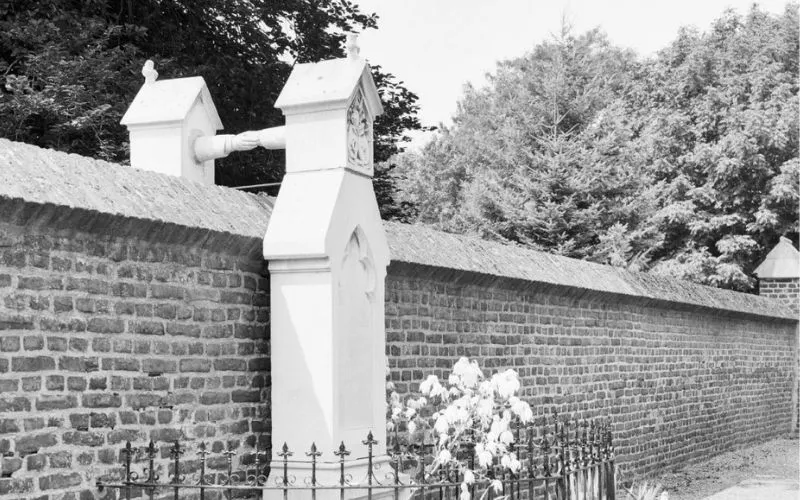
Choosing love over custom, Josephina requested to be buried as near as possible to Jacob — on the Catholic side of the wall, but directly adjacent to his grave. Her resting place faces his, with only the wall dividing them. To connect the two graves, the family commissioned two sculpted hands reaching across the wall, eternally joined above the divide.
This touching design became an enduring symbol of unity — a love that not even death, nor the barriers of religion, could separate.
The Symbolism of the Linked Hands
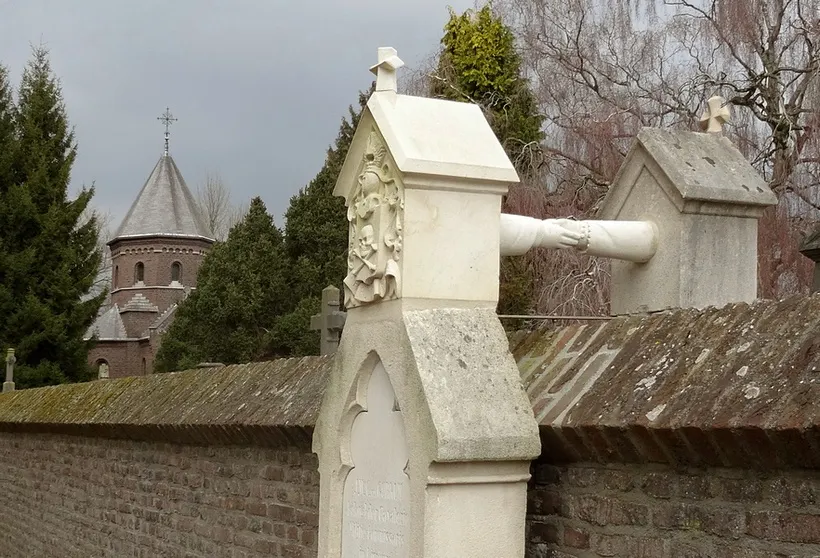
The most striking feature of the Loving Graves of Roermond is the pair of stone hands extending over the dividing wall. Sculpted in pale limestone, one hand reaches from the Protestant side, the other from the Catholic — their fingers gently clasping in a timeless gesture of connection.
The symbolism is powerful and universal. The hands represent reconciliation, faith, and eternal love. They defy the boundaries imposed by religion and society, suggesting that human connection transcends institutional barriers.
In a time when people were divided by dogma and doctrine. Jacob and Josephina’s graves silently proclaim a profound truth — that love is the greatest unifier.
Historical and Cultural Context
The 19th century in the Netherlands was marked by gradual shifts toward religious tolerance. Though interfaith marriages like Jacob and Josephina’s were rare, the century saw a slow softening of rigid divisions. Culminating in more inclusive reforms by the late 1800s.
Roermond, located in the southern province of Limburg, had historically been a Catholic stronghold. Yet even here, Protestant and Catholic communities maintained separate burial spaces, reflecting centuries of mutual mistrust. The wall that separates Jacob and Josephina’s graves was once a physical and symbolic expression of that divide.
However, their story came to represent something far greater — a vision of unity amidst division, and love as resistance. In later years, the site would become an emblem of how compassion and humanity can bridge the deepest divides.
Rediscovery and Enduring Legacy
For decades, the graves of Jacob and Josephina remained a local curiosity. A story whispered among townsfolk and visitors who passed through Roermond’s peaceful cemetery. But with the rise of modern tourism and social media. The site gained international attention as one of the most romantic burial sites in the world.
Travelers, photographers, and history enthusiasts began to visit the cemetery to pay homage to the couple’s enduring love. The image of the two stone hands clasped across the wall became a viral symbol. Shared across platforms as a visual metaphor for connection beyond barriers.
Today, the Loving Graves of Roermond stand as both a historical monument and a modern-day pilgrimage site. For those who believe in love’s transcendent power. Visitors often leave flowers, notes, and tokens at the site. Inspired by the couple’s defiance of convention and their unwavering devotion.
Lessons from a Timeless Love
The story of Jacob and Josephina van Gorcum offers profound lessons that remain relevant today.
-
Love Beyond Boundaries:
Their union shows that love is not limited by religion, class, or social expectation. It flourishes where understanding and mutual respect exist. -
Courage in Choice:
Both Jacob and Josephina lived in a time when choosing love over doctrine could mean social ostracism. Their courage to defy norms in pursuit of personal truth remains inspiring. -
Unity in Division:
Even in death, their graves remind us that human compassion can bridge the widest divides — religious, cultural, or ideological. -
Legacy of Hope:
More than a century later, their story continues to inspire people from all walks of life to seek harmony, understanding, and connection across boundaries.
Visiting the Loving Graves of Roermond
The Old Cemetery of Roermond (Oude Begraafplaats Nabij de Kapel in ’t Zand) lies within walking distance from the city center. The graves of Jacob and Josephina are easily recognizable by the two clasped stone hands extending over the central wall.
Visitors can explore the serene grounds, reflecting not only on the love story of the couple. But also on the broader history of religious coexistence in the Netherlands. The cemetery remains an active site of cultural heritage preservation, managed with respect for its historical and emotional significance.
Conclusion: A Love That Lives On
The Loving Graves of Roermond are more than a historical curiosity. They are a poetic testament to the endurance of human love and the futility of division.
Jacob van Gorcum and Josephina van Aefferden’s story continues to resonate. Because it captures the universal truth that love transcends boundaries — of faith, of culture, and even of death itself.
In their eternal gesture of joined hands. They remind us that compassion and connection are the true monuments of civilization, lasting long after walls have crumbled.
ALSO READ: Gorgona Medusa Pediment from the Temple of Artemis, Corfu: Myth, Art, and Archaeology (580 BC)