The Tower of Jericho: The World’s Oldest Stone Monument and Its Mysterious Purpose
A Monument Older Than History Itself
Standing tall for over 10,000 years, the Tower of Jericho is one of the most astonishing and enigmatic structures of the ancient world. Rising 8.5 meters (28 feet) above the ground and built around 8000 BC, this conical stone tower predates the pyramids of Egypt and Stonehenge by millennia.
Located at Tell es-Sultan, in modern-day Jericho in the West Bank, the tower is part of the UNESCO World Heritage Site that preserves the remains of one of humanity’s first urban settlements. It is not only the earliest known stone monument but also one of the world’s first examples of monumental architecture — built long before metal tools or written language existed.
The Tower of Jericho stands as a silent witness to the dawn of civilization, a time when humans first began to organize, build, and think beyond survival.
Discovery and Excavation: Uncovering the Ancient Giant
The story of the Tower’s rediscovery begins in the early 20th century. British archaeologist John Garstang first excavated the site of Jericho in the 1930s, uncovering sections of the tower but misdating it to the Bronze Age (around 2000 BC).
It wasn’t until the 1950s, when Kathleen Kenyon, one of the most renowned archaeologists of her time, led a series of meticulous excavations, that the true age of the tower was revealed. Using stratigraphic analysis and radiocarbon dating, Kenyon established that the tower belonged to the Pre-Pottery Neolithic A period (PPNA) — around 8000 BC, making it more than 10,000 years old.
This revelation completely changed our understanding of early human architecture and community organization. Suddenly, Jericho wasn’t just one of the world’s oldest cities — it was the home of the world’s first skyscraper.
Structure and Construction: A Feat of Neolithic Engineering
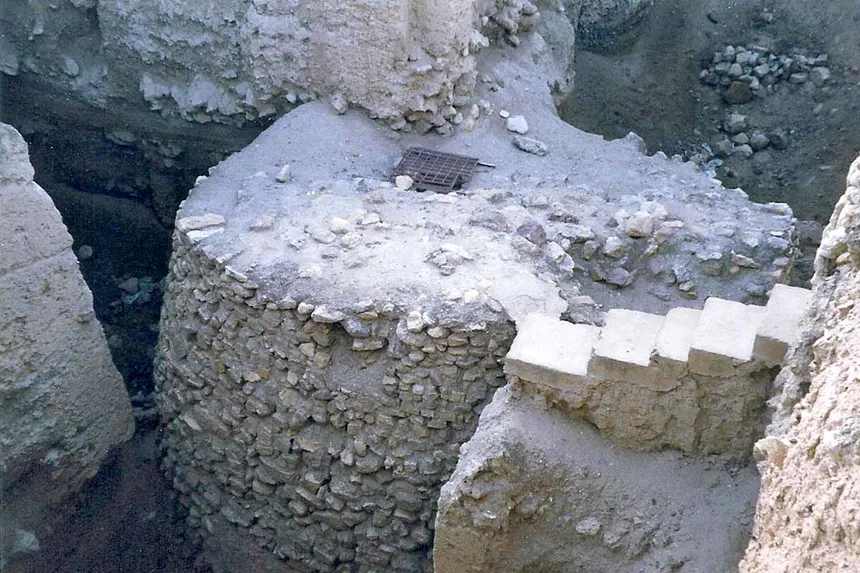
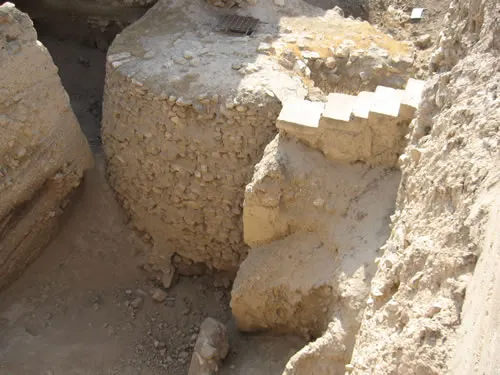
The Tower of Jericho is an architectural masterpiece considering its prehistoric origins. Built of limestone rubble, the structure stands 8.5 meters tall and 9 meters wide at its base, narrowing as it rises into a conical shape. Its walls are nearly 2 meters thick, and inside is a spiral staircase of 22 carefully cut steps, ascending from the base to an internal platform near the top.
Archaeologists estimate that constructing the tower would have required nearly 11,000 working days — equivalent to about 30 people working full-time for a year. This is a remarkable level of community coordination for a society still transitioning from hunting and gathering to agriculture.
The stones used were locally sourced, but their sheer size and precise placement reveal an impressive understanding of balance, geometry, and material strength. The builders achieved all this without metal tools, wheels, or beasts of burden — a true testament to human ingenuity.
The Cultural Context: The World of Pre-Pottery Neolithic A
The people who built the Tower of Jericho belonged to what archaeologists call the Sultanian culture, a Neolithic community thriving in the Jordan Valley during the Pre-Pottery Neolithic A (PPNA) period.
This was a revolutionary time in human history — the birth of agriculture. People were beginning to settle permanently, cultivating wheat and barley, domesticating goats, and constructing the first permanent houses. The establishment of Jericho — one of the earliest known cities — marks a turning point from nomadic life to organized urban settlement.
The construction of such a massive communal structure like the Tower indicates the emergence of social organization, shared belief systems, and collective labor, hallmarks of early civilization.
Theories About Its Purpose: Mystery of the Tower
Despite decades of research, the true purpose of the Tower of Jericho remains one of archaeology’s great enigmas. Scholars have proposed several compelling theories:
1. Astronomical Function
Recent studies suggest that the tower was aligned with the setting sun during the summer solstice. Researchers at Tel Aviv University found that around 8000 BC, the sunset on the solstice would have cast a dramatic shadow from a nearby mountain directly onto the tower.
This implies that the builders might have used the structure as a solar marker, linking their construction to astronomical events. Such a connection would make the tower one of the world’s earliest examples of archaeoastronomy, reflecting how ancient people observed and celebrated celestial cycles.
2. A Symbol of Social Unity
Another interpretation views the Tower as a communal project — a monument designed to foster social cohesion. As early agricultural societies emerged, people faced new challenges: property ownership, food storage, and social hierarchy. The building of the Tower may have served as a unifying endeavor, a shared ritual that strengthened identity and cooperation among Jericho’s inhabitants.
3. Defensive Structure or Watchtower
Some scholars initially proposed that the tower functioned as a fortification or watchtower, guarding the settlement against floods or intruders. However, the lack of direct evidence for warfare or defensive mechanisms during the PPNA period makes this interpretation less likely. Instead, the Tower may have symbolized protection of a spiritual kind — guarding the community in a religious or ritual sense.
4. Funerary or Ritual Purpose
There is also speculation that the Tower was associated with ancestor worship or ritual ceremonies. The Neolithic people of Jericho practiced burial beneath their houses and venerated skulls of the deceased — suggesting a complex belief system centered on death, rebirth, and ancestral protection. The Tower might have served as a monumental focal point for such rituals.
The Tower as a Symbol of Transformation
Regardless of its exact function, the Tower of Jericho marks a profound moment in human development. It represents a transition from mere survival to symbolic thought, from individual shelters to monumental public architecture.
It shows that even in prehistory, humans sought meaning beyond the material — they looked to the sky, to community, and to the divine. The effort and cooperation required to build it speak volumes about the early human capacity for collective vision and purpose.
Preservation and UNESCO Recognition
Today, the Tower of Jericho stands as the centerpiece of the Tell es-Sultan archaeological site. Which is officially recognized as a UNESCO World Heritage Site. Excavations and preservation projects have ensured that visitors can witness this Neolithic marvel firsthand.
Modern conservation efforts focus on stabilizing the structure and protecting it from erosion and environmental damage. Interpretive displays at the site help visitors understand the significance of the tower and the culture that built it. Bringing the distant past vividly to life.

Legacy: Humanity’s First Monument
The Tower of Jericho continues to inspire archaeologists, historians, and architects around the world. It challenges our assumptions about when civilization began and reminds us that creativity and cooperation are as ancient as humanity itself.
Built thousands of years before writing, metal, or organized religion. The tower reveals that our ancestors already possessed a deep understanding of engineering, symbolism, and collective identity.
In many ways, the Tower of Jericho stands as the first monument of human ambition. The earliest testament to our species’ desire to build, to remember, and to reach toward the sky.
ALSO READ: Copper Ornament with Shell Teeth: A Stunning Moche Artifact from 6th–7th Century Peru