Viking-Era Silver Treasure and Ancient Farm Unearthed in Täby, Sweden
A Glimpse into the Viking World
Archaeologists from Arkeologerna, a division of the Swedish History Museums, have made a breathtaking discovery in Täby, just north of Stockholm. During extensive excavations carried out between 2020 and 2021, the team unearthed a massive Viking Age farmstead, a burial ground, and a stunning silver treasure buried more than a thousand years ago.
This discovery is one of the most significant Viking-era archaeological finds in recent Swedish history, shedding new light on everyday life, social structures, and wealth during the late Iron Age and early Middle Ages (500–1050 CE).
The Excavation: A Journey Back to the Viking Age
The site in Täby was investigated ahead of planned housing developments, as is common practice in Sweden. When archaeologists began their work, they quickly realized that the area contained more than just traces of settlement — it was a window into a thriving Viking farming community.
The excavation revealed house foundations, longhouses, outbuildings, hearths, and storage pits, indicating a prosperous and well-organized farm. The layout of the settlement and the quality of the artifacts suggest that this was a powerful local estate, likely controlled by an influential family within the Viking social hierarchy.
Unearthing the Silver Treasure
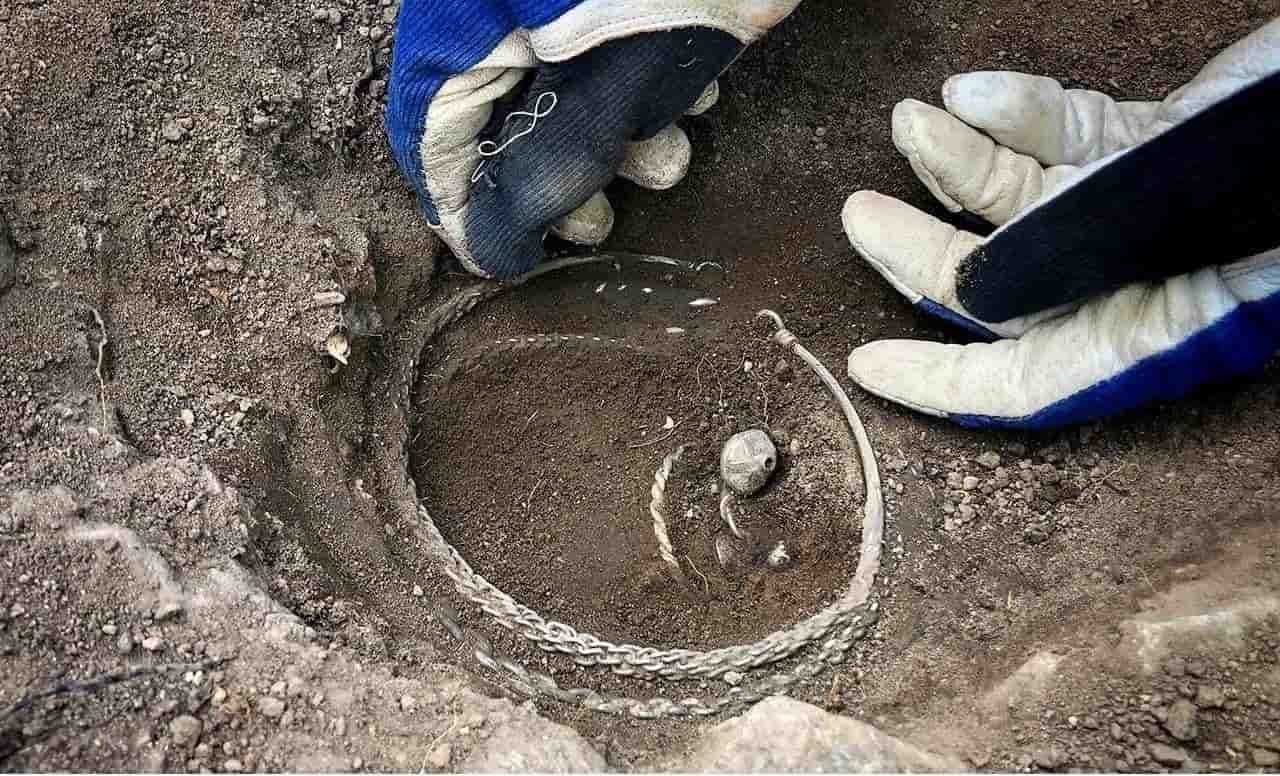
Among the most remarkable finds was a silver hoard buried in a small ceramic vessel. Inside, archaeologists found a glittering collection of coins, jewelry fragments, and silver ingots. Many of the coins originated from far beyond Scandinavia, including Arabic dirhams, Anglo-Saxon pennies, and continental European currency, testifying to the Vikings’ vast trade networks and global connections.
The silver hoard had been deliberately hidden — perhaps during a time of conflict or uncertainty — and never retrieved by its owner. This act of burial, common in the Viking Age, symbolized both protection of wealth and spiritual offering.
“This is an exceptional discovery that tells us about the wealth and far-reaching contacts of the people who lived here,” said Maria Lingström, one of the lead archaeologists from Arkeologerna. “Finding such a complete and well-preserved treasure is very rare.”
The Wealth and Trade of Viking Täby
Täby’s location in Uppland, near waterways connecting to the Baltic Sea, made it an ideal hub for trade and agriculture. During the Viking Age, Uppland was home to numerous chieftain estates and runestones, indicating a dense and prosperous population.
The discovery of the Täby hoard supports the idea that the region’s inhabitants were deeply involved in international trade, exchanging furs, iron, and slaves for silver, silk, and spices.
The presence of Arabic coins (dirhams) reveals the long-distance trade routes that stretched from Scandinavia to the Middle East via the Volga and Dnieper river systems. These routes were key to the Vikings’ economic success and the accumulation of wealth across northern Europe.
The Farmstead: Everyday Viking Life
Beyond the treasure, the Täby excavation offered a detailed glimpse into everyday Viking life. Archaeologists uncovered evidence of craftsmanship, animal husbandry, and agriculture. Remains of cattle, sheep, goats, pigs, and horses were found, suggesting a mixed farming economy.
Tools and domestic items such as weaving weights, pottery shards, and iron implements highlight the daily work of Viking men and women. Women in particular played crucial roles in textile production and household management, while men often handled trade, warfare, and political alliances.
The layout of the settlement—with a large longhouse surrounded by smaller buildings—indicates a hierarchical society, with a powerful family at the center and workers or thralls (slaves) occupying secondary dwellings nearby.
Burial Grounds and Ancient Beliefs
Close to the settlement, archaeologists discovered Viking burial mounds and cremation graves. The variety of burial practices reflects a transitional period between pagan Norse beliefs and the gradual adoption of Christianity.
Some graves contained cremated remains, while others had inhumations (full-body burials) accompanied by grave goods such as weapons, beads, and animal offerings. These findings provide insight into the spiritual world of the Vikings, who believed in an afterlife in Valhalla or other realms, depending on one’s deeds and status in life.
The presence of Christian symbols among some items suggests. That the community was undergoing a religious transformation during the 10th and 11th centuries. When Christianity began to replace traditional Norse paganism in Scandinavia.
Significance of the Täby Discovery
The Täby excavation stands out not only for the treasure itself. But also for the holistic view it provides of Viking society. It combines evidence of wealth, trade, agriculture, religion, and daily life in one location.
According to Arkeologerna, the site helps bridge the gap between the Viking Age and the early medieval period. Illustrating how Swedish communities evolved from pagan tribal systems into the early Christian kingdoms that later defined Scandinavia.
“What’s truly special is how well-preserved the site is,” noted archaeologist John Hamilton. “We can trace the evolution of this community over several centuries — from a modest Iron Age farm to a wealthy Viking estate.”
The Treasure’s Legacy and Public Display
After conservation and study, the silver hoard and other key artifacts from Täby are expected to be displayed. At the Swedish History Museum in Stockholm, allowing the public to see these objects for the first time.
The discovery has already attracted international attention, inspiring renewed interest in Viking archaeology and Sweden’s deep historical roots. It serves as a reminder that even in modern, developed areas like Täby. Hidden stories from the distant past still lie beneath the soil.

What We’ve Learned from the Täby Discovery
-
Viking Wealth Was Global: The presence of foreign silver coins proves that Vikings traded widely — from England to the Islamic Caliphate.
-
Täby Was a Powerful Estate: The scale of the farmstead suggests high social rank and strong local influence.
-
Cultural Transformation: Burial evidence reflects a society in transition from paganism to Christianity.
-
Preservation of Daily Life: Everyday artifacts give us rare insights into domestic work, craftsmanship, and community organization.
Conclusion: A Treasure from the Past Illuminating the Present
The Viking silver treasure of Täby, Sweden, is far more than a collection of ancient coins. It is a story of a community that thrived, traded, and transformed over centuries. The discovery links the everyday lives of Viking farmers and traders to the broader currents of European and global history.
Through careful excavation and research, archaeologists have opened a new chapter in our understanding of Viking society, economy, and belief systems. Proving once again that beneath Sweden’s modern landscape lies a legacy of remarkable depth and richness.
ALSO READ: Stela Yomop: The Divine Authority of Lady Ix Ook Ayiin in Classic Maya Civilization