The Roman Snake-Thread Glass Bottle of Nijmegen: A Masterpiece of Early Imperial Glasswork
A Jewel of Roman Artistry
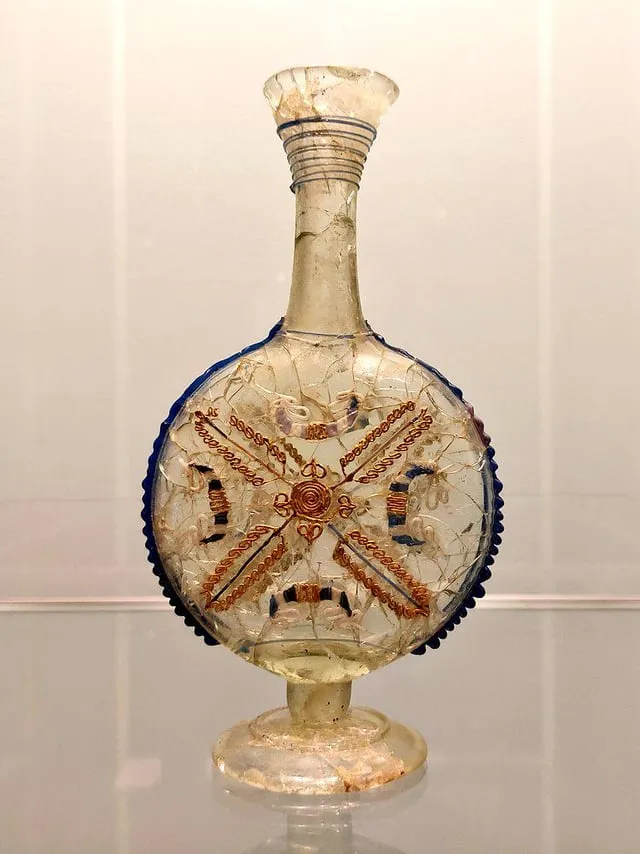
Within the galleries of Museum Het Valkhof in Nijmegen, Netherlands, one object captivates visitors with its radiant beauty and technical sophistication — the Roman Snake-Thread Glass Bottle. Shimmering under the light with hues of blue, white, and gold, this rare vessel embodies the elegance and innovation of early Imperial Roman glassmaking, a period when artisans elevated everyday objects into expressions of wealth and prestige.
Crafted in the mid-1st century CE, this bottle is more than a container — it is a testament to the fusion of science, luxury, and design that defined the Roman Empire’s artistic spirit. Its survival through the centuries offers a glimpse into a vanished world where glass, once a utilitarian material, became an object of desire and display.
The Allure of the Snake-Thread Design
At first glance, the most striking feature of the Nijmegen bottle is its snake-thread decoration — a mesmerizing pattern of colored glass threads spiraling across the vessel’s surface. The name derives from the sinuous, serpentine appearance of the applied threads, which seem to glide over the smooth body of the bottle like coiled ribbons of molten silk.
This technique, known to ancient glass historians as “snake-threading” or “trailing”, involved the application of thin, molten glass filaments onto the surface of a freshly blown vessel. The threads were then twisted, fused, and layered in contrasting colors, creating intricate patterns that danced under light.
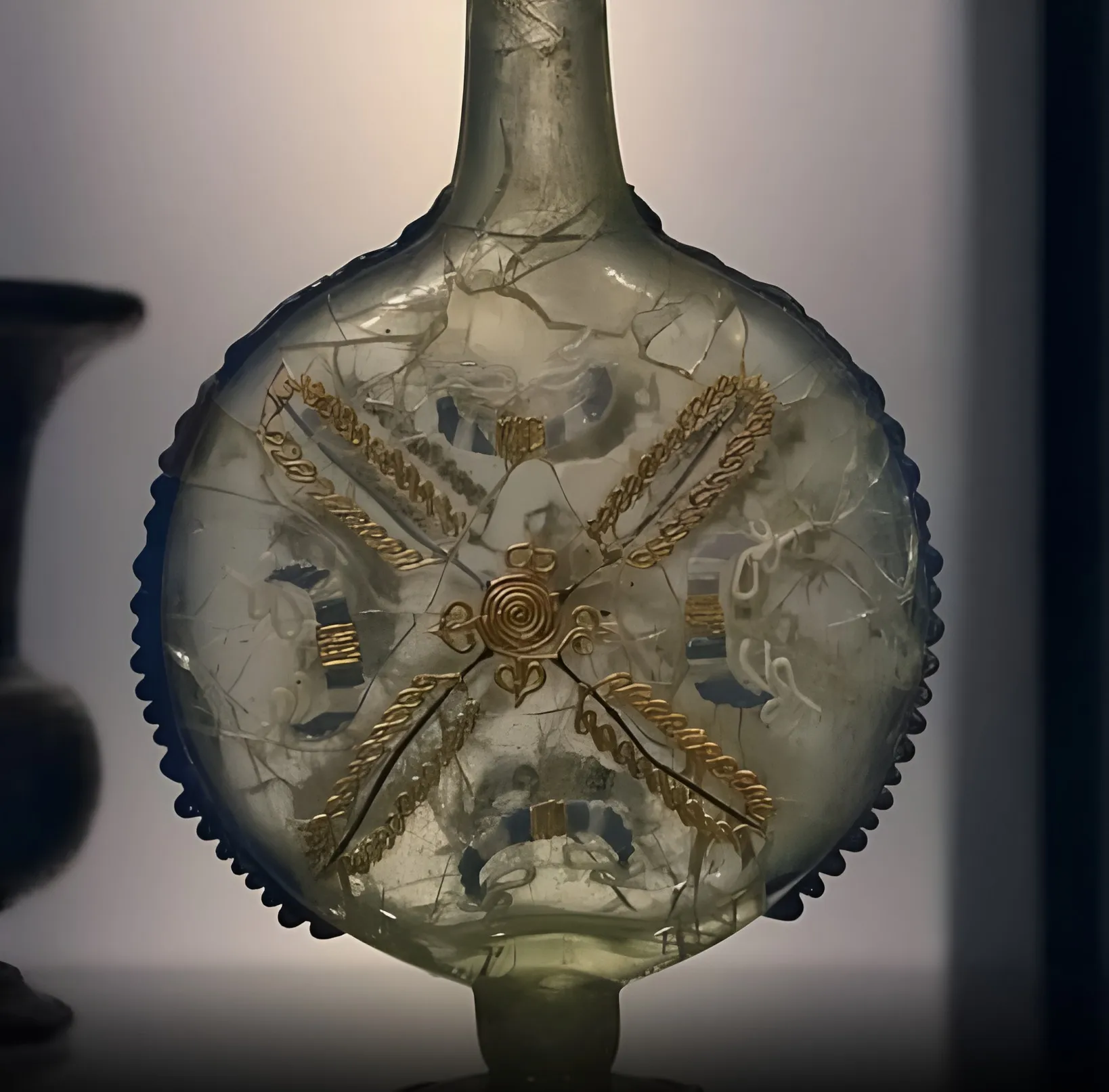
In the case of the Nijmegen piece, artisans combined white, cobalt blue, and gilded threads, producing a vivid interplay of color and shimmer. The gold accents — an exceptionally rare feature — highlight the bottle’s elite status, suggesting it once belonged to a household of significant wealth, possibly even imperial or aristocratic.
Mastery of Ancient Technique: How the Bottle Was Made
The creation of such a vessel required extraordinary skill and timing. Roman glassmakers worked in workshops heated to extreme temperatures, where molten glass could be manipulated only within a narrow window before cooling into rigidity.
Step 1: Blowing the Base Form
The artisan began by blowing a small glob of glass into a basic bottle shape using a blowpipe — a revolutionary technology developed around the 1st century BCE that transformed the glass industry.
Step 2: Applying the Snake-Threads
While the body was still hot and malleable, the glassworker applied pre-colored threads of glass in contrasting hues. Each thread was carefully wound around the vessel’s surface, requiring a steady hand and artistic vision to achieve symmetrical, even spacing.
Step 3: Twisting and Fusing
The threads were then twisted or dragged with a fine metal tool, creating dynamic wave-like effects before being fused into the surface through reheating. In some cases, artisans would overlay gilded or metallic elements, producing a glimmering, jewel-like finish — as seen in this Nijmegen example.
Step 4: Annealing and Finishing
Finally, the piece was slowly cooled in an annealing oven to prevent cracking. Once cooled, it might be polished or engraved, completing the transformation from raw glass to imperial luxury.
This combination of artistry and technical innovation showcases why Roman glassmakers were regarded as masters of material transformation, able to turn sand and fire into visual poetry.
A Symbol of Roman Elegance and Status
In the Roman world, glass was both utilitarian and symbolic. By the early Imperial period, glassmaking had evolved from opaque, mold-cast vessels to transparent, blown glass that rivaled precious stones in clarity and color.
Vessels such as the Nijmegen Snake-Thread Bottle were not everyday items; they were statements of refinement and indicators of elite taste. Wealthy Romans used such bottles to store perfumes, aromatic oils, or luxury cosmetics, items that themselves signified affluence and sophistication.
Moreover, the bottle’s play of light and texture would have been particularly admired in Roman domestic interiors, which were often adorned with reflective surfaces like polished marble and bronze. The bottle’s gleaming threads would have complemented these spaces perfectly — art objects meant to delight both the eyes and the senses.
The Decline of the Snake-Thread Technique
Despite its dazzling beauty, the snake-thread technique enjoyed only a brief period of popularity. By the mid-1st century CE, it began to fall out of fashion, replaced by newer decorative innovations. Such as millefiori (mosaic glass), engraving, and cameo glasswork.
One reason for this decline was complexity and cost. Producing snake-thread decoration demanded immense precision and could easily result in flawed or uneven surfaces. As Roman glass workshops sought to increase production efficiency to meet growing demand, simpler yet equally attractive designs became preferable.
This shift makes surviving examples like the Nijmegen bottle exceptionally rare. Each surviving piece represents not only the artistry of an individual craftsman. But also a transitional moment in the evolution of Roman decorative arts.
Museum Het Valkhof: Guardian of Roman Heritage
Today, the Museum Het Valkhof in Nijmegen stands as one of Europe’s most significant centers for Roman archaeology in the Netherlands. Located near the site of the ancient Roman settlement Ulpia Noviomagus Batavorum. The museum holds a rich collection of artifacts that illuminate the Roman presence along the Rhine frontier.
The Snake-Thread Bottle occupies a place of honor among these treasures. Displayed under controlled lighting that accentuates its luminous threads. It serves not only as a masterpiece of Roman craftsmanship but also as a cultural bridge. Connecting the Roman world with the people of the modern Netherlands.
Through this object, visitors can trace the intersection of art, science, and empire. Witnessing how Roman luxury goods circulated across vast distances. From workshops in Italy, Syria, or Gaul to the distant provinces of the Empire.
The Broader Significance of Roman Glass
Artifacts like the Nijmegen bottle highlight the globalized nature of the Roman economy. Raw materials such as silica, natron (a mineral flux from Egypt), and metallic oxides for coloring were traded across regions. Feeding a network of glass workshops from Alexandria to Cologne.
Roman glassmaking innovations — particularly blowing techniques and decorative applications. Would go on to influence Byzantine, Islamic, and later Venetian glass traditions. In this sense, the Nijmegen bottle is not merely a relic. But a milestone in the story of human creativity and technological progress.
Scientific Insights and Modern Analysis
Recent studies using microscopy and chemical analysis have provided new insights into how such glass objects were made. Traces of gold leaf, cobalt, and manganese found on similar vessels. Confirm the use of advanced material science, even by ancient standards.
The bottle’s composition — a soda-lime-silica glass — suggests it was made using ingredients typical of Eastern Mediterranean workshops. Indicating possible trade connections between Rome and the Near East. This aligns with Nijmegen’s strategic role as a frontier city in the Roman Empire. Where luxury imports often flowed to high-ranking officials and military elites.
Conclusion: Eternal Beauty in Fragile Form
The Roman Snake-Thread Glass Bottle of Nijmegen stands as a timeless expression of artistic ingenuity and cultural sophistication. Through its swirling patterns and radiant hues, it reminds us of a world. Artisans intertwined craftsmanship and beauty, allowing even a small vessel to embody the grandeur of the empire.
Though fragile, its survival across two millennia speaks volumes about the durability of art. And the human desire to transform raw materials into symbols of meaning, identity, and wonder.
As it gleams today within the halls of Museum Het Valkhof. This rare artifact continues to whisper stories of luxury, artistry, and innovation. Bridging ancient Rome and the modern world in one exquisite thread of glass.
ALSO READ: The Crocodile Rain Spouts of Mali – Guardians of Mud and Spirit