Crazy Horse Memorial – The Spirit of the Lakota Carved in Stone
A Mountain Becomes a Memory
Rising from the granite heart of the Black Hills in South Dakota, the Crazy Horse Memorial stands as one of the most ambitious and meaningful sculptural projects ever conceived. Begun in 1948, this colossal mountain carving honors Crazy Horse, the revered Oglala Lakota warrior, whose courage and leadership made him a symbol of resistance and pride for Indigenous peoples across North America.
Unlike many monuments that celebrate conquest, this one embodies remembrance, resilience, and reclamation. Conceived as a Native American response to Mount Rushmore, it reclaims sacred land and transforms it into a living testament to identity and endurance.
Though still unfinished, the Crazy Horse Memorial has already achieved something greater than its stone form — it has become a cultural beacon, drawing millions to reflect on history, spirit, and the enduring power of purpose.
The Vision Behind the Mountain
The story of the Crazy Horse Memorial begins with Lakota Chief Henry Standing Bear, who sought to create a monument that would honor his people’s heroes on their own sacred ground. He famously wrote to sculptor Korczak Ziolkowski, who had previously worked on Mount Rushmore, saying:
“My fellow chiefs and I would like the white man to know that the red man has great heroes also.”
Ziolkowski accepted the challenge, arriving in the Black Hills in 1947 with a vision as vast as the mountain itself. Using little more than dynamite, hand tools, and determination, he began what would become his life’s work — a sculpture of Crazy Horse on horseback, arm outstretched toward his people’s lands.
The project was deliberately privately funded, rejecting government money to ensure artistic and cultural independence. Ziolkowski worked until his death in 1982, after which his wife Ruth and their ten children carried on the mission. Today, the Crazy Horse Memorial Foundation continues to guide the project, keeping its purpose rooted in education, culture, and unity.
A Monument of Unprecedented Scale
The Crazy Horse Memorial is designed to be the largest mountain carving in the world. Once complete, it will measure:
-
641 feet long
-
563 feet high
-
Crazy Horse’s face alone is 87 feet tall, compared to the 60-foot faces on Mount Rushmore.
The sculpture depicts Crazy Horse riding his steed, his left arm extended, pointing toward the horizon. When asked where his lands were, Crazy Horse reportedly replied:
“My lands are where my dead lie buried.”
That gesture — an eternal pointing toward the earth — captures both loss and belonging, echoing across generations.
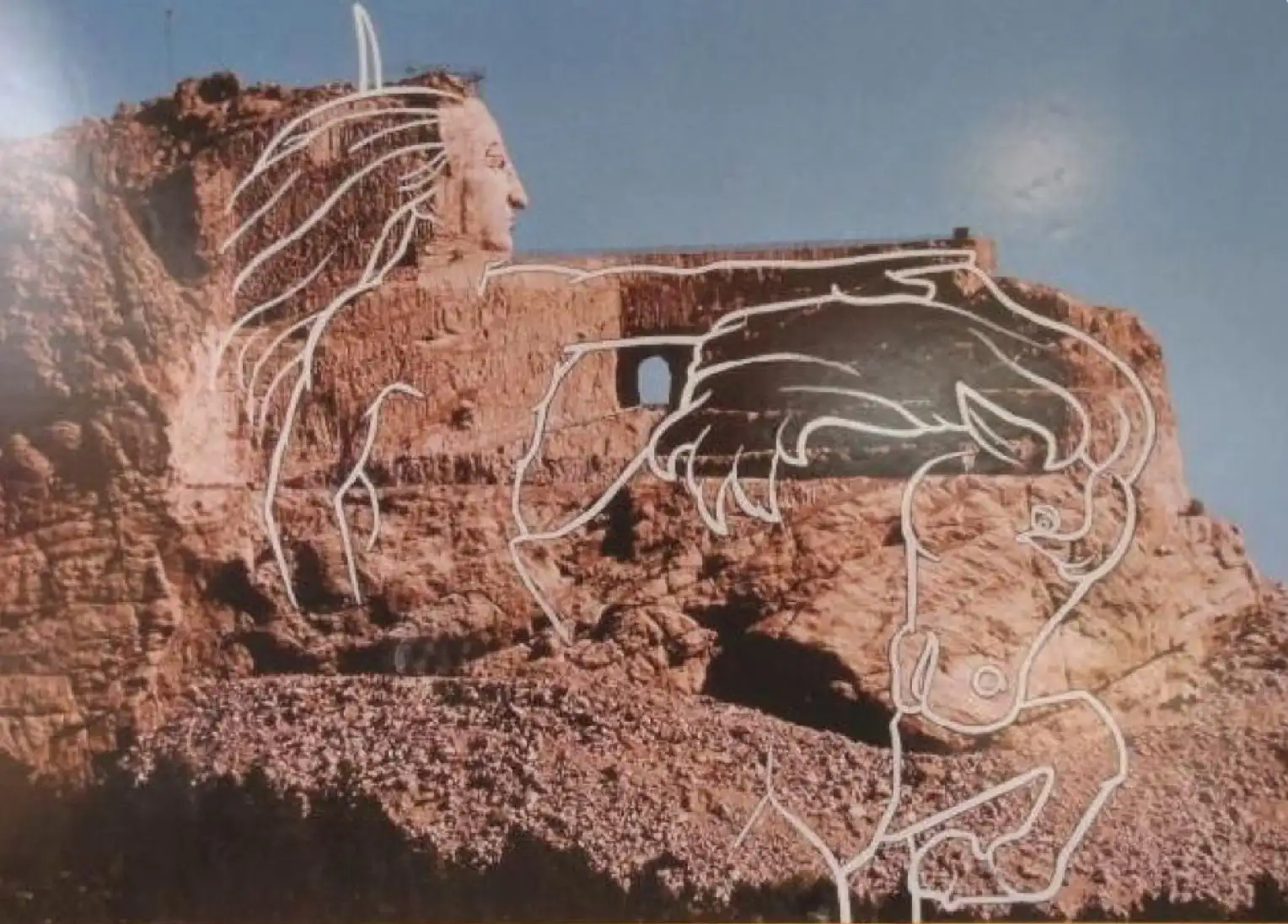
The mountain itself, composed of granite and pegmatite, has become both canvas and collaborator. Every blast, every chisel mark, is a dialogue between human vision and geological time.
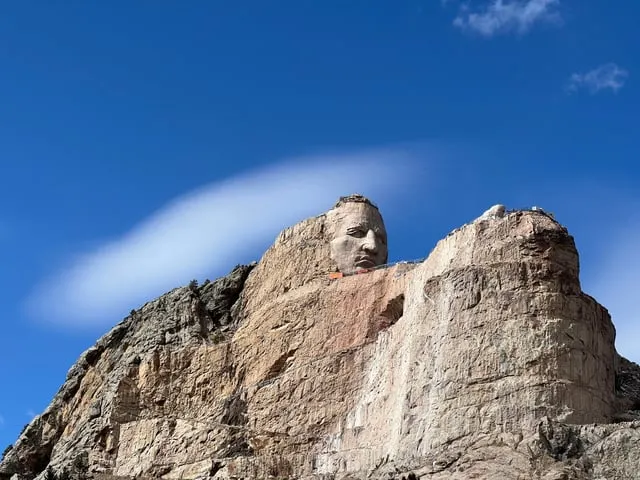
Only the face of Crazy Horse is completed so far, yet even this fragment exudes monumental power — a fusion of defiance and serenity, the spirit of a warrior who fought for his people’s freedom now immortalized in stone.
Crazy Horse: The Warrior and the Legend
Born around 1840, Crazy Horse (Tȟašúŋke Witkó) was a leader of the Oglala Lakota, renowned for his bravery, humility, and devotion to his people’s way of life. He played a pivotal role in defending the Great Plains during the U.S. westward expansion, most famously at the Battle of the Little Bighorn in 1876, where he and Sitting Bull led warriors to victory over General Custer’s forces.
Crazy Horse never signed treaties with the U.S. government, refusing to surrender his people’s sovereignty. To the Lakota, he represented pure spirit and unbroken will — a man who fought not for fame, but for the land, the buffalo, and the freedom to live according to their traditions.
His life was cut short in 1877, when he was fatally wounded under unclear circumstances at Fort Robinson, Nebraska. Yet his legacy, like the mountain that now bears his image, endures as a symbol of dignity, resistance, and remembrance.
Art Meets Activism: A Living Legacy
Beyond the sculpture itself, the Crazy Horse Memorial has grown into a center for Native American education and culture. The site houses:
-
The Indian Museum of North America, showcasing artifacts, artwork, and stories from over 300 Native nations.
-
The Native American Educational and Cultural Center, offering programs that promote understanding and preserve Indigenous heritage.
-
The Indian University of North America, a scholarship-based higher education program that supports Native students in achieving academic and cultural success.
These institutions embody the true spirit of the memorial — not just to honor one man, but to empower future generations. As Ruth Ziolkowski once said:
“The mountain is not the memorial. What we are doing for the Indian people is the memorial.”
The Unfinished Beauty: Art in Progress
More than seven decades since its inception, the Crazy Horse Memorial remains unfinished — and that incompleteness has become part of its meaning.
To some, it is a work in progress symbolizing persistence; to others, a living metaphor for the ongoing journey toward recognition, reconciliation, and justice for Native peoples.
Each year, visitors watch as progress continues, stone by stone, through the efforts of engineers, sculptors, and descendants of both the Lakota Nation and the Ziolkowski family. The annual “Night Blast” ceremonies, held in June and September, illuminate the mountain with fireworks and flames, honoring Crazy Horse’s spirit and reminding the world that this project is a prayer carved in granite — not for completion alone, but for understanding.
Visiting the Crazy Horse Memorial
Located near Custer, South Dakota, just 17 miles from Mount Rushmore, the Crazy Horse Memorial offers an experience that blends history, art, and reflection.
Visitors can explore:
-
The Visitor Complex, which includes museums, theaters, and viewing decks.
-
The Sculpture Studio-Home, where Ziolkowski lived and worked.
-
Educational exhibits on Native American life, culture, and spirituality.
Standing at the foot of the mountain, gazing upward at the massive face of Crazy Horse emerging from the rock, is an experience both humbling and profound. The landscape itself — the sacred Black Hills (Ȟe SápA) — deepens the sense of reverence.
This is not just a tourist site. It is a sacred encounter with endurance, identity, and the human drive to leave meaning etched in the world.
Symbolism of the Stone: What the Mountain Speaks
The Black Hills have long been sacred to the Lakota and other Plains tribes — a spiritual center known as “the heart of everything that is.” For a monument to rise from this ground, bearing the face of one of their greatest leaders, is both a gesture of healing and an act of reclamation.
The unfinished form mirrors the ongoing story of Native resilience. It reminds visitors that history is not a relic but a living force, and that recognition is a journey still unfolding.
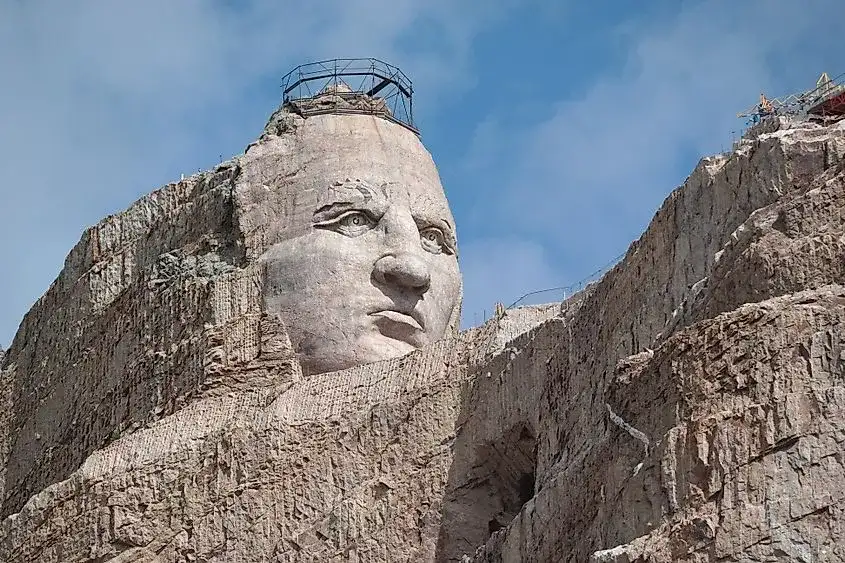
Wind, sun, and stone all play their part. The mountain breathes with time. Its silence is eloquent — a whisper of endurance, a song of the earth itself.
Conclusion: The Face in the Mountain, the Spirit in the Sky
The Crazy Horse Memorial stands not as a completed monument, but as an ongoing conversation between people, history, and the land. It embodies the courage of a warrior, the vision of a sculptor, and the unbroken strength of a people whose stories deserve to be told in stone and sky alike.
Here, art and activism meet. Memory becomes mountain. And every gust of wind that passes over the granite face carries the same message that Crazy Horse himself once embodied — that freedom, dignity, and identity can never be erased.
To stand before this monumental work in progress is to feel the weight of history and the lightness of hope — to witness a mountain that remembers, and a spirit that endures forever.
ALSO READ: Yangshuo Moon Hill: The Iconic Natural Arch of China