The Lost Giant of the North: Steller’s Sea Cow — The Tragic Extinction of the Arctic’s Gentle Titan
In the frigid waters between Russia and Alaska, there once lived a colossal marine mammal that defied belief. Known as Steller’s Sea Cow (Hydrodamalis gigas), this gentle titan was a close relative of today’s dugong and manatee. First documented in 1741 by the German naturalist Georg Wilhelm Steller, it was so immense, so placid, and so strange that many dismissed Steller’s reports as fantasy.
Yet the Steller’s Sea Cow was very real — and tragically short-lived in the modern world. Within just 27 years of its discovery by Europeans, this magnificent creature was driven to extinction.
Discovery in the Icy North
The year was 1741, and Steller was part of Vitus Bering’s Great Northern Expedition, exploring the uncharted regions of the North Pacific. When their ship wrecked near what is now the Commander Islands, Steller spent months stranded with the crew. It was during this time that he observed the extraordinary sea cows living along the island’s coastlines.
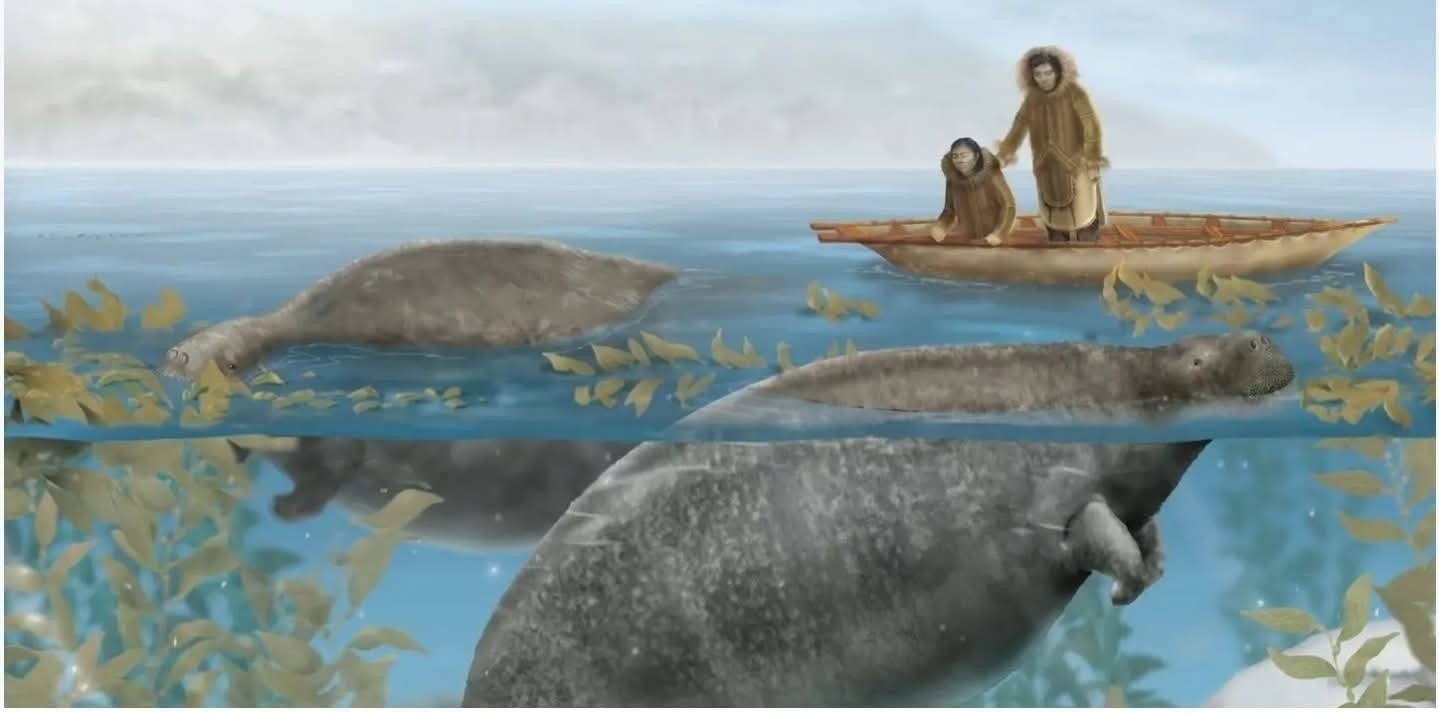
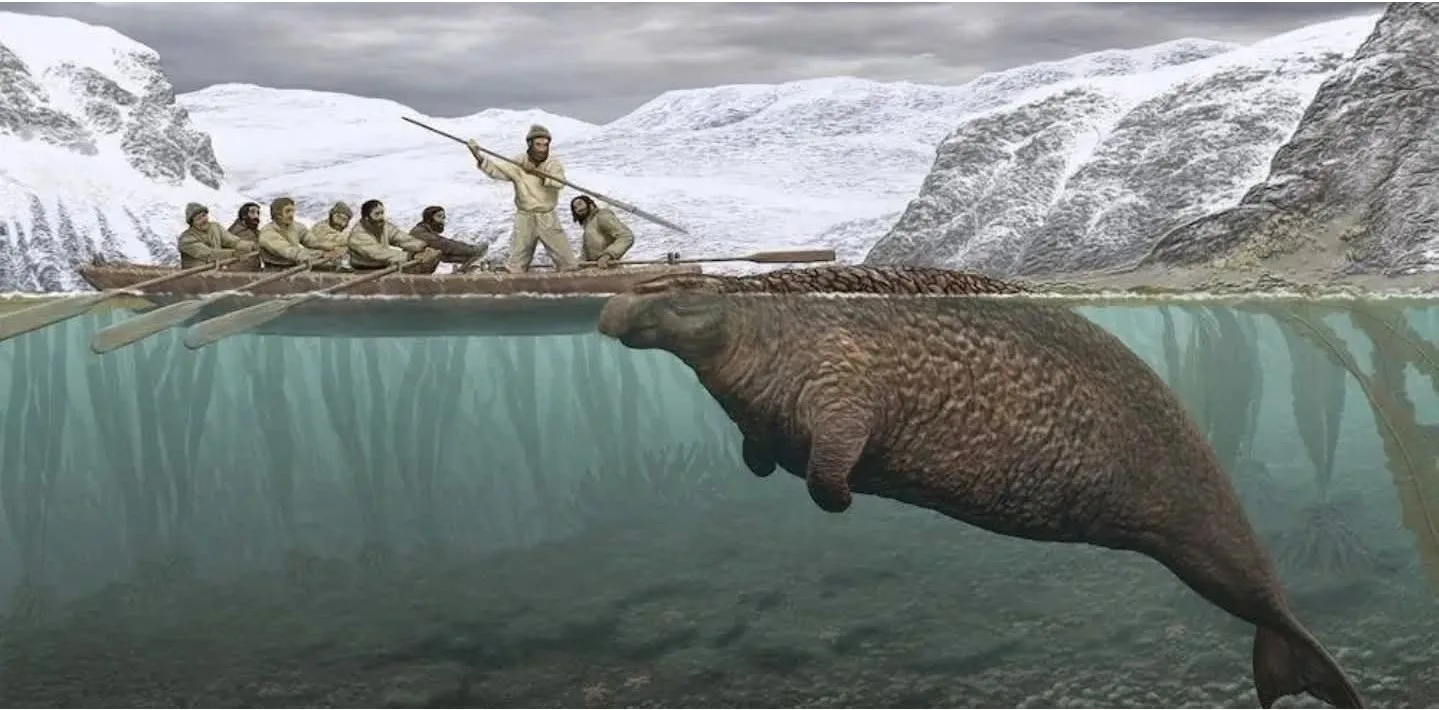
In his journal, Steller described them in remarkable detail — their massive size, gentle temperament, and herbivorous feeding habits. Measuring up to 9 meters (30 feet) in length and weighing as much as 10 metric tons, they were larger than any living sirenian (the order including dugongs and manatees).
The sea cows spent their days grazing on kelp in the cold shallows, moving slowly in small family groups. They were curious, social, and monogamous, forming tight bonds with their mates and young.
Anatomy of a Giant
The Steller’s Sea Cow was a marvel of evolution — perfectly adapted to the subarctic waters of the Bering Sea. Unlike its tropical relatives, it lacked teeth, instead possessing keratinized plates in its mouth that allowed it to shear and crush tough seaweeds.
Key Features:
-
Size: Up to 9 meters (30 feet) long
-
Weight: Around 8–10 metric tons
-
Skin: Thick, dark, and bark-like, offering protection from cold and abrasion
-
Blubber: Up to 10 cm thick, providing insulation
-
Diet: Primarily kelp and other marine vegetation
-
Behavior: Social, monogamous, slow-moving
Their enormous bodies and thick hides made them appear almost prehistoric, remnants of a lost Pleistocene world. Steller noted that the sea cows rarely dove deep, as their bodies were buoyant, and they spent much of their time feeding at the surface.
A Peaceful Existence
Steller was captivated by the sea cows’ gentle nature. He wrote that they were “timid and incapable of defending themselves”, showing no aggression even when attacked. When one member of a group was injured or killed, others would stay nearby, seemingly trying to help or mourn.
Their social bonds and slow, trusting behavior made them vulnerable to human exploitation. Tragically, their docility would soon lead to their demise.
The Road to Extinction
At the time of Steller’s discovery, the sea cow’s range had already diminished drastically. Fossil evidence shows that Hydrodamalis gigas once inhabited a vast region stretching across the North Pacific, from Japan and California to the Aleutian Islands. But by the mid-18th century, only a small population — perhaps fewer than 2,000 individuals — remained around the Commander Islands.
After Steller’s expedition returned to civilization, word spread quickly about this remarkable creature. Whalers, fur traders, and explorers traveling through the Bering Sea began hunting them for:
-
Meat: Described as sweet and tender, providing food for long voyages
-
Fat: Rendered into oil, prized for its longevity and burn quality
-
Hide: Tough and durable, used for making boat coverings and belts
Within less than three decades, relentless hunting wiped out the last population. The final confirmed sighting occurred around 1768, marking the official extinction of Steller’s Sea Cow — a mere 27 years after it was first scientifically documented.
A Vanished Giant
The extinction of Steller’s Sea Cow is one of the fastest and most heartbreaking examples of human impact on megafauna. In evolutionary terms, it happened in the blink of an eye.
This species had survived for millions of years, weathering ice ages, shifting seas, and changing ecosystems — only to be annihilated within a generation of human contact.
The sea cow’s disappearance also disrupted the kelp forest ecosystems of the region. As a major herbivore, it played a key role in maintaining the balance of marine vegetation. Its extinction may have altered the coastal dynamics of the Bering Sea permanently.
Scientific Rediscovery and Fossil Evidence
For centuries, the Steller’s Sea Cow existed only in Steller’s writings, preserved through his meticulous descriptions. But in the 19th and 20th centuries, fossil and subfossil remains began to confirm his accounts.
Skeletal fragments discovered on the Commander Islands, Aleutian Islands, and Alaska provided physical evidence of the species. Researchers found that the bones were dense and heavy, indicating slow, buoyant swimming — another adaptation to cold, shallow waters.
Modern studies using DNA analysis have revealed that Steller’s Sea Cow diverged from its closest living relative, the dugong, around 22 million years ago. Its large size and thick blubber evolved as a response to the frigid environment of the North Pacific.
Lessons from a Lost Giant
The story of Steller’s Sea Cow is more than a tale of extinction — it is a stark reminder of humanity’s capacity to alter the natural world irreversibly.
In less than three decades, overexploitation destroyed a species that had endured for millennia. This tragedy echoes today in the decline of other large marine animals — whales, manatees, and dugongs — threatened by pollution, hunting, and habitat loss.
Conservation Lessons:
-
Vulnerability of isolated species: Small, localized populations are highly susceptible to extinction.
-
The importance of early protection: Once exploitation begins, recovery may be impossible for slow-reproducing species.
-
Ecological ripple effects: The loss of one species can disrupt entire ecosystems, as with the disappearance of this kelp grazer.
Steller’s Sea Cow serves as a timeless warning — that discovery should never precede destruction.
Echoes in the Cold
Though long extinct, the legend of Steller’s Sea Cow endures in the imagination of scientists and storytellers alike. Its bones lie buried beneath layers of sand and ice, its memory preserved in Steller’s 18th-century journals.
Some myths even whisper that a few may have survived in remote, unexplored waters — a hope more romantic than scientific, yet one that speaks to humanity’s longing for redemption in the face of loss.
The sea cow’s story is not just about extinction; it’s about connection — between discovery and responsibility, between knowledge and care. In the sigh of the Arctic wind and the sway of the kelp forests, perhaps a faint echo of the gentle giant still lingers.
ALSO READ: The Stone Guardians of Monte Albán — Voices of the Zapotec Ancestors