The Giant Dragonfly of Prehistoric Skies — Earth’s First Aerial Predator
Long before the thunder of dinosaurs shook the Earth, the skies were ruled by a very different kind of predator — a colossal dragonfly whose wings stretched nearly two feet wide. This ancient creature, known from fossil discoveries dating back 300 million years, represents one of the largest flying insects ever to exist.
Scientists call it Meganeura, a genus of giant dragonflies that soared through the swampy forests of the Carboniferous Period, when lush vegetation and high oxygen levels created conditions unlike anything seen today.
With its vast wingspan, lightning-fast reflexes, and razor-sharp mandibles, this prehistoric hunter dominated the air long before birds, bats, or even dinosaurs evolved. Its fossilized remains tell the story of a primeval Earth — young, vibrant, and alive with strange giants.
A World Before Dinosaurs: The Carboniferous Landscape
The Carboniferous Period (approximately 359–299 million years ago) was an era of dramatic ecological transformation. Vast tropical wetlands covered much of what is now Europe and North America. Towering clubmosses, giant ferns, and horsetail trees formed the first dense forests in Earth’s history.
Amid this green world, oxygen levels soared to nearly 35% of the atmosphere — far higher than today’s 21%. This abundance of oxygen played a critical role in allowing insects like Meganeura to grow to extraordinary sizes.
The dense, humid air supported their massive wings, making flight easier and more energy-efficient. With no vertebrate predators in the skies, these giant insects became Earth’s first aerial rulers, gliding effortlessly over primeval swamps and hunting smaller arthropods, amphibians, and even early reptiles.
Meet Meganeura: The Dragonfly Titan
The name Meganeura means “large veins,” referring to the intricate network of veins that strengthened its enormous wings. The first fossils were discovered in the Coal Measures of France in 1880, and they stunned scientists with their sheer scale.
Meganeura’s wings could reach 70 centimeters (about 27 inches) from tip to tip — nearly as wide as a modern raven’s wingspan. Its body, though similar in shape to modern dragonflies, was thicker and more robust, built for both speed and endurance.
Physical Characteristics
-
Wingspan: Up to 70 cm (2.3 ft)
-
Body Length: Approximately 40 cm (16 in)
-
Habitat: Swampy forests and wetlands
-
Diet: Carnivorous — feeding on smaller insects and amphibians
-
Flight: Powerful and precise, capable of hovering and swift dives
With compound eyes offering a nearly 360° view, Meganeura could detect the slightest movement. Its long legs were equipped with spines to snatch prey midair — a perfect design for a top predator in a world of early life forms.
The Science Behind Gigantism: Why Insects Were So Big
One of the most fascinating aspects of Meganeura’s existence is its gigantic size, which scientists attribute to the unique environmental conditions of the Carboniferous.
1. High Oxygen Concentration
The elevated oxygen levels in the atmosphere allowed insects’ simple respiratory systems — tiny tubes called tracheae — to deliver oxygen efficiently throughout their large bodies. Modern insects are limited by today’s lower oxygen levels, but back then, biology and physics allowed them to grow far beyond their current limits.
2. Lack of Aerial Competition
During Meganeura’s reign, no birds or large flying vertebrates existed. Without predators or competitors in the sky, these insects filled the top predator niche, free to evolve larger wings and bodies suited for domination of the air.
3. Favorable Climate and Vegetation
The warm, humid climate of the Carboniferous supported vast forests and wetlands teeming with life. These environments provided abundant prey — from small insects to juvenile amphibians — ensuring Meganeura’s continued success.
Predator of the Primeval Skies
In its world, Meganeura was the apex aerial predator. It hunted with the same precision and grace as modern dragonflies, ambushing prey in mid-flight with lethal speed.
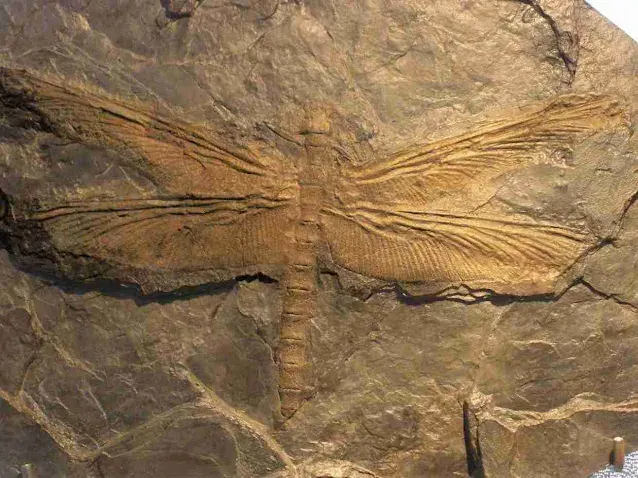
Its powerful jaws and toothed mandibles could tear apart small insects and amphibians. Scientists believe Meganeura also used stealth tactics, flying slowly above the vegetation before swooping down on unsuspecting targets.
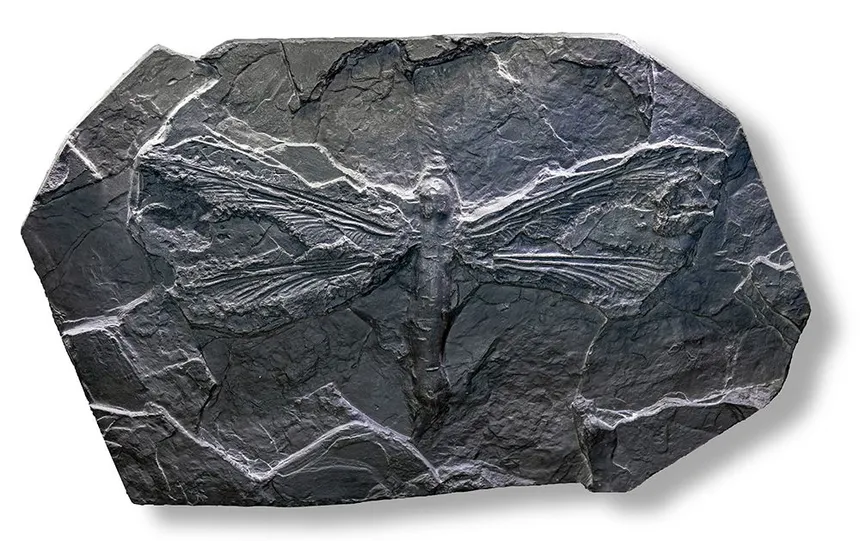
Each fossilized wingbeat represents a moment in Earth’s evolutionary experiment — when flight itself was still new, and the rules of life were being rewritten.
Discovery and Fossil Significance
The first fossils of Meganeura were unearthed in the late 19th century in France’s coal-rich regions, preserved in shale and limestone — remnants of ancient swamp deposits. These fossilized impressions captured the delicate veins of wings and even traces of the insect’s body, offering rare insights into early insect anatomy.
Subsequent discoveries in England, Germany, and the United States confirmed that Meganeura was not an isolated phenomenon but part of a broader radiation of giant arthropods that included millipedes over 2 meters long (Arthropleura) and enormous scorpions (Pulmonoscorpius).
Each find has helped paleontologists piece together the puzzle of prehistoric life, illustrating how atmospheric conditions and evolutionary opportunity combined to produce a world of true giants.
The Fall of the Giants
As Earth’s climate changed toward the end of the Carboniferous, oxygen levels gradually decreased. By the Permian Period (around 299–252 million years ago), environmental shifts — including drier conditions and fluctuating temperatures — made it harder for giant insects to survive.
Smaller, more adaptable species emerged, leading to the decline of megainsects like Meganeura. Eventually, vertebrate flyers — such as pterosaurs and, much later, birds — would take to the skies, ending the reign of the dragonfly titans.
Yet, the legacy of these early flyers endures. Modern dragonflies, though much smaller, retain many of the same characteristics: exceptional vision, agile flight, and a predatory instinct honed through hundreds of millions of years of evolution.
A Glimpse into Earth’s Ancient Skies
The discovery of Meganeura fossils offers more than just a look at prehistoric insects — it provides a window into the Earth’s evolving atmosphere, ecosystems, and biodiversity. Each fossil is a record of how life adapted to environmental changes long before humans walked the planet.
These dragonflies ruled not just the skies but also symbolized the balance of life and environment. Their size was both a triumph of nature’s potential and a reminder of its fragility. When oxygen levels dropped, even the mightiest fell.
In today’s context, Meganeura reminds us of the delicate relationship between life and the planet’s chemistry — a balance still vital for our own survival.
Conclusion: The Legacy of the First Sky Kings
Over 300 million years ago, when the Earth was young, forests new, and oxygen thick in the air, a giant dragonfly ruled the heavens.
Its wings cast shadows over ancient ferns and mosses, and its flight marked the dawn of aerial life on our planet. Though extinct, Meganeura remains one of evolution’s most awe-inspiring experiments — proof of nature’s boundless creativity and adaptability.
Today, when a modern dragonfly darts through the summer air, it carries within its fragile body the memory of that ancient lineage — the story of Earth’s first aerial hunter who once owned the skies.
ALSO READ: The Siberian Unicorn: The Real Giant That Inspired Ancient Legends