The Siberian Unicorn: The Real Giant That Inspired Ancient Legends
Long before the myth of the graceful unicorn galloping through medieval tales, a real creature may have roamed the Earth — one so awe-inspiring that it could easily have sparked the imagination of ancient peoples. Known as the Siberian Unicorn, this formidable beast was not a horse at all, but a giant, shaggy rhinoceros scientifically called Elasmotherium sibiricum.
This Ice Age titan lived across the vast steppes of Eurasia roughly 39,000 years ago, and possibly as recently as 29,000 years ago, meaning it coexisted with early humans. With its enormous horn, thick fur, and massive frame, the Siberian Unicorn stood as a true wonder of prehistoric life — and a likely source of the unicorn myths that would echo through human culture for millennia.
The Discovery of Elasmotherium
The story of the Siberian Unicorn begins with science. The species Elasmotherium sibiricum was first described in 1808 by Johan Fischer von Waldheim, the director of the Moscow Natural History Museum. His research was based on fossilized remains unearthed in the Siberian plains — jawbones, skull fragments, and most famously, evidence of an enormous horn positioned on the animal’s forehead.
The name Elasmotherium derives from Greek: “elasmo” meaning plate and “therion” meaning beast, referring to the animal’s distinctive ribbed molars. These teeth were adapted for grinding tough grasses and steppe vegetation — a diet perfectly suited to the cold, dry plains it called home.
As paleontologists uncovered more fossils across Russia, Kazakhstan, Ukraine, and Mongolia, a clearer picture emerged: Elasmotherium was unlike any other rhinoceros, both in appearance and in legend.
Physical Description: The True Ice Age Giant
The Siberian Unicorn was a giant among giants. Standing up to 6.5 feet (2 meters) at the shoulder and stretching nearly 15 feet (4.5 meters) in length, it weighed around 4 tons — comparable to a large African elephant.
Its most striking feature was its massive horn, likely measuring up to 1.5 meters (5 feet) long. Unlike bone, this horn was composed of keratin, the same protein that makes up human hair and nails — and the horns of modern rhinos.
Though no complete horn fossils have survived (keratin decomposes over time), scientists have inferred its size and placement from the skull’s large frontal dome. This horn, set atop the animal’s forehead rather than the snout, may have given rise to stories of a single-horned “horse” — the unicorn.
Covered in a thick, shaggy coat, the Elasmotherium was well adapted to Ice Age climates. Its long limbs and domed head suggest it grazed on grasses and low vegetation, using its horn to dig through snow or soil in search of food during harsh winters.
The Horn: Function and Symbolism
The horn of the Siberian Unicorn is the centerpiece of its mystery — both scientifically and mythologically. While popular imagination envisions it as a tool of magic, in reality, it likely served several practical purposes:
-
Foraging: The horn may have been used to scrape snow and ice to uncover grasses and bulbs.
-
Defense: Like modern rhinos, Elasmotherium probably used its horn to ward off predators such as cave lions or hyenas.
-
Mating Displays: Males may have displayed their horns to attract females or assert dominance within herds.
To ancient humans, witnessing such a creature would have been awe-inspiring. Its size, power, and singular horn could easily have sparked the first unicorn legends, blending reality with myth.
Indeed, medieval travelers in Central Asia told stories of horned beasts and traded “unicorn horns” — often narwhal tusks or rhino horns — as magical relics. It is entirely plausible that early human encounters with fossilized Elasmotherium remains fueled these enduring myths.
Habitat and Distribution
Fossil evidence places Elasmotherium across a vast range of Eurasia, from the Don River in Russia to Siberia and Kazakhstan. Its preferred habitat was the open grassland steppe, similar to modern-day Mongolia — a landscape shaped by Ice Age winds, permafrost, and seasonal extremes.
Here, the Siberian Unicorn thrived alongside other iconic megafauna such as the woolly mammoth, woolly rhinoceros, cave bear, and saber-toothed cat. These ecosystems supported rich grasslands, but they were also fragile, deeply dependent on climate stability.
Diet and Behavior
Elasmotherium was a grazer, feeding mainly on grasses, bulbs, and tubers. Its distinctive skull and jaw structure — featuring a large nasal cavity and high-crowned molars — suggest it evolved to process tough, fibrous vegetation.
Scientists believe its grazing habits were similar to modern-day bison or horses, and its massive horn might have helped dig for roots or break frozen ground. Stable isotope analysis of fossilized teeth supports this diet, confirming its dependence on steppe vegetation.
Socially, the Siberian Unicorn may have lived in small herds or family groups, moving seasonally to follow food sources.
Coexistence with Early Humans
One of the most fascinating aspects of the Siberian Unicorn is its overlap with early Homo sapiens. Fossil remains dated to around 29,000 years ago suggest that Elasmotherium survived far longer than previously thought, sharing the landscape with humans in the late Pleistocene.
This coexistence opens intriguing possibilities: humans may have hunted these massive creatures or at least witnessed them firsthand, inspiring the myths and legends later passed down through oral tradition.
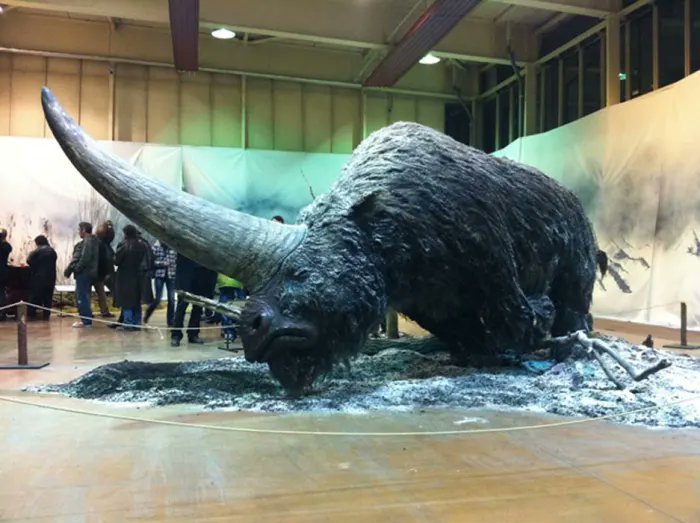
The striking image of a one-horned giant roaming the snowy plains could easily have become the seed of the unicorn myth — a symbol of power, mystery, and purity that persisted through ancient and medieval times.
Extinction: The End of a Giant
The extinction of the Siberian Unicorn remains a topic of scientific debate. For years, it was thought to have disappeared about 200,000 years ago, but new radiocarbon dating has dramatically revised that estimate to around 29,000 years ago.
Several factors likely contributed to its decline:
-
Climate Change: As the Ice Age ended, temperatures rose, and grasslands gave way to forests and wetlands, reducing available food.
-
Habitat Loss: Shifts in vegetation and soil composition made it harder for large grazers to survive.
-
Human Interaction: Early humans may have hunted Elasmotherium for meat, horns, or hide — accelerating its decline.
Unlike some smaller species, Elasmotherium’s large size and specialized diet made it vulnerable to even minor environmental disruptions.
Legacy of the Siberian Unicorn
Though the Siberian Unicorn vanished thousands of years ago, its legacy endures — both in scientific study and human imagination.
For paleontologists, Elasmotherium provides a crucial window into Ice Age ecosystems and the evolution of rhinoceroses. For storytellers and historians, it bridges the line between natural history and myth, connecting real creatures with the legends they inspired.
In modern culture, the Siberian Unicorn stands as a symbol of how truth and imagination intertwine — how ancient people interpreted their world through wonder and storytelling.
Conclusion
The Siberian Unicorn (Elasmotherium sibiricum) remains one of the most extraordinary creatures to have ever walked the Earth. Towering, powerful, and majestic, it embodied both the raw might of nature and the mystery that fuels human imagination.
From the frozen steppes of Ice Age Eurasia to the pages of ancient legend, the story of Elasmotherium reminds us that even myths often have roots in reality. Beneath the layers of folklore lies a truth forged in bone and stone — the memory of a real unicorn that once thundered across the Earth.
ALSO READ: Chedworth Roman Villa: A Timeless Masterpiece of Roman Luxury and Engineering