The Baigong Pipes Mystery: China’s 150,000-Year-Old Enigma Beneath Mount Baigong
A Mystery Buried in Stone
In the remote deserts of Qinghai Province, China, near the enigmatic Mount Baigong, lies one of the most perplexing archaeological puzzles ever unearthed — the Baigong Pipes. These rust-colored, tube-like formations have baffled scientists, geologists, and alternative researchers for decades. Embedded in both the rock face and the surrounding terrain, some of these pipes even extend into a nearby saltwater lake, forming a geometric network that seems far too ordered to be a coincidence.
What makes the Baigong Pipes so fascinating is their age and composition. The rock encasing the structures is estimated to be around 150,000 years old, long before the rise of any known civilization capable of smelting metal. Yet laboratory analyses show that the pipes contain iron and rare trace elements that don’t match the region’s natural geology.
The mystery deepens with local legends, which speak of “sky people” who descended from the heavens to build a great machine on Mount Baigong — long before humanity’s recorded history began.
1. Discovery of the Baigong Pipes
The Baigong Pipes were first brought to scientific attention in the 1990s, when a group of researchers visited Delingha, a sparsely populated area near Mount Baigong. Local herders had long spoken of strange metallic tubes protruding from caves high in the mountain.
Upon investigation, scientists discovered:
-
Dozens of metal-like pipes, some as thick as 40 centimeters in diameter.
-
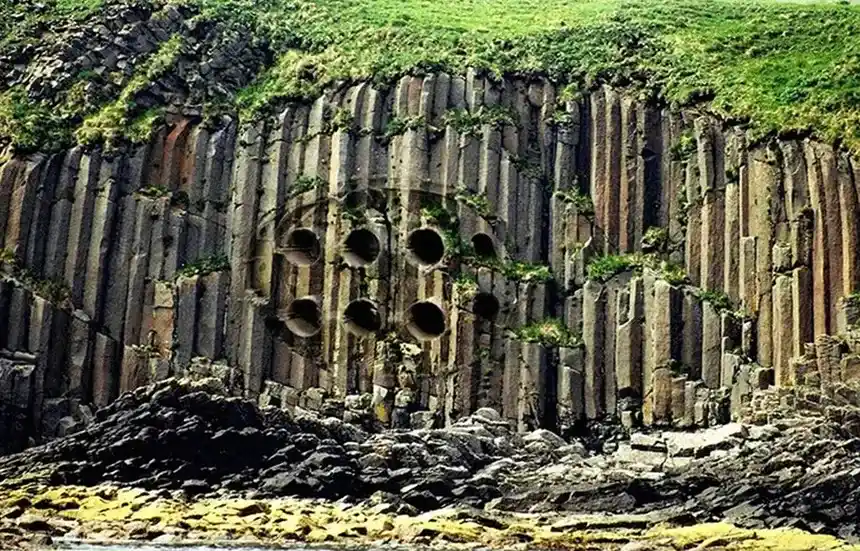
Several cavities and caves, with vertical and horizontal pipes embedded within the stone.
-
Pipes leading into Lake Toson, a nearby saltwater lake, as if part of an ancient drainage or transport system.
The discovery immediately sparked debate and curiosity worldwide. How could such structures have formed — and who, or what, created them?
2. Geological and Archaeological Context
Mount Baigong is located near the Qaidam Basin, an arid plateau surrounded by mountains and lakes. The region is geologically ancient, with sedimentary rocks dating back hundreds of thousands of years.
According to radiometric dating and geological surveys, the rock surrounding the pipes formed approximately 150,000 years ago. If the pipes were embedded at the same time, their origin would predate modern Homo sapiens by tens of thousands of years.
This timeline immediately challenges traditional archaeology, which attributes the earliest known metalworking to around 5,000 BCE — not 145,000 years earlier.
3. Composition and Scientific Testing
Chinese scientists from the Beijing Institute of Geology conducted tests on the Baigong Pipes’ material composition. The results showed:
-
Approximately 92% common iron,
-
8% trace metals including calcium and rare elements,
-
And the presence of oxidation consistent with long-term exposure to the elements.
Perhaps most puzzlingly, some samples showed radioactive isotopes and crystalline structures that didn’t correspond to the local soil or rock. Others appeared highly symmetrical and hollow, resembling manufactured tubing rather than natural mineral deposits.
Further analysis at Northwestern Polytechnical University (Xi’an) revealed that the iron had aged uniformly, suggesting it wasn’t a modern intrusion or contamination — but something that had existed in the rock for millennia.
4. Natural Explanations: Fossilized Roots or Geological Formations?
While the composition and structure are striking, geologists have proposed natural explanations for the Baigong Pipes.
One popular theory suggests that the pipes may be fossilized tree roots. Over time, mineral-rich groundwater could have replaced the organic material with iron oxides, leaving behind tubular impressions that mimic metal.
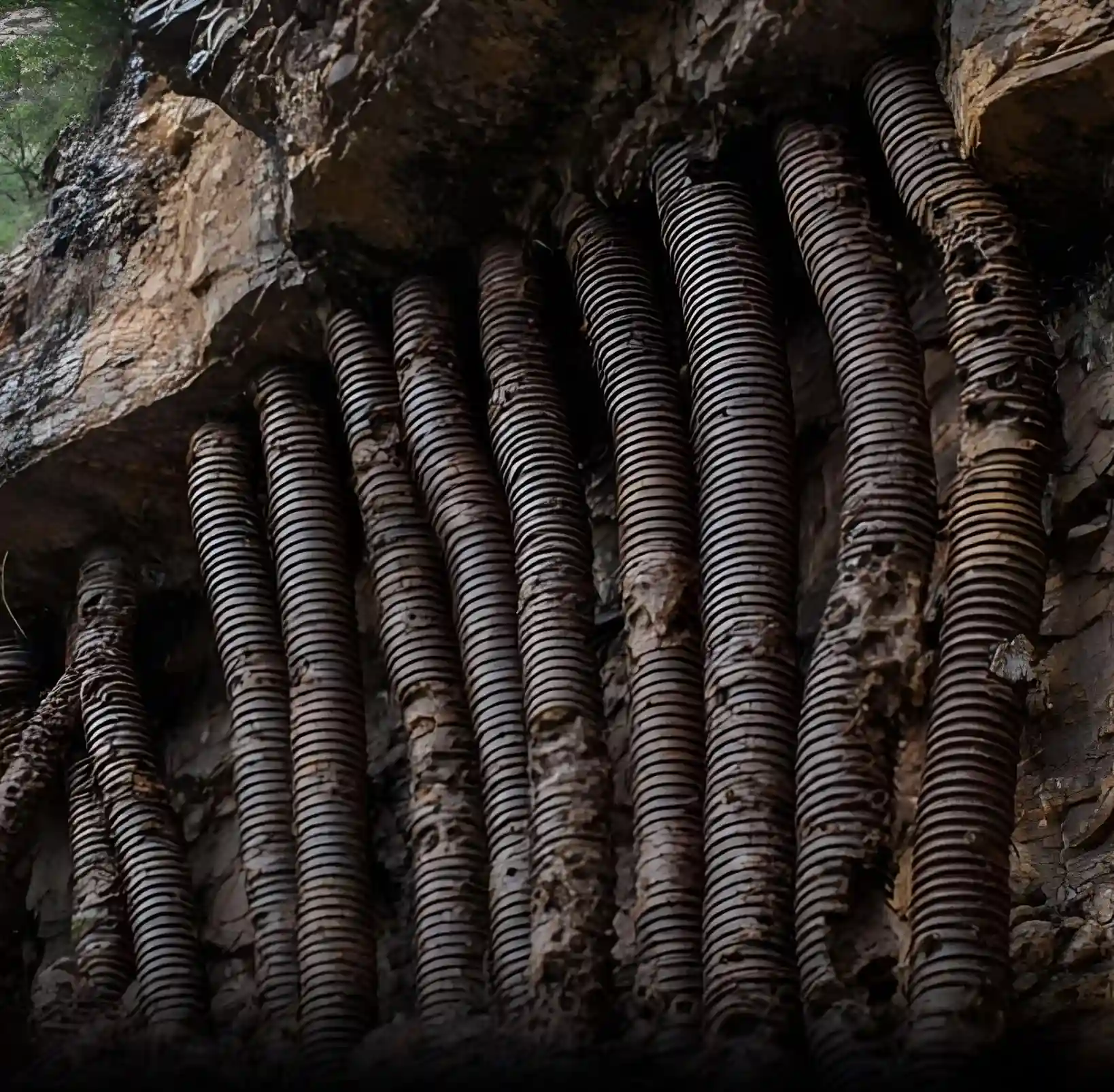
Another hypothesis points to iron-rich sedimentary concretions, where minerals precipitate in cylindrical forms through volcanic or hydrothermal activity. In such cases, the symmetrical shapes may simply be natural crystallization patterns, not the result of human or extraterrestrial design.
However, even proponents of these theories admit that the regular spacing and alignment of the pipes remain difficult to explain through purely natural processes.
5. Legends of the “Sky People”
Long before scientific study, local folklore told of beings from the sky who descended upon Mount Baigong to build a mysterious structure — a “heavenly palace” or ancient machine. These legends, passed down through generations, describe the area as a sacred site and warn of strange “lightning from the mountain” during storms.
According to the stories, the “sky people” abandoned their creation after a great flood transformed the surrounding landscape, leaving only remnants — possibly the Baigong Pipes — as evidence of their presence.
While these myths are often dismissed as fantasy, their geographic alignment with the actual archaeological site adds an intriguing dimension. Many ancient cultures preserved historical events through oral traditions, and it’s possible that such stories encode ancient encounters with meteorological or cosmic phenomena.
6. The Extraterrestrial Hypothesis
The combination of metallic appearance, precise geometry, and extreme age has fueled speculation that the Baigong Pipes may not be of terrestrial origin.
Proponents of the ancient astronaut theory argue that the pipes could be remnants of an extraterrestrial installation, possibly related to energy production, water management, or spacecraft docking infrastructure.
Supporters point to:
-
The pipes’ symmetrical layout, which appears engineered.
-
Their connection to both mountain caves and a lake, suggesting a system designed for resource flow.
-
The unusual metals, which might have been used in advanced technologies.
While mainstream science rejects such theories as speculative, they remain popular in alternative archaeology and UFO research communities. The Baigong Pipes, in this view, represent a technological anomaly left behind by non-human visitors — a message written in metal, waiting to be deciphered.
7. Modern Investigations and Scientific Skepticism
In recent years, renewed studies have sought to reconcile the mystery with natural science. Researchers from the Chinese Academy of Sciences have emphasized that iron oxidation and mineralization can occur in highly unusual ways, producing pipe-like structures even in remote, ancient rocks.
Still, questions remain:
-
Why do the pipes appear geometrically aligned?
-
Why do some penetrate solid rock layers without visible fissures?
-
And why does their chemical makeup differ so markedly from surrounding materials?
The lack of consistent field documentation has only added to the puzzle. Some samples studied may have come from different areas or modern contamination, complicating the data. As a result, the Baigong Pipes continue to occupy a gray area between geological curiosity and archaeological enigma.
8. A Symbol of Human Curiosity and Wonder
Whether the Baigong Pipes are fossilized roots, natural mineral formations, or remnants of a forgotten civilization, their discovery captures the timeless human impulse to question the unknown.
They remind us that the Earth still holds mysteries beyond our full comprehension, and that science and myth often intertwine in our search for truth.
Each new analysis brings us closer to understanding not only what these formations are, but also how ancient people interpreted the strange phenomena around them. The Baigong Pipes stand as a bridge between geology and imagination, between science and legend — a testament to our enduring fascination with the cosmos and our place within it.
Conclusion: Nature, Legend, or Lost Technology?
The Baigong Pipes mystery continues to captivate researchers and enthusiasts around the world. Whether they were shaped by the slow artistry of nature, the hands of an ancient people, or something not of this Earth, they represent one of the most intriguing unsolved enigmas in archaeology.
Until conclusive evidence emerges, the pipes near Mount Baigong will remain a symbol of our planet’s hidden past, a reminder that even in the age of science, the Earth still whispers secrets from the deep time of creation.
ALSO READ: Forged from the Stars: The 2,700-Year-Old Meteoritic Iron Bracelet Unearthed in Poland