The Library of Trinity College Dublin: Ireland’s Timeless Treasure of Knowledge and Architecture
A Temple of Knowledge in the Heart of Dublin
Standing at the heart of Ireland’s capital, the Library of Trinity College Dublin is more than a building — it’s a living monument to human knowledge and artistic achievement. Founded in the late 16th century and continuously expanding ever since, it has become Ireland’s largest library, housing over 6 million printed volumes alongside countless manuscripts, maps, and rare books that span centuries of scholarship.
But among its many treasures, one room stands out above all — the Long Room, a vast chamber that has captivated visitors for over 280 years. With its dark oak arches, soaring book-lined walls, and air rich with history, the Long Room represents not only a dedication to learning but also the aesthetic beauty of intellectual pursuit.
1. A Legacy Born of Learning: The Origins of Trinity College Library
The story of the Library of Trinity College Dublin begins in 1592, when Queen Elizabeth I founded Trinity College to promote education and the Protestant faith in Ireland. As the institution grew, so did its collection of books, manuscripts, and academic works — becoming an indispensable resource for scholars and students.
By the 18th century, the library had outgrown its early buildings. Plans were drawn to create a grander space worthy of its growing reputation. This vision culminated in the construction of the Old Library and its most famous feature — the Long Room, completed in 1743.
From its earliest days, the library’s purpose was clear: to preserve and share the world’s knowledge, not only for Ireland but for the global community of learners who have passed through its doors.
2. The Long Room: The Heart of the Library
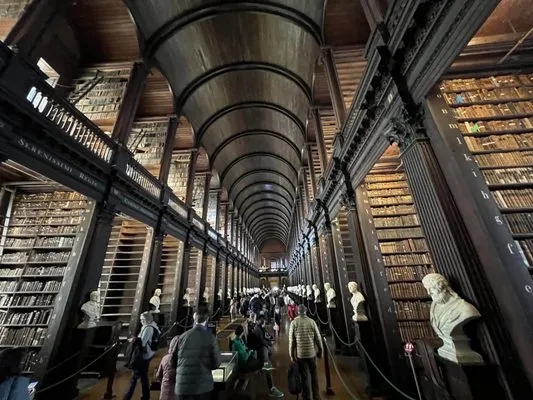
At the core of the Library of Trinity College Dublin lies the Long Room, an awe-inspiring 65-meter-long hall filled with over 200,000 of the library’s oldest volumes. Walking through it feels like stepping into another era — a place where the spirit of discovery and the weight of history coexist in perfect harmony.
The Long Room’s design, with its barrel-vaulted ceiling, dark oak shelves, and symmetrical architecture, creates an atmosphere that’s both majestic and contemplative. The scent of centuries-old paper mingles with the soft light streaming through tall windows, creating a sensory experience that feels almost sacred.
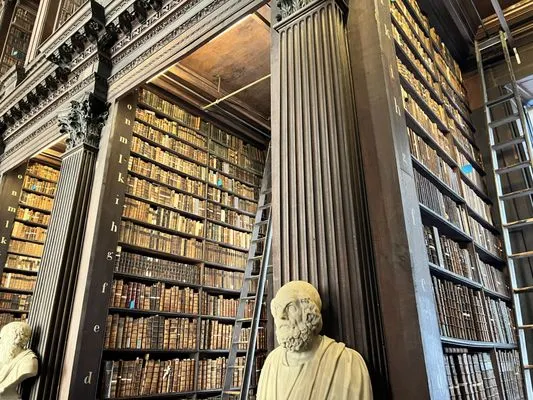
Flanking the hall are marble busts of great philosophers, writers, and scholars, including Homer, Shakespeare, Socrates, and Jonathan Swift. Each gaze seems to follow visitors through the hall, silently bearing witness to the passage of generations of readers and thinkers.
3. The Treasures Within: Manuscripts, Maps, and Rare Books
The Library of Trinity College Dublin is not only famous for its architecture but also for its extraordinary collection. Among its most celebrated treasures is the Book of Kells, a stunning illuminated manuscript created by Celtic monks around the year 800 AD. Often regarded as Ireland’s greatest national treasure, the Book of Kells is renowned for its intricate illustrations and vivid colors that have survived for over a millennium.
In addition to the Book of Kells, the library holds:
-
The Book of Durrow, an earlier example of Insular manuscript art.
-
A 9th-century harp, known as the Brian Boru Harp, the national symbol of Ireland.
-
Thousands of early printed works, including first editions by major European writers.
-
A rich collection of maps, letters, and archives documenting Irish and European history.
These holdings make the library an invaluable resource for historians, linguists, theologians, and art historians, offering a tangible connection to the intellectual heritage of Western civilization.
4. Architecture and Atmosphere: A Masterpiece in Wood and Light
The architecture of the Long Room is as significant as its contents. Built between 1712 and 1732 by architect Thomas Burgh, it originally featured a flat plaster ceiling. However, by the late 18th century, as the collection expanded, the ceiling was raised to accommodate an upper gallery — doubling its capacity and creating the breathtaking vaulted form seen today.
Every detail of the Long Room was crafted to evoke reverence and awe. The oak bookcases are intricately carved, the floors gleam with centuries of polish, and the arches draw the eye upward, symbolizing the ascent of human thought.
It’s little wonder that this space has inspired countless artists, writers, and even filmmakers. Many believe that the Jedi Archives in Star Wars: Episode II – Attack of the Clones were modeled after the Long Room — a fitting homage to a place that has become synonymous with knowledge and beauty.
5. The Busts and Scholars of the Long Room
Running the length of the Long Room are 48 marble busts, commissioned in the 18th and 19th centuries. These sculptures represent some of the greatest minds in Western civilization — figures who shaped philosophy, literature, and science.
Among them are Aristotle, Homer, Newton, Voltaire, and Swift, whose presence serves as both inspiration and reminder that knowledge is built upon the ideas of those who came before.
These busts are more than decoration; they are symbols of the continuity of human thought — the passing of wisdom from generation to generation, immortalized in marble and memory.
6. The Library’s Modern Role: Preservation and Accessibility
While steeped in history, the Library of Trinity College Dublin remains a living institution. Its mission continues to evolve in response to the digital age. Modern initiatives include digitizing rare manuscripts, improving public access, and preserving ancient materials using cutting-edge conservation methods.
The library also serves as the legal deposit library for Ireland and the UK, meaning it receives a copy of every book published in those countries. As a result, its collection continues to expand — a growing archive that captures the evolution of thought, language, and culture.
7. Visiting the Library: A Pilgrimage for Book Lovers
For travelers to Dublin, the Library of Trinity College is an unmissable destination. Visitors can explore the Old Library and view the Book of Kells Exhibition, which offers context on Ireland’s monastic artistry and cultural legacy.
Stepping into the Long Room, guests often describe a sense of reverence — an almost cathedral-like silence broken only by soft footsteps and whispered awe. Each corner reveals another layer of history, from the carved staircases to the gilded book titles glimmering in low light.
Whether you are a historian, bibliophile, or casual tourist, the Library of Trinity College Dublin. Offers an experience unlike any other — a tangible connection to centuries of human curiosity and creativity.
8. The Enduring Symbol of Irish Heritage and Enlightenment
Beyond its books and architecture, the Library stands as a symbol of Ireland’s commitment to knowledge, culture, and art. It reflects both the intellectual spirit of the Enlightenment and the resilience of Irish identity. Serving as a bridge between the past and the present.
Generations of scholars, writers, and dreamers have found inspiration beneath its wooden vaults. And as the world continues to change. The Library remains a steadfast guardian of humanity’s collective wisdom — a reminder that knowledge is the truest form of immortality.
Conclusion: A Living Monument to Human Curiosity
The Library of Trinity College Dublin is not merely a repository of books. It is a celebration of human thought, creativity, and perseverance. From the grandeur of the Long Room to the luminous pages of the Book of Kells. Every detail tells a story of centuries devoted to learning.
As one of the world’s most beautiful and historically significant libraries. It continues to inspire awe in all who enter its halls. For Ireland, it stands as a national treasure. For the world, it remains a shining symbol of the power of knowledge to transcend time.
ALSO READ: The Writing Boy: Pierre Jaquet-Droz’s 18th-Century Automaton That Paved the Way for Modern Robotics