The Writing Boy: Pierre Jaquet-Droz’s 18th-Century Automaton That Paved the Way for Modern Robotics
When Machines First Learned to Write
In the late 18th century — long before the age of computers or artificial intelligence — a Swiss watchmaker named Pierre Jaquet-Droz crafted a marvel that would astonish the courts of Europe. It was called “The Writing Boy”, a lifelike automaton designed to mimic human handwriting with stunning precision.
Unveiled in 1774, this mechanical boy wasn’t just a toy or curiosity; it was the world’s first programmable android. Containing more than 6,000 intricate components, it could dip a quill into ink, write sentences on paper, and even subtly move its head and eyes — a breathtaking display of artistry and engineering that blurred the line between man and machine.
What Jaquet-Droz created was far ahead of his time — a symbol of human ingenuity, mechanical mastery, and the birth of automation.
1. The Mind Behind the Machine: Pierre Jaquet-Droz
Pierre Jaquet-Droz (1721–1790) was a Swiss watchmaker and inventor from La Chaux-de-Fonds, a region renowned for precision craftsmanship. His fascination with mechanics went beyond keeping time — he was captivated by the possibility of creating lifelike motion through gears and springs.
During the Enlightenment, Europe was experiencing an explosion of curiosity about science, art, and the nature of life itself. Automata — self-moving mechanical figures — became symbols of both philosophical inquiry and technological brilliance.
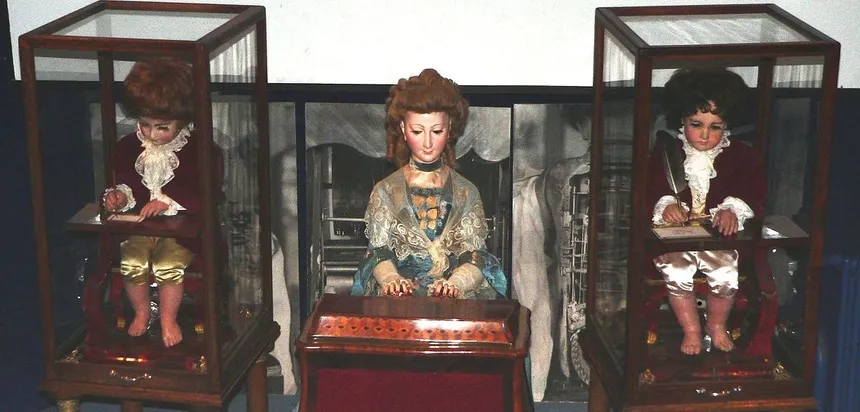
Jaquet-Droz, alongside his son Henri-Louis and assistant Jean-Frédéric Leschot, sought to push this art to its limits. Between 1768 and 1774, they produced three legendary automata that would define their legacy:
-
The Writer (or The Writing Boy)
-
The Draughtsman
-
The Musician
Of these, The Writing Boy was the most complex — and the most astonishing.
2. A Machine That Could Think? The Mechanism Behind The Writing Boy
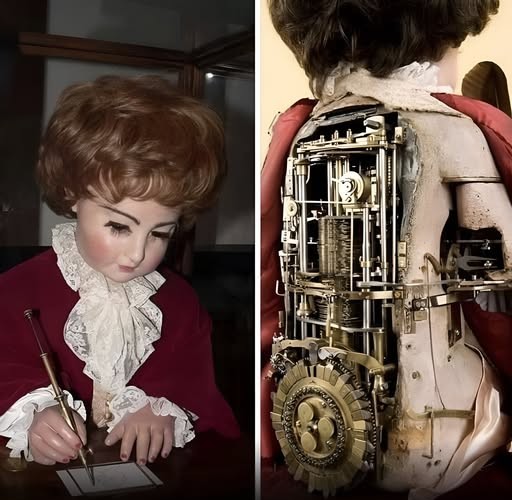
At first glance, The Writing Boy appeared as a charming doll — a young boy dressed in 18th-century attire, seated at a small desk with a quill in hand. But beneath the porcelain face and silk clothing lay an engineering marvel.
Inside its body were around 6,000 mechanical parts — an elaborate system of cams, gears, and levers that powered every movement. The key to its intelligence lay in a programmable cam disk hidden in its base.
This disk functioned like an early form of memory storage — the ancestor of modern programming. Each groove in the disk corresponded to a stroke of the pen, dictating the order, direction, and pressure of the quill’s movement.
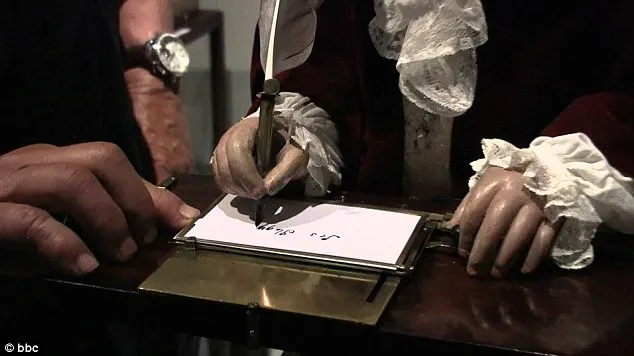
The Writing Boy could:
-
Dip its quill into ink, mimicking human behavior
-
Write up to 40 characters, arranged into custom sentences
-
Adjust stroke pressure, creating natural variations in handwriting
-
Blink and move its head, giving an illusion of concentration
Every aspect of the automaton was designed to imitate human intention — a concept revolutionary for its time.
3. The Debut: Astonishing the Courts of Europe
When Jaquet-Droz revealed The Writing Boy to the court of King Louis XVI of France, it caused an immediate sensation. The audience, including members of the French aristocracy, philosophers, and scientists, watched in awe as the automaton performed what seemed impossible — a machine that wrote as if it possessed thought.
In an era when mechanical wonders symbolized human reason and divine craftsmanship, The Writing Boy became an icon of Enlightenment ideals.
It wasn’t merely entertainment; it was a philosophical statement — proof that humans could replicate the functions of life through science and precision. Some viewers even felt uneasy, questioning whether such creations blurred the boundary between man, machine, and soul.
4. The Writing Boy and the Birth of Programming
What made The Writing Boy extraordinary wasn’t just its lifelike motion, but its programmability. By rearranging the cams on its disk, Jaquet-Droz could change what the automaton wrote — effectively “reprogramming” it.
This feature made The Writing Boy a mechanical precursor to modern computers. Like binary code in computing, the cam’s grooves represented stored information that could be read and executed by the machine’s mechanism.
Historians often compare The Writing Boy to Charles Babbage’s Analytical Engine or Ada Lovelace’s early algorithms, though it predated both by nearly a century. It proved that complex, conditional actions could be encoded into a mechanical system — an idea central to the development of robotics and digital logic.
5. A Masterpiece of Craftsmanship and Aesthetics
Beyond its scientific importance, The Writing Boy was also a work of art. Jaquet-Droz and his team were master watchmakers, and their obsession with beauty extended to every detail.
The boy’s porcelain face was painted with delicate lifelike expressions. His hair was real, his clothing hand-stitched from fine silk, and his movements — from dipping the quill to shaking off excess ink — were astonishingly natural.
Even the handwriting produced by the automaton had personality. Each letter curved with a sense of rhythm and variation, mimicking the imperfections that make human writing unique.
In a world without electricity, to achieve such grace purely through clockwork mechanics was nothing short of miraculous.
6. Legacy and Influence: From Automata to Artificial Intelligence
The Writing Boy and its companion automata — The Musician and The Draughtsman — toured across Europe, captivating audiences from London to Madrid. They were studied by scientists, admired by artists, and copied by craftsmen.
But their influence reached far beyond the 18th century. Modern historians and engineers view The Writing Boy as a direct ancestor of robotic automation. It demonstrated three key ideas that define today’s machines:
-
Programmability — the ability to store and execute a set of instructions
-
Precision engineering — mechanisms capable of reproducing fine motor skills
-
Human mimicry — machines designed to replicate natural behavior
These same principles underlie modern robotics, AI algorithms, and computer programming. In a sense, Jaquet-Droz anticipated the digital revolution by more than 200 years.
7. Where The Writing Boy Lives Today
Today, The Writing Boy still exists — remarkably intact — and continues to operate. It is housed in the Musée d’Art et d’Histoire in Neuchâtel, Switzerland, where it remains one of the most prized mechanical artifacts in the world.
Visitors can watch the automaton in motion as it gracefully dips its quill and writes out messages, just as it did nearly 250 years ago. The sound of its gears and springs is like a heartbeat — a mechanical rhythm echoing through centuries of innovation.
For modern engineers, The Writing Boy is not just an antique curiosity but a living testament to early robotics, proving that creativity and craftsmanship can transcend time.
8. The Human Dream of Creating Life
Beneath its brass and porcelain exterior, The Writing Boy embodies something deeply human — the desire to create life in our own image.
For Pierre Jaquet-Droz, building this automaton was more than mechanical artistry; it was a philosophical pursuit. Could a machine imitate thought? Could gears replicate intention? These questions would later define entire fields of science, from cybernetics to artificial intelligence.
Even today, as AI systems learn to write, paint, and converse, the same fascination that captivated 18th-century audiences continues to drive human innovation.
Conclusion: The Writing Boy’s Enduring Legacy
More than two centuries after its creation, Pierre Jaquet-Droz’s Writing Boy still captivates and inspires. It bridges the gap between the Enlightenment’s clockwork world and the digital age, reminding us that the roots of modern technology lie in humanity’s oldest dream — to build machines that reflect our intelligence, emotion, and imagination.
The Writing Boy is not just an automaton; it is a symbol of timeless creativity, a mechanical poem that continues to write the story of human progress.
ALSO READ: The Morbid Obsession of Carl Tanzler and Maria Elena de Hoyos: A Love Beyond the Grave