The “Melted” Stairs and Eternal Beauty of Ancient Egypt
A Temple Where Time and Stone Intertwine
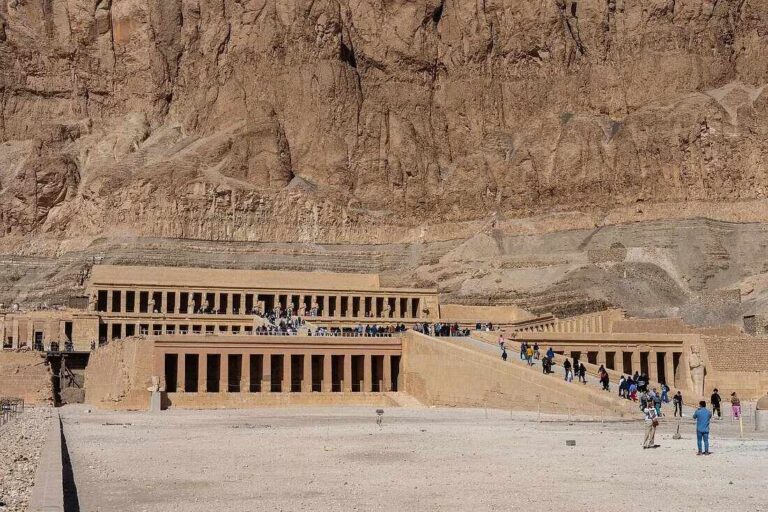
In the heart of Dendera, about 60 kilometers north of Luxor, stands one of the best-preserved and most enigmatic temples in all of Egypt — the Temple of Hathor. Dedicated to Hathor, the goddess of love, music, joy, and motherhood, the temple radiates divine harmony and architectural grandeur.
What makes the site particularly fascinating is its layered history — a sacred space continually rebuilt and expanded upon for over 2,000 years, from the Middle Kingdom (2030–1650 BC) through the Ptolemaic and Roman periods.
Visitors today are captivated not only by the temple’s stunning reliefs but also by the mysterious “melted” staircase, whose smooth, worn appearance seems to defy time and reason. Beneath its weathered surfaces lie centuries of ritual, symbolism, and artistic mastery.
1. The Sacred Site of Dendera: A Continuum of Worship
The Dendera complex has been a spiritual center since Egypt’s earliest dynasties. Archaeological evidence shows that a shrine dedicated to Hathor existed here as early as the Old Kingdom (around 2600 BC).
However, most of the visible temple today dates to the late Ptolemaic period, when Egypt was ruled by the Greek descendants of Ptolemy I, one of Alexander the Great’s generals. Construction began under Ptolemy XII Auletes (father of Cleopatra VII) around 54 BC and continued under Roman emperors such as Augustus and Tiberius.
This continuity of worship — Egyptian deities honored under Greek and Roman rulers — reflects the cultural synthesis of late ancient Egypt, where traditional religion persisted even as new influences arrived from the Mediterranean world.
2. Goddess Hathor: Lady of Love, Joy, and the Sky
To understand Dendera’s grandeur, one must understand Hathor herself. In Egyptian mythology, Hathor was one of the most beloved and widely worshipped deities. She embodied fertility, music, beauty, and maternal care.
Often depicted as a cow or a woman with cow horns holding the solar disk, Hathor symbolized the nurturing power of the sun and its life-giving warmth. She was also considered the celestial mother of Horus, linking her to kingship and divine renewal.
Dendera, her principal cult center, was believed to be the site of her annual reunion with Horus of Edfu, a symbolic marriage that renewed the cycles of fertility and cosmic harmony. These celebrations drew thousands of pilgrims, turning Dendera into a vibrant hub of devotion.
3. The Architecture of the Temple: Harmony in Stone
The Temple of Hathor is a masterpiece of Ptolemaic architecture, blending Egyptian tradition with Hellenistic precision. The main temple covers an area of about 40,000 square meters, surrounded by a massive mudbrick enclosure wall that once encompassed subsidiary chapels, shrines, and sacred lakes.
The hypostyle hall — the grand entrance chamber — is particularly awe-inspiring. Its 24 massive columns, each crowned with Hathor-headed capitals, support a ceiling filled with astronomical carvings depicting constellations, the zodiac, and scenes of the goddess Nut swallowing the sun each evening and birthing it at dawn.
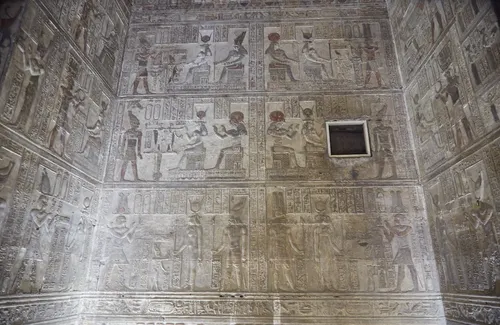
Despite centuries of soot accumulation, the vivid colors of the ceiling have survived beneath the dark surface. Restoration efforts have revealed shades of turquoise, gold, and lapis blue, illuminating a celestial map that once guided ancient priests in their rituals.
4. The “Melted” Staircases: Pathways of Ritual and Mystery
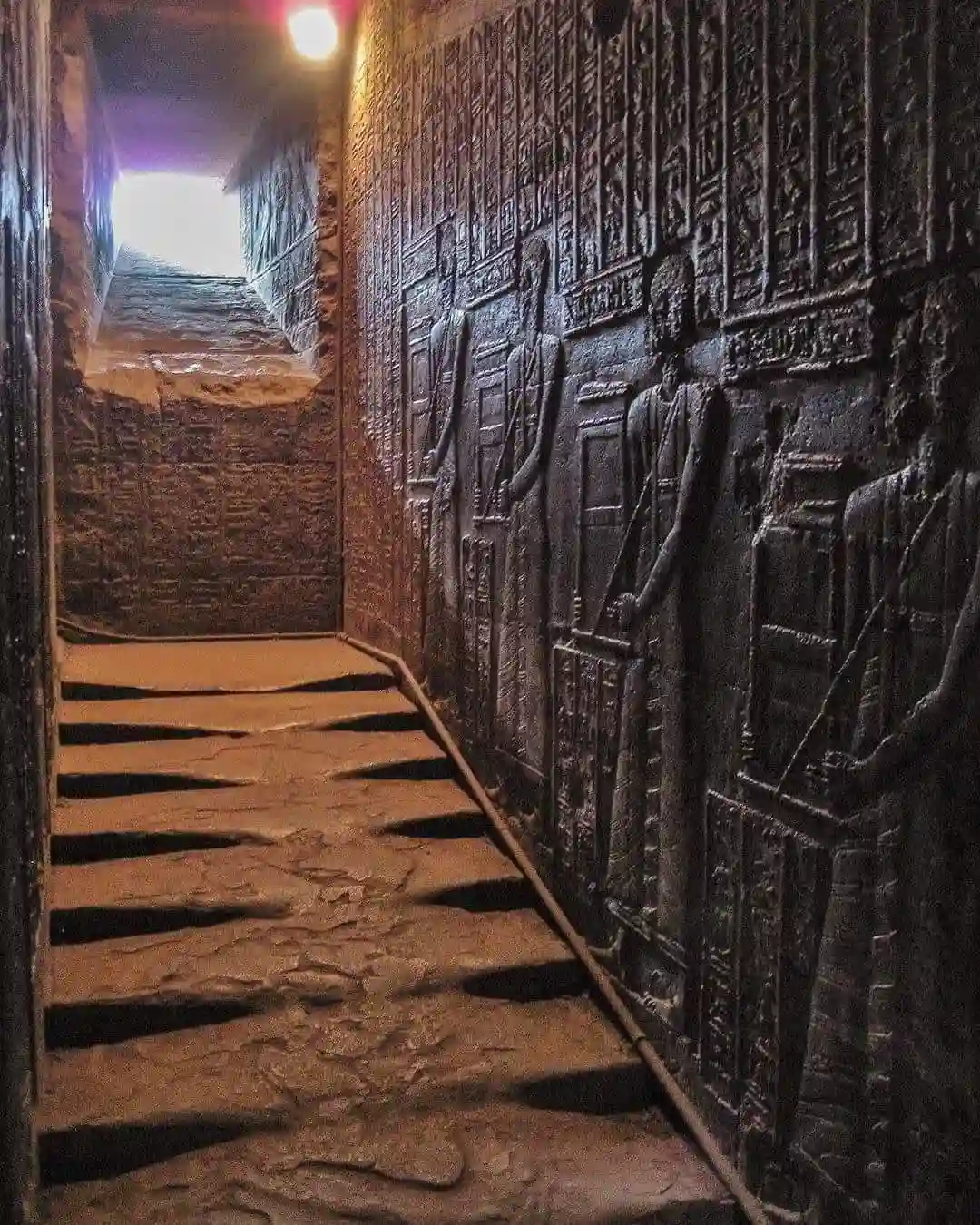
Among Dendera’s most intriguing features are the staircases that spiral to the temple roof. One of these stairways appears strangely “melted”, its steps smooth and uneven as if softened by heat.
While some speculate about mysterious causes — including theories involving ancient energy or lost technologies — archaeologists offer a more practical explanation: centuries of ritual use.
These staircases were part of an annual procession route. During sacred festivals, priests would ascend the stairs carrying statues of Hathor to the roof, where ceremonies honoring the solar rebirth were performed. The heavy foot traffic, combined with the friction of sand and time, gradually wore the stone smooth, creating the “melted” effect we see today.
Even so, standing within the narrow, dimly lit stairway, one cannot help but feel a sense of awe — as though walking through the footprints of countless ancient pilgrims ascending toward the heavens.
5. The Roof Reliefs: Star Maps and Celestial Visions
The rooftop sanctuaries of Dendera hold some of Egypt’s most extraordinary astronomical reliefs. The most famous is the Dendera Zodiac, a circular depiction of constellations and celestial deities that merges Egyptian cosmology with Greek astronomical concepts.
The original Dendera Zodiac now resides in the Louvre Museum in Paris, but a replica remains in its place at Dendera. Scholars interpret the carving as both an astrological calendar and a cosmic map, showing the intricate fusion of science and spirituality in the Ptolemaic worldview.
Nearby, other reliefs depict Hathor’s celestial barque, symbolizing her journey across the sky and through the underworld — a divine voyage echoed in Egyptian funerary beliefs.
6. Exquisite Reliefs and the Famous “Dendera Light”
Every wall of the Temple of Hathor bursts with hieroglyphic inscriptions and bas-reliefs. These scenes depict offerings to the gods, rituals of purification, and mythological narratives. Each meticulously carved and filled with symbolic meaning.
One chamber, in particular, has captured modern imagination: the crypt beneath the temple. Where a series of reliefs depict what appear to be elongated bulb-like shapes held by priests. This image, popularly dubbed the “Dendera Light”, has been interpreted by some as evidence of ancient electrical technology.
However, Egyptologists explain it as a symbolic depiction of creation. Showing the serpent (representing divine energy) emerging from the lotus flower (a symbol of rebirth) within the womb of the sky goddess Nut.
Regardless of interpretation, the reliefs continue to fascinate both scholars and visitors. Illustrating how art, religion, and mystery converged in Egyptian sacred spaces.
7. The Temple Through Time: Preservation and Rediscovery
Over millennia, sand, neglect, and time buried much of Dendera. It was rediscovered in the 19th century by French archaeologists, who marveled at its preservation. Unlike temples ravaged by floods or quarrying, Dendera’s remote location shielded it from extensive damage.
In the modern era, restoration projects led by the Egyptian Ministry of Antiquities have cleaned and stabilized the temple. The removal of soot and debris has revealed the original colors of its ceilings and columns. Offering a glimpse of how brilliantly painted and alive the temple once appeared.
Today, the Temple of Hathor stands not only as an archaeological wonder but also as a living museum. A window into the artistry, science, and devotion of ancient Egypt.
8. The Enduring Legacy of Dendera
Dendera’s Temple of Hathor embodies more than stone and sculpture — it reflects the endurance of human faith and creativity. Across dynasties, invasions, and cultural shifts, the temple remained a sacred sanctuary dedicated to joy, fertility, and cosmic order.
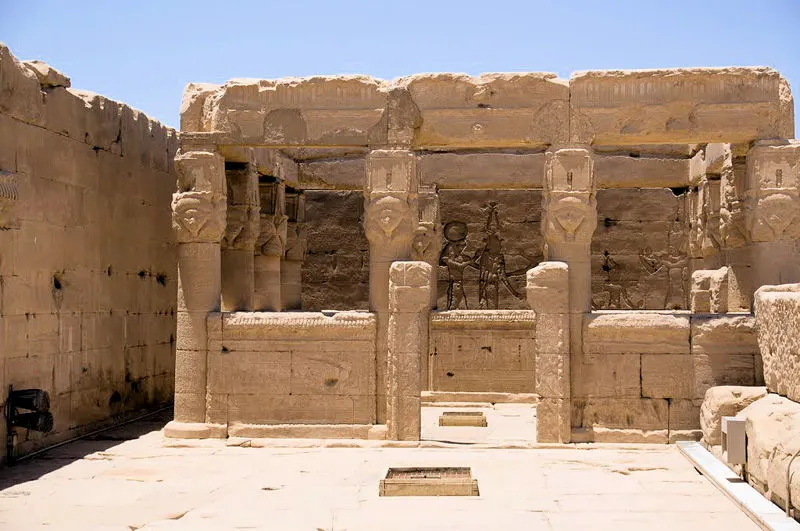
The site continues to inspire historians, architects, and spiritual seekers alike. For many, it represents the harmonious blend of Egyptian, Greek, and Roman influences. That defined Egypt’s last great era before Christianity transformed the ancient world.
Conclusion: Where Heaven Meets Earth
The Temple of Hathor in Dendera is a place where the divine and human realms intersect. Where stone staircases spiral toward the sky and celestial maps shimmer above mortal worshippers. Its “melted” stairs and intricate reliefs remind us that even as civilizations change. The human impulse to reach for the eternal remains.
As sunlight pours into its courtyards and touches carvings made over two millennia ago. The temple still sings Hathor’s timeless song — of beauty, music, and everlasting rebirth.
ALSO READ: The Enigmatic Symbols of La Pasiega: Decoding Ice Age Communication in Spain