The Enigmatic Symbols of La Pasiega: Decoding Ice Age Communication in Spain
Hidden Messages in Stone
Deep beneath the limestone hills of Cantabria, northern Spain, lies the Cave of La Pasiega—a prehistoric sanctuary that continues to challenge our understanding of human expression. While neighboring caves like Altamira are famed for their lifelike bison and horses, La Pasiega conceals something far more cryptic: a series of geometric markings and abstract symbols that predate written language by tens of thousands of years.
Dating between 22,000 and 18,000 years ago, these geometric figures stand apart from typical Ice Age depictions of animals. Their structured arrangement and deliberate repetition have fascinated archaeologists and linguists alike, suggesting that early humans might have used them not only for art but for symbolic communication — perhaps even an embryonic form of writing.
1. The Discovery of La Pasiega Cave
The Cave of La Pasiega was discovered in 1911 within the Monte Castillo cave complex near Puente Viesgo, an area rich in Paleolithic heritage. Early excavations by renowned prehistorian Henri Breuil, along with Hugo Obermaier and Hermilio Alcalde del Río, revealed extensive panels of figurative and non-figurative art across several chambers.
What caught Breuil’s attention, however, were not the majestic animal figures but the enigmatic linear patterns and grid-like shapes etched and painted on the walls. Unlike hunting scenes or animal depictions, these markings appeared systematic, as though they conveyed information understood by their creators.
Breuil famously described them as “a genuine inscription,” suggesting they might represent a proto-script — a primitive form of notation or symbolic record long before the invention of writing systems in Mesopotamia or Egypt.
2. The Geometric Markings: Patterns Beyond Art
The La Pasiega symbols are painted mostly in red ochre, with some examples engraved directly into the stone. They consist of:
-
Rectangular grids divided into smaller sections
-
Parallel lines and cross-hatching
-
Chevron and ladder-like designs
-
Dots, triangles, and abstract signs arranged in clusters
These motifs appear in specific sequences, often repeated across different walls of the cave, implying intentional design rather than random decoration.
Some of the most striking examples include a rectangular symbol divided into smaller compartments, almost resembling a modern chart or code. Others display rows of dashes or lines, reminiscent of counting or tally marks. Such visual consistency suggests a shared meaning or system, understood within the cultural context of Upper Paleolithic communities.
3. Symbolism in the Upper Paleolithic World
During the Upper Paleolithic period (roughly 40,000–10,000 BCE), Homo sapiens across Europe produced an astonishing variety of symbolic art — from the animal masterpieces of Lascaux to the mysterious Venus figurines of Central Europe.
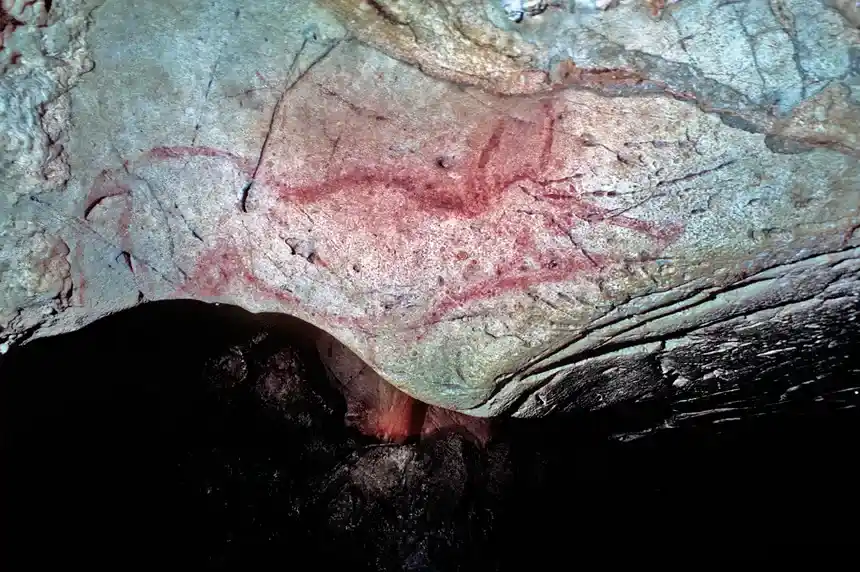
Yet, among these creations, abstract signs are relatively rare and often overshadowed by figurative art. At La Pasiega, however, the emphasis shifts. The geometric motifs dominate several panels, indicating that symbolic representation held a significant role in the lives of these Ice Age artists.
Anthropologists suggest that these signs might have been used for ritual, communication, or even early mnemonic systems — visual aids to record information such as seasonal cycles, migrations, or social events. In this sense, the markings may represent the earliest known form of information storage.
4. Early Theories: Breuil’s “Proto-Writing” Hypothesis
When Henri Breuil studied the La Pasiega panels in the early 20th century, he proposed that they could represent a “proto-writing” system — an early attempt at encoding meaning through standardized symbols.
Breuil’s theory, radical for its time, sparked debate within archaeological circles. Many scholars of the era dismissed the idea that Ice Age humans could produce anything resembling writing, arguing that true literacy emerged only with agriculture and complex states.
However, modern research has softened this skepticism. Advances in cognitive archaeology and discoveries of other symbolic sites — such as the Blombos Cave engravings in South Africa (c. 70,000 years ago) — show that symbolic thinking existed long before cities or written records. La Pasiega’s inscriptions fit within this broader pattern of early abstract cognition.
5. Modern Interpretations: Calendar, Code, or Communication?
In recent decades, new analytical techniques such as digital imaging, radiocarbon dating, and pattern analysis have reignited scholarly interest in La Pasiega’s markings. Researchers now propose several interpretations:
-
Lunar or Seasonal Calendar: The repetition of marks and dots might correspond to lunar phases or seasonal cycles important for hunting and migration.
-
Clan or Group Symbols: Certain patterns may have served as identity markers for social groups or families within the Paleolithic community.
-
Ritual or Spiritual Codes: The deliberate placement of the symbols near animal figures may indicate a spiritual link, connecting natural and supernatural realms.
-
Early Information Storage: Some archaeologists view the markings as a visual memory aid — a way to encode information about resources, territories, or events.
None of these interpretations are universally accepted, but all highlight the same point: La Pasiega reflects complex, abstract thought far beyond simple decoration.

6. The Broader Significance: Challenging the Timeline of Writing
If the La Pasiega symbols truly represent a form of symbolic notation, they dramatically challenge our timeline of human communication.
Traditional history places the invention of writing around 5,000 years ago, with the Sumerian cuneiform tablets and Egyptian hieroglyphs. Yet La Pasiega’s abstract symbols — painted 18,000 years earlier — suggest that the conceptual foundations of writing may stretch back to Ice Age hunter-gatherers.
This insight reshapes how we view prehistoric intelligence. Far from being primitive, these early humans displayed cognitive abilities comparable to our own, capable of abstraction, symbolism, and memory.
7. A Window into the Ice Age Mind
Standing in the dim light of La Pasiega, one can imagine the flicker of a torch illuminating the crimson grids on the cave wall. Each stroke of pigment was intentional, each line part of a message whose meaning has been lost to time.
Perhaps these symbols recorded stories of survival — the return of game herds, the passing of moons, or the memory of ancestors. Perhaps they were sacred marks, created as offerings to unseen forces. Whatever their purpose, they reveal a people who thought symbolically, who sought to communicate beyond words.
8. Preservation and Legacy
Today, the Cave of La Pasiega is a UNESCO World Heritage site, part of the Cave of Altamira and Paleolithic Cave Art of Northern Spain. Access is highly restricted to preserve the fragile pigments from humidity, light, and human interference.
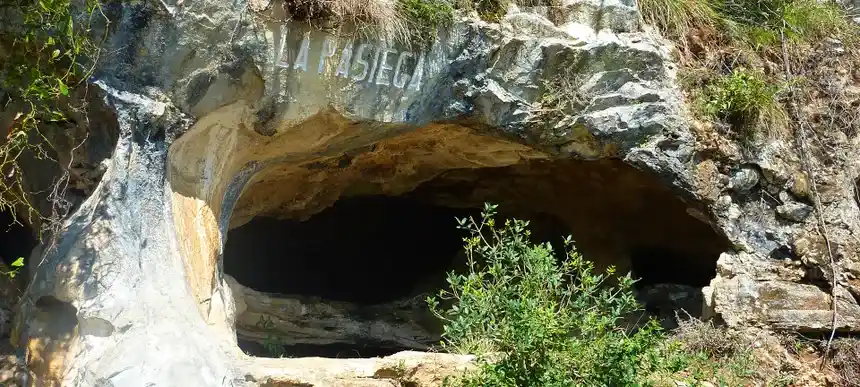
Modern technologies like 3D scanning and virtual modeling allow researchers and visitors alike to explore the site without physical intrusion. These digital reconstructions ensure that the enigmatic language of La Pasiega continues to inspire and educate future generations.
Conclusion: Echoes of the First Symbols
The geometric markings of La Pasiega Cave remind us that the human drive to communicate. To record, and to understand the world is ancient and universal. Long before alphabets and parchment, early humans were already encoding meaning in symbols. Using the walls of caves as their first pages.
Whether they represent a calendar, a code, or the earliest stirrings of written language. The La Pasiega cave symbols stand as a testament to the intellectual brilliance of our Ice Age ancestors. A whisper from prehistory telling us that the story of writing began not in cities. But in the silent depths of the earth.
ALSO READ: The Golden Leaf of Napoleon’s Coronation Crown: A Fragment of Imperial Glory👑