The Nimrud Lens: Ancient Assyrian Crystal That May Rewrite the History of Optics🔍
A Mysterious Crystal from Ancient Mesopotamia
In 1850, during an archaeological excavation at the ancient Assyrian city of Nimrud in present-day Iraq 🇮🇶, British archaeologist Sir Austen Henry Layard uncovered a curious object — a small, polished piece of rock crystal, unlike anything else found at the site.
This discovery, later known as the Nimrud Lens, would go on to puzzle historians, archaeologists, and scientists for over a century. Estimated to date back to around 750 BC, this lens-shaped artifact raises one of the most intriguing questions in ancient science:
👉 Did the Assyrians understand the principles of optics more than two thousand years before modern lenses were developed?
1. Discovery of the Nimrud Lens
The Nimrud Lens was unearthed in the North West Palace of Nimrud, once a grand Assyrian royal residence built under King Ashurnasirpal II. Layard discovered it among various luxury items — ivory carvings, jewelry, and glassware — suggesting it was a prized possession.
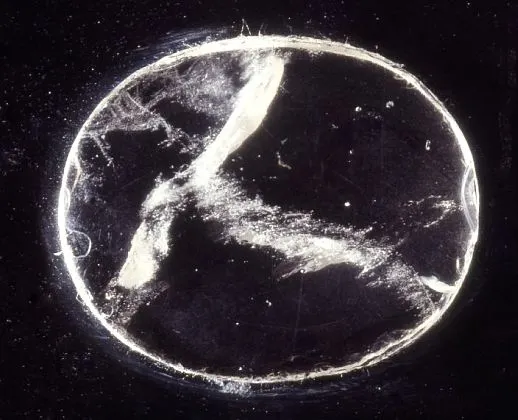
Now housed in the British Museum in London, the Nimrud Lens measures about 3.8 cm (1.5 inches) in diameter and is made of rock crystal (quartz). Its convex surface and roughly plano-convex shape immediately caught researchers’ attention.
Despite its small size, the artifact’s craftsmanship indicated deliberate design and potential function — possibly as an optical lens, making it one of the oldest known lenses in human history.
2. Description and Composition: The Craftsmanship of Ancient Optics
Under examination, the Nimrud Lens displays careful grinding and polishing, giving it a curved, convex surface similar to a modern magnifying lens. The opposite side, however, is somewhat irregular, suggesting it may have been shaped by hand rather than with mechanical tools.
Researchers using modern optical testing have determined that the lens has a focal length of around 11 cm (4.3 inches) — sufficient to magnify small objects or focus sunlight into a concentrated beam.
Its material, natural rock crystal (SiO₂), is both durable and transparent, capable of producing clear magnification. The craftsmanship demonstrates the technical skill and material knowledge of the ancient Assyrian artisans who worked it over 2,700 years ago.
3. Theories About Its Function
Since its discovery, the purpose of the Nimrud Lens has been a topic of passionate debate. Scholars have proposed several possible functions, each offering a glimpse into different aspects of ancient Assyrian science and daily life.
a) As a Magnifying Glass
The most widely accepted theory is that the Nimrud Lens was used as a magnifying tool. Ancient Assyrian craftsmen, especially jewelers and scribes, might have used it to assist with fine engraving, carving, or cuneiform writing on tablets and precious materials.
Given the intricate detail of Assyrian art, this practical application aligns with what we know about their high craftsmanship.
b) As a Burning Glass
Another possibility is that it served as a burning lens — focusing sunlight to create fire or to perform ritualistic acts. This would be similar to how ancient Greeks and Romans later used convex lenses to ignite flames for sacrifices or daily use.
c) As Part of an Early Optical Device
Perhaps the most controversial theory suggests that the Nimrud Lens might have been part of an early telescope or optical instrument. Italian scientist Giovanni Pettinato proposed that multiple lenses, when aligned properly, could have formed a primitive telescope — centuries before the invention of optical lenses in Renaissance Europe.
If true, this would radically shift our understanding of when humans first explored astronomical observation.
4. Astronomical Connections: Did the Assyrians Use It to Study the Stars?
The Assyrians were known for their advanced astronomical knowledge, meticulously recording celestial events such as eclipses, planetary movements, and star positions on clay tablets.
Some researchers argue that the Nimrud Lens could have been used to observe or project celestial images, aiding in their skywatching practices. Though no direct evidence of telescopic use has been confirmed, it’s clear that astronomy played a central role in Assyrian religion and governance.
If the lens had even a small optical purpose in this context, it might represent one of humanity’s earliest tools of scientific observation.
5. Alternative Views: Could It Have Been Decorative?
While the optical theories are captivating, not all scholars are convinced. Some suggest that the Nimrud Lens may have been merely decorative or symbolic, rather than functional.

Its irregular shape and imperfections might have limited its use as a precision optical device. It’s also possible that it was set into a piece of furniture, jewelry, or a ceremonial object, serving as a decorative inlay or “eye” motif — a common symbol in Mesopotamian art.
Even so, the deliberate shaping and polishing of the crystal imply that the Assyrians were experimenting with light and materials in ways not previously recognized.
6. Ancient Knowledge of Optics: A Broader Perspective
The Nimrud Lens is not the only ancient artifact suggesting early optical experimentation. Other examples include:
-
Egyptian polished quartz lenses (around 2500 BC).
-
Greek and Roman glass lenses, later used for vision correction.
-
The Burning Mirrors of Archimedes, which reportedly set enemy ships aflame using focused sunlight.
These discoveries collectively challenge the traditional narrative that optical science began in the Renaissance. Instead, they hint at a long and global history of experimentation with light, stretching back thousands of years.
7. Modern Research and Scientific Testing
Over the years, researchers have used microscopic analysis, optical refraction testing, and 3D imaging to better understand the Nimrud Lens’s design.
Results show that it does indeed magnify up to three times, though its optical quality is uneven. This supports the magnifying-glass hypothesis rather than the telescope theory.
Still, its existence continues to raise fascinating questions about technological innovation in the ancient world. Were the Assyrians aware of its magnifying ability, or did they stumble upon it accidentally through craftsmanship?
The mystery remains unsolved — and that’s what makes the Nimrud Lens so compelling.
8. The Nimrud Lens Today: A Window Into Ancient Ingenuity
Today, the Nimrud Lens is displayed in the British Museum’s Mesopotamian collection. Where it continues to intrigue visitors and researchers alike.
Its presence serves as a reminder of the depth and sophistication of ancient civilizations. Societies that not only mastered art and architecture but may also have delved into early forms of scientific discovery.

Whether it was used to carve intricate details, light sacred fires, or study the heavens. The Nimrud Lens remains a symbol of human curiosity — the timeless desire to see beyond the visible.
Conclusion: A Glimpse Through Time
The Nimrud Lens challenges us to rethink what we know about ancient innovation. More than a simple artifact, it represents the intersection of science, art, and mystery in one small crystal disc.
Perhaps it was a craftsman’s tool. Perhaps an astronomer’s aid. Or perhaps something more profound — an early expression of humanity’s endless quest to understand the world through observation and light.
Over 2,700 years later, as we gaze upon this tiny Assyrian crystal. We’re reminded that the pursuit of knowledge is as ancient as civilization itself.