The Walls of Thessaloniki: Guardians of the Byzantine Empire
The Eternal Guardians of Thessaloniki
The Walls of Thessaloniki (Greek: Τείχη της Θεσσαλονίκης, Teíchi tis Thessaloníkis) stand as one of the most iconic landmarks of Northern Greece. Stretching approximately 4 kilometers, these monumental fortifications surrounded the city from the Byzantine era until the late 19th century, when modernization efforts under Ottoman rule led to their partial demolition.
Once serving as the impenetrable shield of the city, these walls tell the story of Thessaloniki’s strategic importance, architectural evolution, and resilient spirit through centuries of conquest and cultural transformation. Recognized as part of the UNESCO World Heritage Site “Paleochristian and Byzantine Monuments of Thessaloniki” since 1988, the walls continue to captivate historians, travelers, and heritage enthusiasts alike.
Origins: The Foundation of a Fortress City
Thessaloniki’s fortifications trace their roots back to the Hellenistic era, shortly after the city’s foundation by Cassander of Macedon in the late 4th century BC. The city’s strategic location on the Thermaic Gulf, serving as a gateway between Europe and Asia, made it an essential hub for trade and military operations.
The first fortification walls were erected in the 3rd century BC, enclosing the city to protect against invasions. However, after the Roman conquest in 167 BC, Thessaloniki became a peaceful provincial capital under Roman rule, and its defensive structures gradually weakened due to neglect. By the 1st century AD, the ancient walls were already in disrepair, reflecting the long era of relative security under Roman Pax Romana.
Roman Reinforcements and Early Defensive Architecture
The peace of Rome did not last forever. During the 3rd century AD, the city faced new threats from Gothic invasions. To defend itself, Thessaloniki’s inhabitants rebuilt the fortifications using spolia—stones and materials from earlier constructions and temples.
These new Roman walls, dating around 254–268 AD, successfully repelled two major Gothic attacks. The structure, about 1.65 meters thick, featured square defensive towers placed at regular intervals. The city’s main thoroughfare (Mesi or Leoforos) connected the Golden Gate (Porta Aurea) on the west (today’s Vardaris Square) to the Cassandreot Gate on the east. The southern wall ran slightly south of present-day Tsimiski Avenue, marking the city’s ancient coastline.
The Byzantine Transformation: Strengthening the Walls
When Emperor Galerius and Constantine the Great passed through Thessaloniki in the early 4th century, they recognized the city’s growing political and strategic importance. Significant improvements were made to its fortifications during this time.
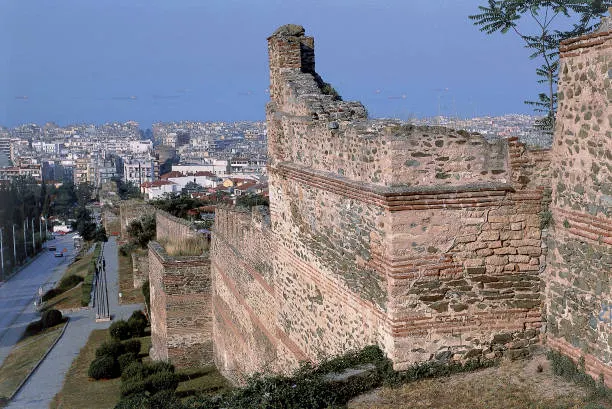
By the end of the 4th century, Thessaloniki witnessed the construction of a new outer wall with triangular projections, expanding the city’s defenses and enclosing additional residential and commercial areas. This early Byzantine wall, dating between 390–450 AD, forms the basis of much of what survives today.
The structure exemplifies late Roman-Byzantine mixed construction techniques—alternating layers of ashlar masonry and brick bands, designed for strength and flexibility during sieges and earthquakes.
The Acropolis and the Heptapyrgion Fortress
At the northernmost part of the walls stands the acropolis of Thessaloniki, a fortified enclave that served as the final defensive refuge during attacks. Within this enclosure lies the Heptapyrgion (Seven Towers) fortress, known in Ottoman times as Yedi Kule.
Originally built during the Byzantine era, the Heptapyrgion was later reconstructed and expanded by the Ottomans. It served variously as a military stronghold, governor’s residence, and eventually, a prison well into the 20th century. Today, it is one of the most imposing and best-preserved sections of Thessaloniki’s medieval fortifications, offering panoramic views of the modern city and the Aegean Sea.
Defensive Upgrades and Medieval Threats
Thessaloniki’s fortifications evolved in response to successive waves of invaders. In the 7th century, during the reign of Heraclius, further improvements were made to strengthen the city against the Avars and Slavs. The towers were heightened, gates were reinforced, and the acropolis became a key point of refuge.
Despite these efforts, the city was not invincible. In 904 AD, Saracen pirates launched a devastating attack from the sea, capturing and plundering Thessaloniki. The tragedy revealed the vulnerabilities of the sea-facing walls, prompting the Byzantines to reinforce them extensively afterward. These new maritime defenses ensured better protection of the port and the southern perimeter.
Ottoman Modifications and Urban Transformation
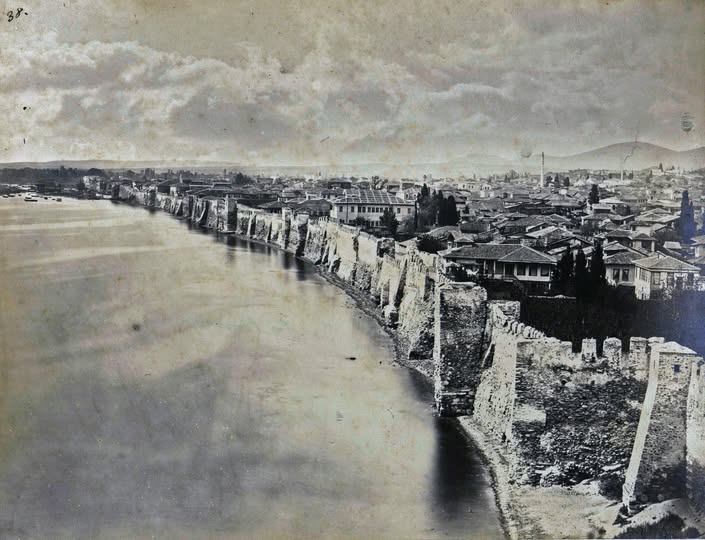
After the Ottoman conquest of Thessaloniki in 1430, the walls continued to serve military and administrative purposes. The Ottomans maintained the acropolis and Heptapyrgion as key defensive outposts and prisons. However, as the city expanded and modernized during the 19th century, large portions of the walls were deemed obstacles to urban growth.
In the late 1800s, under Ottoman urban reforms, the entire seaward section of the walls was demolished to open the city toward the sea and facilitate trade and movement. This marked the end of Thessaloniki as a walled city, though the surviving northern and eastern sections remain remarkably intact.
Architectural Features and Construction Techniques
The Walls of Thessaloniki exemplify the engineering sophistication of Byzantine architecture. Built primarily from stone and brick, they feature alternating courses of materials that provided both stability and aesthetic rhythm.
The walls reach an average height of 10–12 meters and thickness of 4.5 meters at the base. Towers, spaced at intervals of 50–100 meters, provided vantage points for defense and communication. Some sections still bear inscriptions and symbols marking phases of repair or imperial sponsorship.
The surviving portions around the Ano Poli (Upper Town) and the Eptapyrgio area remain the best preserved, showcasing the continuity of construction styles from Late Antiquity through the Ottoman period.
UNESCO Recognition and Modern Preservation
In 1988, the Walls of Thessaloniki were inscribed on the UNESCO World Heritage List as part of the “Paleochristian and Byzantine Monuments of Thessaloniki.” The listing acknowledges their outstanding universal value as a testament to Byzantine military architecture and urban planning.
Today, the Greek Ministry of Culture and local authorities actively maintain and restore surviving sections, ensuring their preservation for future generations. Guided tours, interpretive signage, and educational programs help visitors connect with the city’s layered past.
Visiting the Walls Today
Modern visitors can explore several accessible sections of the walls, especially in the Ano Poli (Upper Town) district. The climb rewards travelers with sweeping views of modern Thessaloniki, the Thermaic Gulf, and Mount Olympus in the distance.
Highlights include:
-
Heptapyrgion Fortress (Yedi Kule) – offering panoramic views and historical exhibitions.
-
Trigonion Tower – one of the best-preserved towers, symbolizing the city’s endurance.
-
Portara Gate and Eptapyrgio Walls – picturesque remains integrated into the modern cityscape.
Conclusion: A Living Chronicle of Thessaloniki’s Soul
The Walls of Thessaloniki are more than mere stone fortifications. They are living chronicles of a city that has stood at the crossroads of empires, faiths, and civilizations. From Hellenistic foundations to Byzantine glory and Ottoman transformation, these walls encapsulate over 1,600 years of history.
Today, as they overlook a vibrant, modern metropolis. The ancient walls remain silent witnesses to Thessaloniki’s enduring strength, cultural depth, and eternal charm.
ALSO READ: Childhood in Ancient Greece: Insights from the Kylix and Athenian Agora Potty