Why the Sunghir Paleolithic Burial Site Is So Strange
About 34,000 years ago, a community of hunter-gatherers in the Russian plains began burying their dead in ways that still mystify archaeologists today. The Sunghir Paleolithic burial site, located about 200 kilometers east of Moscow, is one of the most iconic Upper Paleolithic archaeological sites in Europe.
Discovered in 1955 and excavated between 1957 and 1977, the site preserves a wide range of mortuary behaviors that show just how complex and symbolic early human societies were. From graves filled with thousands of beads and ivory spears to skeletal remains scattered or deposited in unusual ways, Sunghir challenges our understanding of how early Homo sapiens viewed death, status, and ritual.
The Discovery of Sunghir
From Quarry to Iconic Archaeological Site
Sunghir came to light during quarrying operations in 1955. Over the next two decades, excavations uncovered remains dating back 30,000–34,000 years, placing the site firmly within the Upper Paleolithic period.
A Site of Many Burials
At least 10 individuals were buried at Sunghir, though some remains have since been lost. The most famous graves include:
-
An adult male covered in thousands of beads.
-
A double burial of two young individuals, placed head-to-head with extravagant grave goods.
-
Isolated bones, such as femurs and a cranium, deposited in unusual ritual contexts.
The Lavish Adult Burial
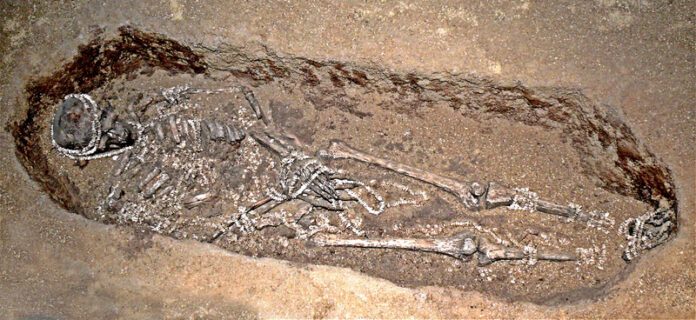
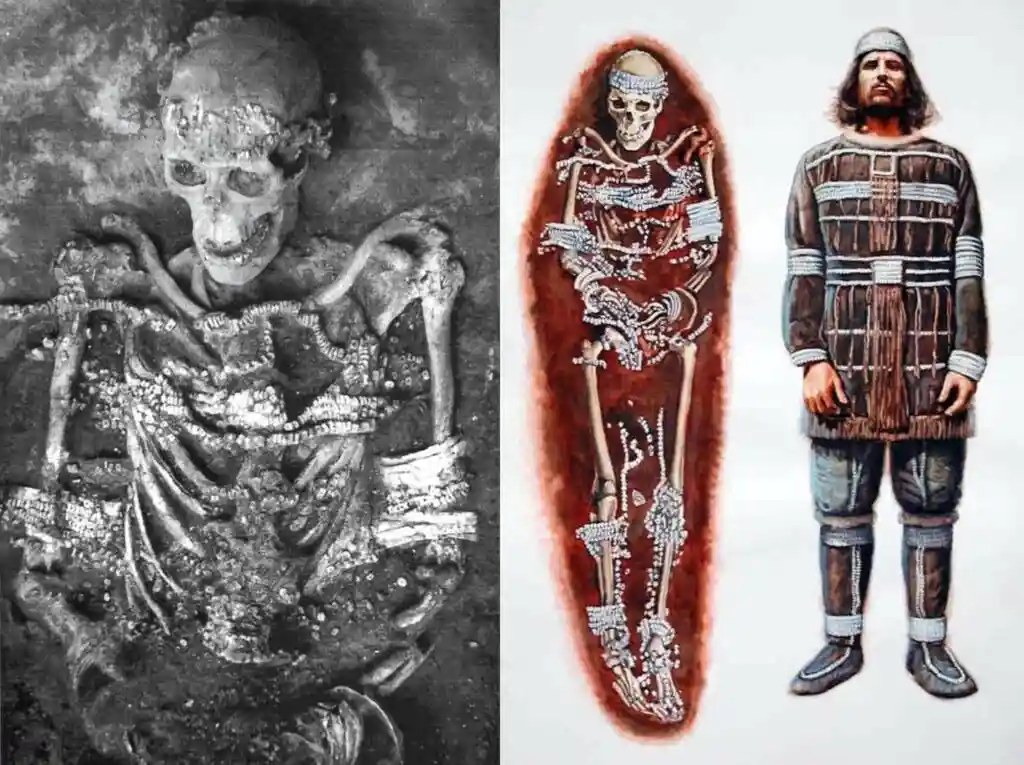
The most striking individual at Sunghir is a 35- to 45-year-old man, whose body was covered in red ochre and adorned with around 3,000 mammoth ivory beads.
Grave Goods and Symbolism
The man’s grave included:
-
Pierced fox canines, worn as ornaments.
-
Ivory armbands and decorative disks.
-
Carefully crafted personal adornments that must have taken years to create.
Bioarchaeological analysis suggests he may have died suddenly from a neck incision, a fact that adds to the mystery of why he was honored with such an elaborate burial.
The Double Burial of Two Children
Head-to-Head Interment
The grave of a juvenile (~10 years old) and an adolescent (~12 years old) is perhaps the most fascinating of all. The children were placed head to head, surrounded by ochre and grave goods of extraordinary value.
Valuable Ivory Spears
Among the items buried with them were carefully manufactured mammoth ivory spears. These would have taken immense effort and skill to produce, and their placement with children suggests they were symbolic rather than utilitarian.
Other Grave Goods
Additional objects included:
-
Ivory disks
-
Pierced cervid antlers
-
Thousands of decorative beads
Diversity of Mortuary Behaviors
What makes Sunghir so unusual is not just the lavishness of its graves but the variety of burial practices represented.
Isolated Human Remains
-
A femur shaft was placed in the children’s grave.
-
Another femur was found nearby, with signs that the body had been left exposed.
-
A cranium, discovered in 1964, was placed with artifacts above the adult’s burial.
Different Burial Types
Archaeologists conclude that at least three forms of burials took place at Sunghir:
-
Lavish graves with beads, ivory, and ochre.
-
Partial burials, where isolated bones were intentionally deposited.
-
Abandoned remains, left on the surface without formal treatment.
Social Structure and Status
Not Status Through Achievement
The striking difference between elaborate and minimal burials suggests that status was an important factor in this community. However, the children’s burial indicates they could not have earned their position through achievement or accumulated wealth.
Disabilities and Special Treatment
Both children may have suffered from visible physical abnormalities. Some archaeologists argue their differences gave them special social significance, which was reflected in their burial treatment.
Pathology and Ritual
This interpretation fits a broader pattern across Upper Paleolithic Europe, where individuals with pathological traits often received unusual burials. These practices may reflect early notions of sacredness, uniqueness, or symbolic roles within society.
Archaeological Interpretations
Complexity of Belief
Archaeologists such as Natasha Reynolds emphasize that Sunghir represents the earliest elaborate Homo sapiens burials in Europe, showing that our ancestors held complex worldviews about death and ritual.
Social Differentiation
According to Erik Trinkaus, lead author of a major study on Sunghir, the site brings together diverse mortuary behaviors seen across Europe during this time, all concentrated in one place.
Ritual Acts, Not Norms
Other scholars, like Paul Pettitt, caution that these elaborate burials should not be seen as typical. Instead, they may represent rare ritual acts performed for individuals who were socially distinct.
The Significance of Sunghir
Earliest Evidence of Social Complexity
Sunghir is one of the earliest burial sites in Europe to show evidence of a social structure not solely based on individual achievement.
Symbolism of Beads and Ochre
The thousands of beads, the ochre, and the carefully crafted grave goods all point to symbolic meaning, possibly linked to ideas of identity, spirituality, and the afterlife.
Testament to Humanity
The site provides a powerful testament to the complexity and humanity of our ancestors, suggesting they had rich symbolic traditions and complex social hierarchies far earlier than once believed.
Conclusion
The Sunghir Paleolithic burial site stands as one of the most fascinating windows into the social and spiritual lives of our early ancestors. With its mix of lavish graves, isolated remains, and symbolic objects, Sunghir reveals a community grappling with ideas of death, status, and ritual meaning more than 30,000 years ago.
At Sunghir, people created exceptional burials and diverse rituals, honoring children with disabilities with treasures and adorning adults with thousands of beads. Its mysteries continue to challenge archaeologists, reshaping our understanding of Upper Paleolithic societies and the origins of human symbolic behavior.
ALSO READ: The Northern Wei Dynasty Sakyamuni Statue of Yecheng: A Hidden Treasure of Buddhist Art