Mystical Monuments: Seahenge and Holme’s Ritual Battle Against a 4,000-Year-Old Cold Spell 🪵❄️
A Window Into Prehistoric Britain
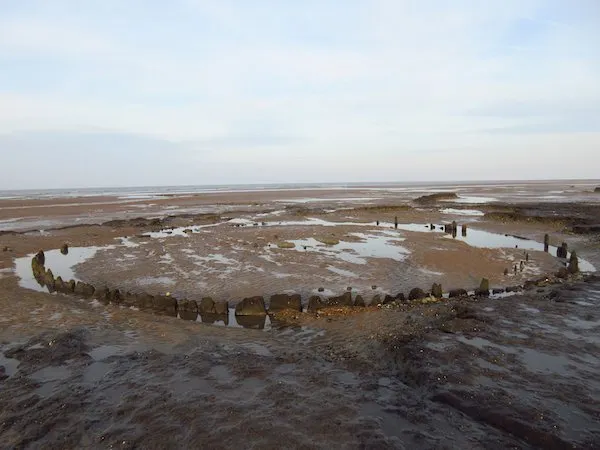
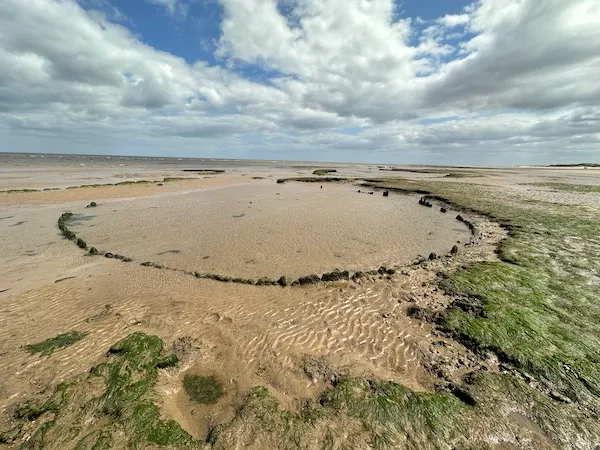
On the windswept coast of Norfolk, England, archaeologists uncovered two of the most enigmatic prehistoric monuments ever found—Seahenge and Holme II. Constructed around 2049 B.C. during the Early Bronze Age, these timber circles were revealed by shifting sands and tidal erosion in the late 20th century.
Unlike the monumental stone circles of Stonehenge and Avebury, these sacred spaces were built from oak, their very wood bearing marks of ancient tools and deliberate ritual. Archaeological research now suggests that Seahenge and its neighbor Holme II were ritual responses to a period of severe climatic upheaval—a cold spell marked by harsh winters and delayed springs.
Their discovery not only opened a new chapter in prehistoric archaeology but also highlighted humanity’s timeless struggle to cope with environmental crises through belief, ceremony, and monumental construction.
What Is Seahenge?
A Timber Circle Lost to the Sea
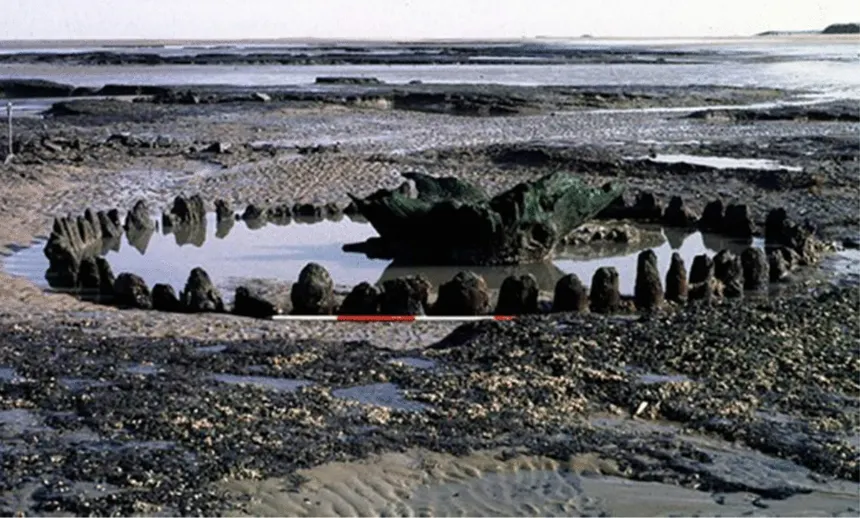
Seahenge, first uncovered in 1998, is a circular timber monument built from 55 split oak posts set upright in the sand. At its center stood a dramatic upturned tree stump, roots raised like grasping arms toward the sky. Measuring about 7 meters across, the structure was enclosed tightly, with only a narrow entranceway.
The monument quickly captured the public imagination, sparking debates about its purpose. Was it a shrine? A mortuary enclosure? A calendar? Today, most scholars agree that Seahenge held profound ritual significance, deeply tied to its time of construction.
Holme II: The Forgotten Twin
Just 100 meters away, archaeologists uncovered a second, lesser-known circle: Holme II. Built around the same time as Seahenge, this timber circle also consisted of oak posts but lacked the central upturned stump. Instead, evidence suggests it may have been used for burial rituals, as fragments of cremated human remains were found within its structure.
Together, Seahenge and Holme II represent a rare and extraordinary pair of monuments—built by the same community, during the same season, likely serving connected but distinct ritual functions.
Climate Crisis in the Bronze Age
The Harsh Winters of 2049 B.C.
Dendrochronology (tree-ring dating) of the timbers revealed something remarkable: the oaks used to build Seahenge and Holme II were felled during the spring of 2049 B.C. The growth rings of these trees show signs of environmental stress—thin bands indicating unusually cold conditions and delayed growing seasons.
This aligns with broader evidence of a climatic downturn in northern Europe around that time, possibly caused by volcanic eruptions or solar cycles. Communities faced longer winters, late springs, and the constant threat of famine.
Ritual Responses to Survival
In this context, Seahenge and Holme II may have been ritual attempts to restore balance to nature. The upturned tree stump at Seahenge, for instance, has been interpreted as a symbolic “portal,” representing the inversion of the natural order. Ceremonies within the circle may have been designed to summon warmth, fertility, and the return of spring.
Holme II, with its connections to burial and the ancestors, may have served as a complementary site, linking the living with the spirits of the dead in an appeal for cosmic intervention.
Rituals, Symbolism, and Spiritual Meaning
The Upturned Stump as a Cosmic Axis
The central feature of Seahenge—the inverted oak stump—remains one of the most haunting elements of the site. Scholars suggest it may have symbolized the axis mundi, a world-tree connecting the realms of earth, sky, and underworld. By inverting it, the builders may have sought to reverse the unnatural cold. Turning the natural order upside down to bring balance once more.
Seasonal Ceremonies
The alignment of the circle and the seasonal timing of its construction suggest Seahenge was linked to rituals of death and rebirth, themes common across prehistoric societies. Just as winter gave way to spring, so too did ritual practices aim to renew life from hardship.
Ancestors and Divine Forces
Holme II’s cremated remains point to the role of ancestor veneration in these ceremonies. Ancient communities may have believed that invoking the dead could influence the natural world, bridging the human and divine realms to secure survival.
Archaeological Discovery and Preservation
Unearthed by the Sea
Tidal sands concealed Seahenge and Holme II for nearly four millennia until coastal erosion revealed them in the 1990s. Their discovery sparked both excitement and controversy, as archaeologists removed the fragile timbers for preservation.
Conservation Efforts
Today, Seahenge’s timbers are preserved and displayed at the Lynn Museum in King’s Lynn, Norfolk. Where visitors can experience the circle reconstructed within a museum setting. This preservation effort ensures the delicate wood, once exposed to saltwater, survives for future generations.
Holme II’s remains were less complete. But the information gleaned from them has been invaluable in understanding the broader ritual landscape.
Seahenge and Holme II vs. Stonehenge
While comparisons to Stonehenge are inevitable, Seahenge and Holme II are fundamentally different in scale, material, and function.
-
Stonehenge is monumental, enduring, and aligned with celestial events.
-
Seahenge is intimate, impermanent, and deeply tied to seasonal survival rituals.
Both, however, reveal the profound importance of ritual landscapes in Bronze Age Britain and humanity’s constant efforts to connect with cosmic forces.
Lessons from the Ancient Timber Circles
Seahenge and Holme II are more than archaeological curiosities. They teach us:
-
Human resilience – Ancient people faced climate crises with creativity and ritual.
-
Spiritual ingenuity – Communities turned to ceremony as a way of seeking control over uncontrollable forces.
-
Fragility of heritage – The sea would have swallowed these wooden monuments forever without preservation.
Conclusion: Rituals Written in Timber
Seahenge and Holme II remain some of the most mysterious and moving monuments of prehistoric Britain. Constructed during a time of crisis, they stand as timber testaments to human hope, spirituality, and survival.
As the tides continue to shift along England’s eastern coast. These monuments remind us that humanity has always grappled with the challenges of nature. Sometimes through technology, sometimes through belief, and often through the creation of monuments that bridge the earthly and the divine.
In their weathered timbers, we glimpse a world where ritual was survival. Where every circle carried cosmic meaning, and where communities looked to the gods, their ancestors, and the very order of the universe to bring back the warmth of spring.
ALSO READ: Goblin Valley State Park: The Timeless Hoodoos of Utah’s Desert Garden 🏜️🪨