The Mold Gold Cape: A Masterpiece of Bronze Age Craftsmanship
The Mold Gold Cape
Among the treasures of prehistoric Europe, few artifacts rival the Mold Gold Cape in beauty, craftsmanship, and historical importance. Discovered in 1833 in Mold, Flintshire, Wales, this remarkable piece dates back to approximately 1900–1600 BCE, during the Early Bronze Age. Fashioned from a single sheet of gold, the cape demonstrates not only technical mastery but also the profound symbolic power that gold carried in ancient societies.
Although its form resembles armor, the cape was never intended for protection in battle. Instead, its rigidity and ornate design point to a ceremonial role—an object worn by leaders, priests, or figures of divine authority to project power, prestige, and sacredness.
Discovery in Mold, Flintshire
The cape was uncovered in 1833 by workmen quarrying for stone at a burial mound known locally as Bryn yr Ellyllon, or “Fairy Hill.” Alongside the cape, archaeologists later recorded the remains of human bones, amber beads, and fragments of bronze, suggesting a high-status burial. Unfortunately, much of the cape was damaged during the discovery, as it was not immediately recognized as an artifact of immense significance.
Today, the restored Mold Gold Cape is preserved at the British Museum, where it continues to attract scholars and visitors fascinated by its enigmatic history.
Craftsmanship and Technique
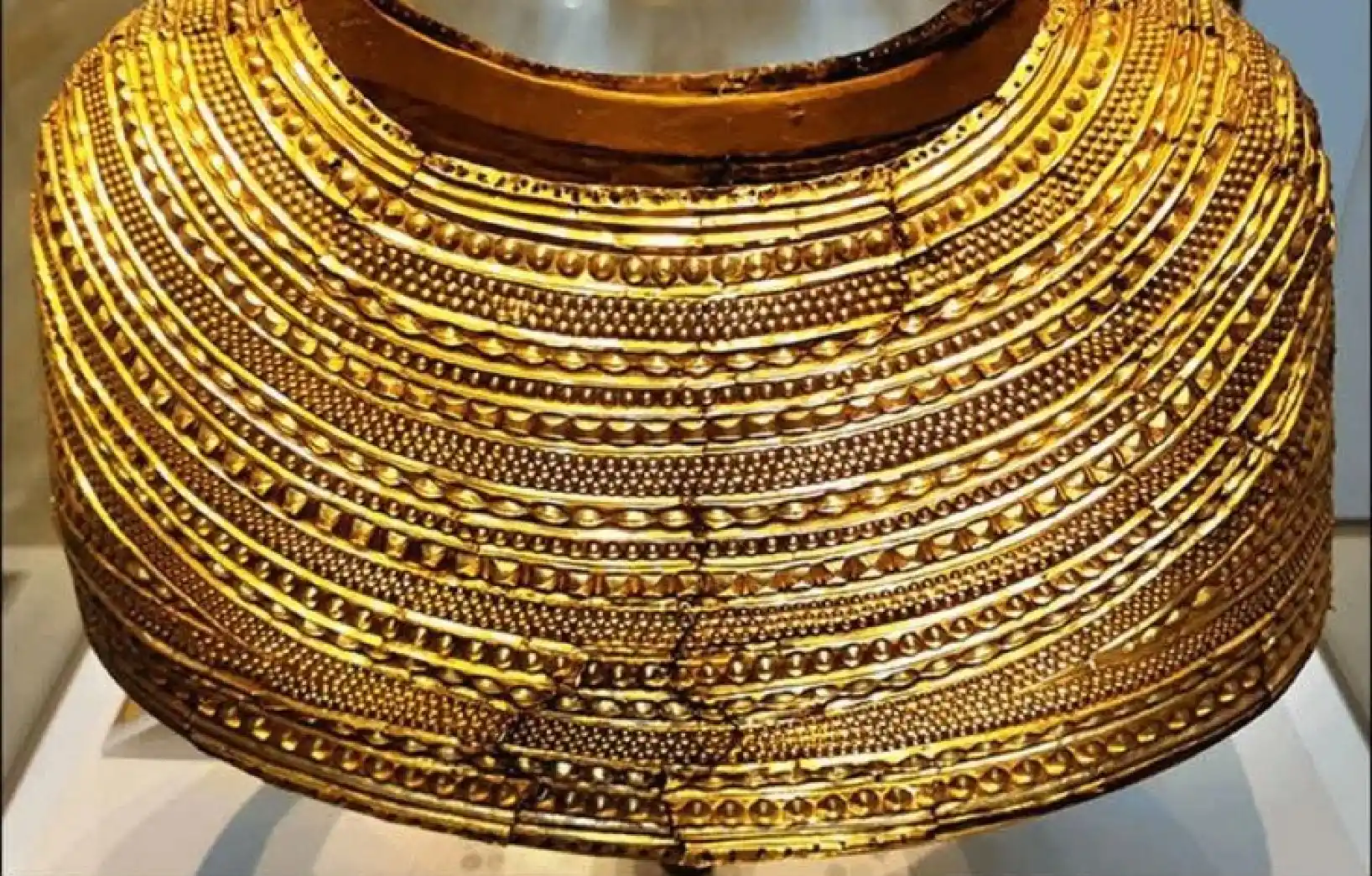
One of the most striking aspects of the Mold Gold Cape is its extraordinary craftsmanship. Created from a single gold ingot hammered into a thin sheet, the cape was meticulously shaped to cover the shoulders, chest, and upper back.
The decoration was achieved through a process called repoussé, where patterns are hammered from the reverse side to create raised designs. The cape features rows of intricate motifs—semi-circles, chevrons, and ridges—that give the surface a textured, shimmering quality.
Goldsmiths of the Early Bronze Age had no advanced tools, yet they were able to produce a piece of stunning complexity and durability. This reflects not only their technical skill but also the immense value placed on artistry, symbolism, and ritual display.
Symbolism and Ceremonial Role
The Mold Gold Cape was never a practical garment. Its rigid shape would have restricted arm movement, making it impossible to wear during everyday activities. Instead, scholars believe it functioned as a ritual object—a garment of authority worn during ceremonies or funerary rites.
The cape’s brilliance and restrictive form likely emphasized transformation. When worn, it would have turned the individual into a radiant, almost otherworldly figure, embodying divine or cosmic power. In this way, the cape acted as both armor of light and a symbol of sacred authority, reinforcing social and spiritual hierarchies within Bronze Age communities.

Gold in the Bronze Age
Gold was exceedingly rare during the Early Bronze Age, and its luminous quality was often associated with the sun, the divine, and immortality. Unlike bronze or stone, gold does not tarnish, making it a natural metaphor for eternal life and cosmic order.
The Mold Gold Cape demonstrates how communities invested immense resources into ritual objects that embodied status, spirituality, and continuity with the divine. Its creation would have required not just wealth but also the mobilization of skilled artisans and social networks capable of acquiring gold.
A Window into Prehistoric Society
The Mold Gold Cape provides insight into the social and religious structures of Bronze Age Europe. The fact that it was buried with a high-status individual suggests it was tied to elite identity, leadership, or priesthood.
Its ceremonial purpose points to a society in which ritual performance and symbolism played central roles. Rather than viewing the cape merely as an accessory, it should be understood as a statement of power and an embodiment of belief systems that linked humans with the divine order.
Comparisons with Other European Goldwork
While prehistoric gold artifacts have been discovered across Europe, the Mold Gold Cape remains unique. Its form, decoration, and ceremonial purpose distinguish it from other finds such as torcs, lunulae, or burial ornaments.
Most Bronze Age gold items were smaller, portable, and personal. The cape’s scale and intricacy reveal an exceptional level of ambition, suggesting. It was a prestige item without equal in its time. This makes it one of the finest surviving examples of prehistoric goldworking.
The Mold Gold Cape Today
Now housed in the British Museum in London. The Mold Gold Cape is considered one of the institution’s most iconic treasures. It has also returned to Wales for temporary exhibitions. Where it draws thousands of visitors eager to connect with their heritage.
For archaeologists, historians, and visitors alike, the cape continues to inspire fascination. It is a tangible reminder that Bronze Age communities were not only skilled artisans. But also complex societies deeply invested in ritual, symbolism, and expressions of identity.
Cultural Legacy and Modern Significance
The Mold Gold Cape has transcended its ancient origins to become a symbol of Welsh heritage and European prehistory. Its shimmering design continues to inspire modern artists, jewelers, and cultural storytellers who reinterpret its meaning for contemporary audiences.
Beyond aesthetics, the cape serves as a reminder of the enduring human desire to express identity, authority, and spirituality through material culture. Just as it transformed its Bronze Age wearer into a figure of radiance. It now illuminates our understanding of the past, linking us to a tradition of beauty, ritual, and sacred expression.
Conclusion
The Mold Gold Cape is far more than a beautiful artifact. It is a masterpiece of prehistoric craftsmanship. A symbol of ritual and authority, and a window into the beliefs of Bronze Age Europe. Crafted nearly 4,000 years ago from a single sheet of gold. It continues to captivate modern audiences with its brilliance and mystery.
As we gaze upon its gleaming surface today. We are reminded of the universality of human creativity and the timeless connection between beauty, power, and the sacred. The Mold Gold Cape stands as one of the most extraordinary survivals of Europe’s ancient past. A treasure that will continue to inspire wonder for generations to come.
ALSO READ: