Silver Roman Ring with Agate Intaglio: Two Fishes and an Anchor from Vinovia
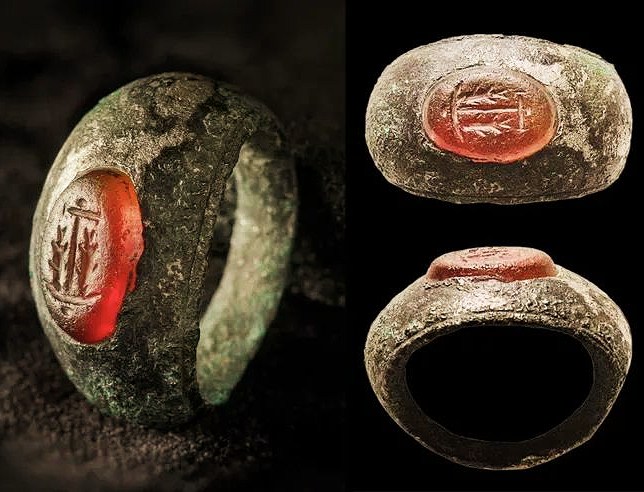
In 2014, archaeologists excavating the ruins of the Roman fort of Vinovia (modern Binchester) in County Durham, England, uncovered a remarkable piece of personal adornment: a Silver Roman ring set with an agate intaglio. The gemstone features a finely carved design of two fishes hanging from an anchor, a motif that resonates with layers of symbolic meaning in the Roman world.
Dating to the 3rd century AD, the ring is not only a stunning example of Roman craftsmanship but also a window into the cultural, spiritual, and personal lives of those who lived in Roman Britain nearly 1,800 years ago.
The Discovery at Vinovia
The Roman fort of Vinovia (Binchester) was established around AD 79 as part of Rome’s northern frontier defenses. It guarded the crossing of the River Wear and served as an important military outpost for centuries.
During excavations in 2014, archaeologists unearthed a small but significant treasure among the ruins: the silver ring with an agate intaglio. The find sparked interest not only among specialists but also the general public, as it combined artistic beauty with deep symbolic associations.
The discovery reflects the personal belongings of Roman soldiers and civilians, offering rare insight into the intimate aspects of life in Roman Britain.
Description of the Ring
The ring is made of silver, a precious metal valued both for its beauty and durability. Its centerpiece is an oval agate gemstone engraved with an intaglio—a design cut into the stone’s surface, rather than raised.
The intaglio depicts:
-
Two fishes, delicately carved, suspended from
-
An anchor, the central motif binding the composition.
The craftsmanship demonstrates the skill of Roman gem engravers, who used fine tools and abrasive powders to achieve remarkable detail on hard stones like agate.
Symbolism of the Fishes and Anchor
The imagery of fishes and an anchor carries multiple layers of meaning in Roman art and symbolism.
1. Marine and Nautical Significance
The Roman Empire was deeply connected to the sea. Fishes and anchors symbolized navigation, safety, and prosperity from maritime trade. A ring with such motifs might have belonged to someone associated with seafaring, commerce, or even a soldier who had traveled widely by sea.
2. Religious and Mythological Symbolism
-
Fishes were associated with abundance, fertility, and good fortune.
-
Anchors symbolized stability and security, a grounding force amid life’s uncertainties.
3. Early Christian Interpretation
Perhaps the most intriguing possibility is an early Christian meaning. By the 3rd century AD, Christianity had begun spreading quietly within the Roman Empire.
-
The fish (ichthys) was a covert Christian symbol, representing faith in Christ.
-
The anchor symbolized hope and steadfastness.
The combination of fish and anchor appears in other early Christian contexts, making it possible that this ring served as a subtle emblem of Christian identity.
Intaglios in Roman Jewelry
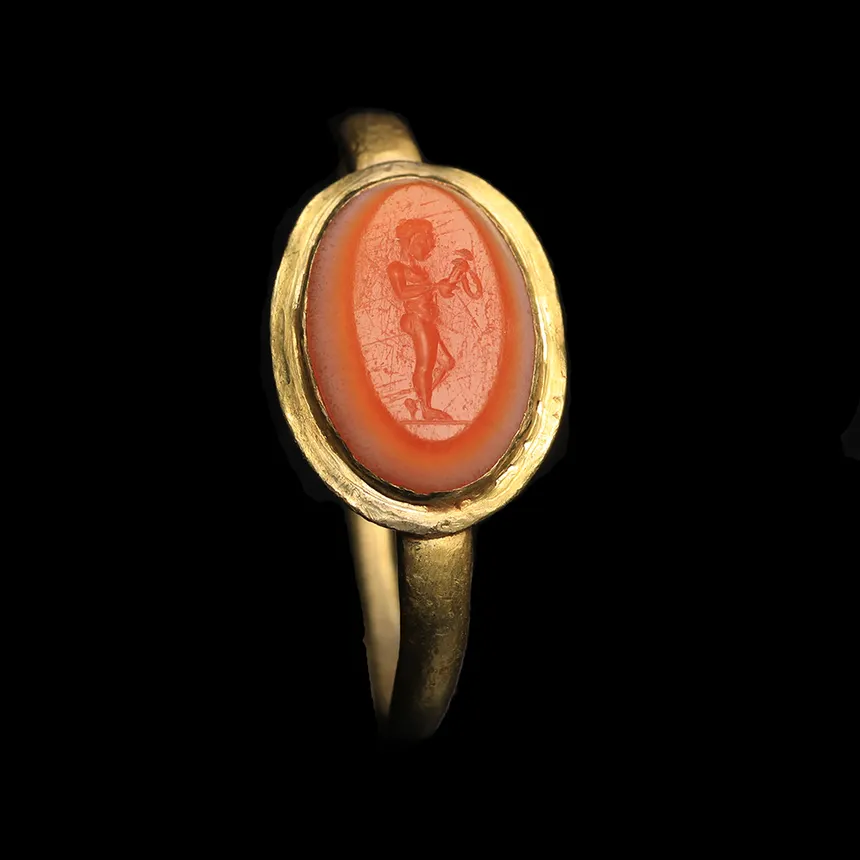
Roman intaglios were highly prized not only as decorative items but also as functional seals. Pressed into wax, they authenticated documents or secured goods.
-
Gemstone Choices – Agate, carnelian, onyx, and amethyst were common stones for intaglios.
-
Subjects – Designs ranged from gods, animals, and mythological scenes to personal symbols and initials.
-
Uses – They served as personal identifiers, much like a signature.
The Vinovia ring may therefore have been both a seal of identity and a statement of belief or personal values.
Roman Jewelry in Britain
The discovery of the Vinovia ring highlights the richness of Roman material culture in Britain. Jewelry was not just a luxury but also a way to express:
-
Social status – Precious metals and gemstones indicated wealth and prestige.
-
Cultural identity – Designs reflected Roman traditions, but also local adaptations.
-
Personal beliefs – Motifs often carried protective or religious significance.
Finds like this show how deeply Roman lifestyle and aesthetics had permeated even distant provinces.
The Roman Fort of Vinovia
The setting of the discovery adds further depth to its story. Vinovia (Binchester) was one of the largest Roman forts in northern Britain, garrisoned for over three centuries.
-
It housed both legionary soldiers and auxiliary units, many of whom came from distant provinces.
-
Civilian settlements developed around the fort, bringing traders, families, and artisans.
-
Finds from the site include pottery, coins, personal items, and religious artifacts.
The ring may have belonged to a soldier, officer, merchant, or perhaps a family member living within the fort’s bustling community.
Artistic and Cultural Value
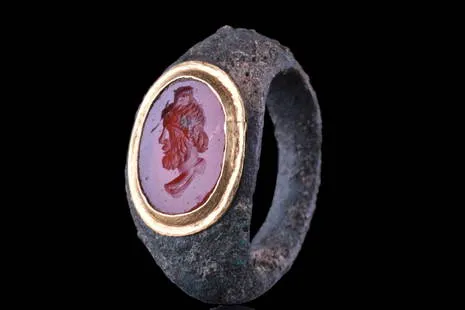
The Vinovia silver ring exemplifies Roman artistry in miniature form. Its aesthetic value lies in the delicate carving of the fishes and anchor, while its cultural value resides in the symbolic and personal meanings it carried.
For archaeologists and historians, it represents:
-
A tangible link to an individual in Roman Britain.
-
Evidence of cultural exchange, as both Roman and potentially Christian motifs are present.
-
A work of craftsmanship, demonstrating skill in both metalworking and gemstone engraving.
Comparisons to Other Roman Intaglios
The motif of fishes and anchors is not unique to Vinovia; similar intaglios have been found across the empire. These comparisons help place the ring in a broader cultural context.
-
Rome and Italy – Anchors and fishes often appear in maritime settings.
-
Christian Catacombs – Anchor-and-fish motifs were used as coded Christian symbols.
-
Britain – Other Roman rings with animal motifs have been found, but the Vinovia ring is distinctive for its combined imagery.
Preservation and Display
Today, the Silver Roman ring with agate intaglio from Vinovia is preserved as part of Britain’s archaeological heritage. It has been displayed in exhibitions and studied by experts, ensuring that both its aesthetic beauty and historical significance are appreciated.
Such finds not only enrich our understanding of the Roman past but also connect modern communities with the ancient landscapes beneath their feet.
Conclusion
The Silver Roman ring with an agate intaglio of two fishes and an anchor, unearthed in 2014 at Vinovia, is more than an artifact—it is a story in silver and stone. It speaks of personal identity, spiritual symbolism, and cultural connections within Roman Britain.
Whether a symbol of seafaring, prosperity, or perhaps even early Christian faith, the ring encapsulates the rich interplay of art, belief, and daily life in the 3rd century AD. Today, it stands as a delicate yet powerful reminder, actively showcasing the human experiences embedded within Roman history and inviting rediscovery with every excavation.
ALSO READ: Ancient Chewing Gum Unearthed in Sweden Reveals Life from 10,000 Years Ago