Hoba Meteorite: The World’s Largest Meteorite and Namibia’s Celestial Treasure
In the heart of Namibia lies one of Earth’s most extraordinary celestial treasures — the Hoba Meteorite. Discovered accidentally by a farmer in 1920, this colossal slab of iron has captivated scientists, geologists, tourists, and astronomers alike. At an estimated weight of 60 tons, the Hoba Meteorite holds the record as the largest known intact meteorite on Earth. What makes it even more fascinating is that, despite its immense size and mass, it left behind no impact crater, defying expectations and sparking ongoing scientific curiosity.
The Discovery of the Hoba Meteorite
The story of the Hoba Meteorite begins in 1920, on the Hoba West farm near Grootfontein, Namibia. A farmer named Jacobus Hermanus Brits stumbled upon an unusually large, metallic object while plowing his field. Upon further inspection, it became evident that this was no ordinary rock. Local authorities and scientists soon confirmed that the slab was an iron meteorite, a relic from outer space.
This chance discovery transformed an ordinary Namibian farm into a site of global scientific importance. Since then, the meteorite has remained exactly where it was found, making it the largest meteorite ever discovered that has not been moved.
The Size and Weight of the Meteorite
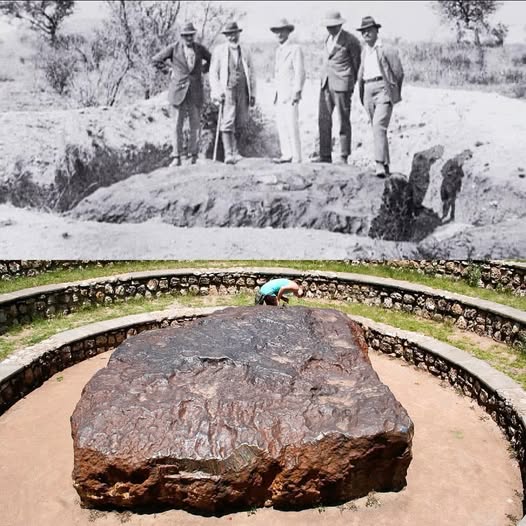
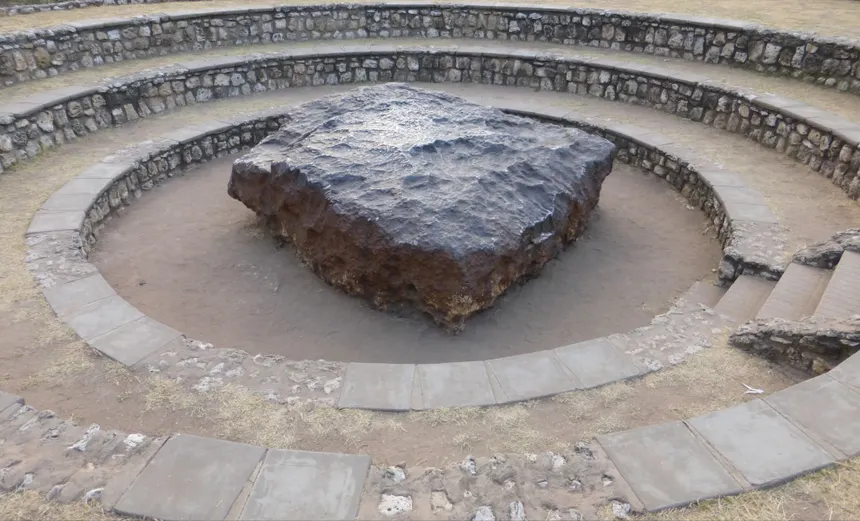
The Hoba Meteorite is a true natural giant. Measuring approximately 2.7 meters long, 2.7 meters wide, and 0.9 meters thick, it is a rectangular block of iron and nickel alloy. Its weight is estimated at 60 tons, though erosion and natural weathering may have reduced its mass slightly over the centuries.
Unlike other meteorites that break apart or scatter upon impact, Hoba has remained in a single massive slab, making it a rare specimen in the study of meteorites.
Age and Origin: A Visitor from Deep Space
Scientists estimate that the Hoba Meteorite landed on Earth around 80,000 years ago. It is classified as an ataxite, a rare type of iron meteorite rich in nickel (about 16%) and iron (about 82–84%). This composition provides vital clues about the early formation of our solar system, as meteorites are often regarded as time capsules of the universe’s birth.
Hoba likely originated from the asteroid belt between Mars and Jupiter, where countless rocky and metallic bodies orbit the Sun. Through collisions and gravitational disruptions, fragments like Hoba are sometimes knocked out of orbit and drawn toward Earth.
The Great Mystery: No Impact Crater
One of the most intriguing aspects of the Hoba Meteorite is its lack of an impact crater. Given its size and weight, one would expect a dramatic collision with Earth’s surface, leaving behind a sizable crater. However, Hoba rests almost flush with the surrounding land.
Scientists theorize that the meteorite entered Earth’s atmosphere at a very shallow angle, combined with a relatively low velocity. This slowed its descent enough that it landed gently, embedding itself into the soil without causing a major explosion or crater. Its flat, broad surface may also have contributed to this unusual phenomenon by creating atmospheric drag that slowed it down further.
This mystery continues to intrigue researchers and adds to the allure of the Hoba Meteorite as more than just a rock — it is a puzzle left behind by the cosmos.
Cultural and Historical Significance
The Hoba Meteorite is not just a scientific wonder; it has also become a cultural and national treasure for Namibia. Declared a National Monument in 1955, it draws visitors from all over the world.
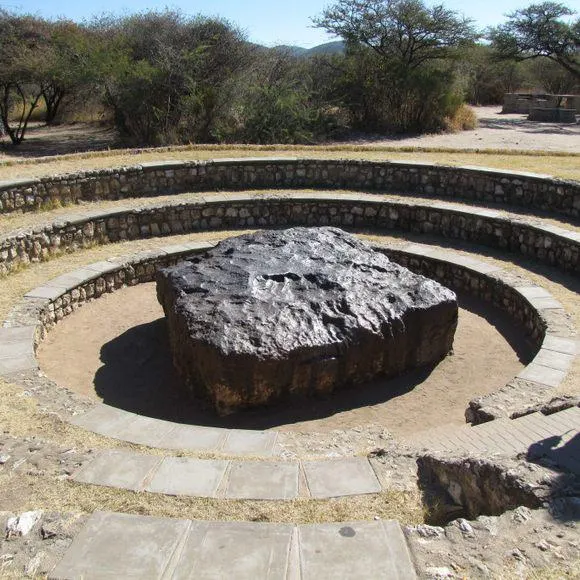
Local communities regard it as a symbol of heritage and natural wonder, while scientists view it as a rare opportunity to study a nearly intact celestial object. The meteorite is displayed in an open-air museum where tourists can see, touch, and marvel at this interstellar relic.
Tourist Attraction: Visiting the Hoba Meteorite
Today, the Hoba Meteorite is one of Namibia’s top natural attractions. Located about 20 kilometers from the town of Grootfontein, the site is easily accessible to visitors. Tourists can explore the meteorite up close, walk around its perimeter, and learn more from the visitor center about its history and composition.
The site is designed as an amphitheater, with steps leading down to the meteorite. This setup allows visitors to not only view but also touch the meteorite, offering a tangible connection to space. For many travelers, it’s a once-in-a-lifetime chance to lay hands on an object that journeyed through the cosmos.
Scientific Research and Studies
The Hoba Meteorite continues to provide valuable insights into space science. Researchers analyze its nickel-iron composition, microscopic structure, and weathering patterns to learn more about the early solar system.
It also serves as a case study in meteoritics, particularly concerning why some large meteorites leave no crater and how atmospheric entry conditions affect impact outcomes. By studying Hoba, scientists can better understand the risks posed by larger asteroids and meteorites that may one day approach Earth.
Conservation and Preservation Efforts
As a site of immense scientific and cultural value, the Hoba Meteorite is under protection. Namibia has taken significant steps to preserve it against erosion, vandalism, and unauthorized extraction.
In earlier years, pieces of the meteorite were chipped away by souvenir collectors and researchers. Leading to gradual loss of material. Today, strict measures ensure that this celestial treasure remains intact for future generations.
Why the Hoba Meteorite Matters
The significance of the Hoba Meteorite extends beyond its size and mystery. It serves as a bridge between Earth and the cosmos, reminding humanity of our planet’s connection to the wider universe. It stands as a monument to natural history, a reminder of our solar system’s violent past, and a wonder that unites science, culture, and tourism.
Conclusion: A Cosmic Legacy in Namibia
The Hoba Meteorite is more than just the largest meteorite on Earth. It is a living testament to the universe’s power and mystery. Weighing 60 tons and dating back tens of thousands of years. It continues to amaze scientists, inspire travelers, and draw the imagination toward the stars.
For anyone visiting Namibia, standing before the Hoba Meteorite is like touching a piece of the universe itself. Its enduring presence reminds us that Earth is not isolated but part of a vast cosmic dance. Where rocks from the sky can forever change the story of our world.
ALSO READ: Toghrol Tower in Rey: A Timeless Masterpiece of Seljuk Architecture