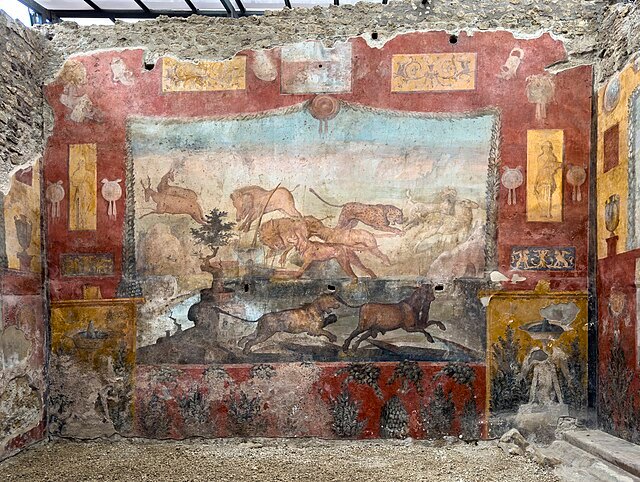
Dramatic Predator-and-Prey Fresco Restored at the House of the Ceii, Pompeii
In the heart of ancient Pompeii, a dramatic scene has returned to life on the back wall of the peristyle garden in the House of the Ceii. Standing nearly two stories tall, this predatory fresco has been painstakingly restored—revealing a violent clash between big cats and their prey. This isn’t a tranquil pastoral vision; it’s a visceral display of tooth and claw.
A Bold Statement of Power and Nature
Roman painters often used expansive outdoor scenes to blur indoor and outdoor boundaries. Yet, this fresco goes beyond landscape illusionism. Instead, it confronts the viewer with a brutal spectacle—big cats attacking domestic and wild animals—conjuring themes of power, mortality, and human dominance over nature.
Framed by two striking marble sphinx fountains at the wall’s base, the fresco becomes an immersive visual experience, amplifying its dramatic impact on visitors or guests strolling through the peristyle.
Egyptian Symbolism and the Cult of Isis
Flanking the main predator-and-prey display are Egyptianized landscapes—complete with boats, crocodiles, rural shrines, and pygmies. These motifs reflect the Romans’ fascination with Egypt during the late Republic and early Empire. Scholars suggest that the inclusion of these exotic images may point to the homeowner’s affiliation with the cult of Isis, which flourished in Pompeii’s final years.
The dual sphinx fountains and Egyptian scenery may have served to associate the domus with mystical and protectionist symbolism, branding it as a place of cross-cultural worship and esoteric sophistication.
Architectural Context: A Samnite Legacy
The House of the Ceii predates the catastrophic 79 CE eruption, with architectural roots reaching back into the late-Samnite period (2nd century BCE). Its retention of Samnite-style peristyle layouts makes it a rare survivor among Pompeii’s multi-layered residences.
This fusion of ancestral construction with late-Roman decorative splendor reflects Pompeii’s accumulation of cultural influences, including Samnite, Roman, Hellenistic, and Egyptian.
Lucius Ceius Secundus: From Magistrate to House Owner
A painted electoral inscription on the house’s façade advertises the name Lucius Ceius Secundus, who likely held a magistracy in Pompeii. The fresco’s grandeur and the nod to Egyptian motifs indicate his wealth, ambition, and cultural awareness.
For a civic leader like Ceius, this dramatic and curated art would have broadcast his public and private persona—asserting control over both symbolic wilderness and elite ritual practices.
Restoration: Reviving Colors and Narrative Drama
The fresco’s recent restoration brought back vibrant pigments and clarity to the chaotic drama. Deep reds, lush greens, and tawny yellows once again define sinewy feline muscles and peril-stricken prey.
Restorers used non-invasive techniques to preserve original paint layers, removing centuries of soot, salt encrustation, and structural degradation. The result is a vivid tableau—intended to awe and unsettle, rather than soothe.
Decoding the Predator‑Prey Motif
-
Symbol of civic power: Big cats were rare and powerful symbols of authority in ancient Rome.
-
Ethical paradox: The dead or dying prey draw attention to the thin line between strength and vulnerability.
-
Philosophical reflection: The human spectator is forced to contemplate mortality, control, and fate.
In a political setting, such imagery reinforces the dominion of a civic leader over natural chaos—suggesting mastery, yet acknowledging the fragility of life.
Egyptianizing as Cultural Capital
During Pompeii’s last decades, Egyptian motifs became fashionable in wealthy homes. Boats, crocodiles, and sphinxes evoked exotic mystery and religious fulfillment. The cult of Isis, in particular, promised protection and enigma—ideal for associating with a powerful household.
By juxtaposing predator imagery with Egyptian esoterica, the Ceii fresco positions itself at the intersection of raw violence and ritual order—a dual narrative meant to impress, mystify, and assert multiple layers of identity.
Peristyle Garden: Decor and Display
The fresco adorned the peristyle garden, an interior courtyard open to the sky and lined with columns. This space served recreational, social, and symbolic functions—hosting banquets, philosophical discourse, and elegiac strolls.
As guests walked through the garden, they moved through a space where nature (gardening), culture (architecture), and mythology (fresco) intersected—creating complex sensory and emotional engagement.
Archaeological Significance
The House of the Ceii’s fresco illustrates several critical points:
-
Urban domestic gardens could serve as theatrical venues for dramatic, propagandistic imagery.
-
Late-Roman Pompeii was receptive to multicultural iconography tied to Egypt and its mystical traditions.
-
Preservation priorities: This house exemplifies how urban residences can house exceptional artwork, often overlooked in favor of temple or public decorations.
Visitor Perspectives and Museum Display
The fresco is open to visitors visiting Pompeii today, integrated into the archaeological park’s perimeter route. Interpretive displays emphasize:
-
Its surprising attention-grabbing scale
-
The violent theatricality
-
The Egyptian elements linked to the cult of Isis
-
Its attribution to Civic elite identity
Many visitors report feeling unsettled—accustomed to romantic wall paintings, this shocking spectacle challenges perceptions of Roman domestic art.
Broader Context: Animal Scenes in Roman Homes
Luxury homes across the Roman Empire often featured wild animals—hunts, exotic exhibitions, theatrical themes—but marble sculpture and statuary tended to dominate. A full-scale painted drama of this sort is rare, particularly with such fidelity to natural anatomy and violent subject matter.
The House of the Ceii fresco thus emerges as one of the most original and daring uses of animal imagery within a private, civic context.
Conclusion: Wild Drama Meets Civic Authority
The predator-and-prey fresco at Pompeii’s House of the Ceii is a statement of power, ritual, and cultural savvy. Nearly two stories tall and enriched with Egyptian motifs, it blurs the line between domestic luxury and wild spectacle. It broadcast the homeowner’s:
-
Dominance over nature
-
Engagement with exotic religious cults
-
Political ambition through brutal allegory
Now fully restored, the fresco reminds us that for the Romans. Even home décor could be theatrical, multicultural, and provocative—reflecting a world where power and myth walked hand in paw.
ALSO READ: The Sacrum Bone of Tequixquiac: America’s Ancient Artistic Treasure