The Forgotten Megaliths of Bada Valley: Indonesia’s Mysterious Ancient Civilization
When thinking of megalithic sites in Southeast Asia, the Plain of Jars in Laos often takes center stage. However, deep within Central Sulawesi, Indonesia, lies an equally enigmatic and ancient site—Bada Valley, home to hundreds of prehistoric megaliths, many of which remain largely unknown to the global public. These stone relics, believed to be over 5,000 years old, speak of a lost civilization whose customs, beliefs, and craftsmanship still baffle modern archaeologists.
This article explores the ancient Bada Valley megaliths, their unique characteristics, historical significance, and the mystery surrounding their origins and purpose.
Introduction: A 5,000-Year-Old Legacy in Sulawesi
Indonesia’s ancient civilization is estimated to have existed as early as 3000 BCE. Long before the rise of Hindu-Buddhist kingdoms in Java or the Srivijaya Empire, mysterious cultures thrived in the remote highlands of Sulawesi. One of the most compelling pieces of evidence for this is the megalithic complex in Bada Valley, a remote region in the Lore Lindu National Park in Central Sulawesi.
Bada Valley is often overshadowed by more famous sites, but its megaliths—featuring stone jars, human-like statues, and abstract carvings—offer tantalizing clues about an unknown prehistoric culture.
Location and Discovery: Central Sulawesi’s Hidden Gem
Bada Valley is located on Sulawesi Island, Indonesia’s fourth-largest island and one of the most geographically unique due to its spidery peninsulas and rugged interior. The valley sits within the highlands of Lore Lindu National Park, a UNESCO biosphere reserve known for its biodiversity and cultural heritage.
Key Facts:
-
Discovered: First documented by Dutch archaeologists in 1908.
-
Number of Megaliths: Over 400 identified structures, with possibly more hidden in the dense forests.
-
Elevation: Around 1,000 meters above sea level.
-
Accessibility: Remote and difficult to reach, which has preserved many of its features from modern development.
Types of Megaliths in Bada Valley
The Bada Valley megaliths come in diverse forms, ranging from giant stone jars to anthropomorphic statues and carved basins. Each type offers a unique puzzle piece in understanding the cultural practices of its creators.
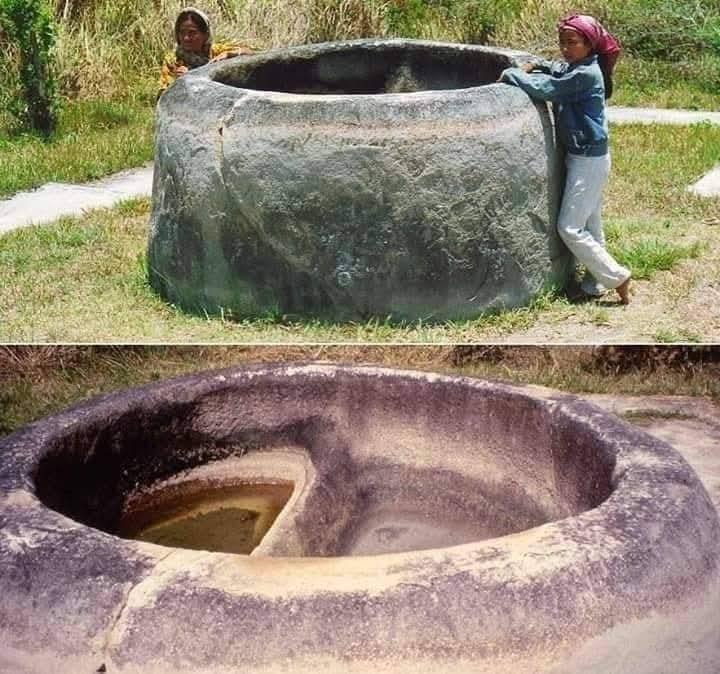
1. Stone Jars
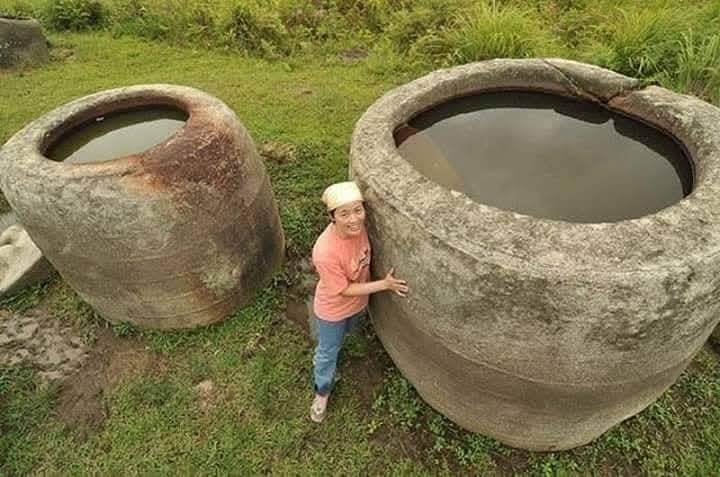
These resemble the megalithic jars found in Laos and are among the most intriguing structures in the valley.
-
Height: Ranges from under 1 meter to over 3 meters.
-
Material: Typically carved from single blocks of volcanic stone.
-
Features:
-
Some have stone lids with carved figures.
-
Others have dual basins, which locals describe as “mother and child” bathing tubs.
-
Carvings are often shallow but precise.
-
2. Statues (Arca)
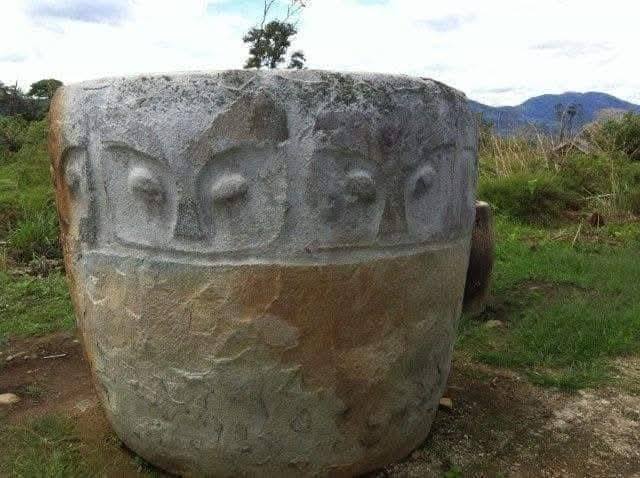
These figures are more symbolic than realistic, yet suggest an advanced level of artistic and spiritual expression.
-
Usually upright, facing west.
-
Often human-like, with features such as eyes, noses, and hands.
-
Possibly represent deities, ancestors, or guardians of the area.
3. Basins and Stone Slabs
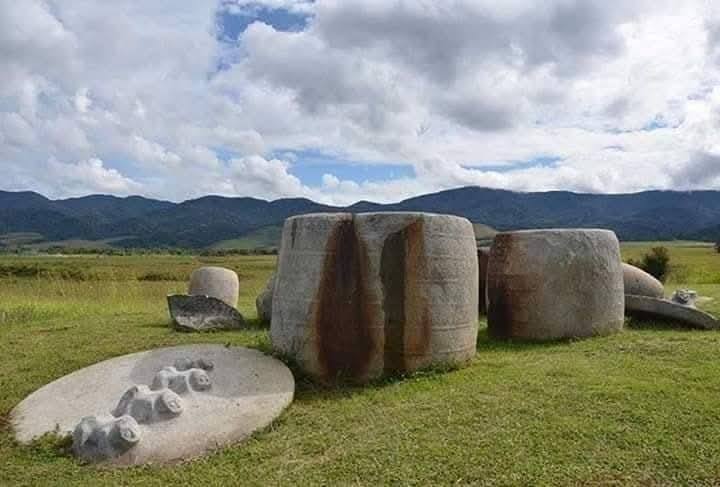
Flat or concave stones whose function remains unclear.
-
May have been used for ritualistic purposes, water storage, or burial preparations.
Mystery and Purpose: What Were the Megaliths Used For?
Despite over a century of study, the exact purpose of the Bada Valley megaliths remains unknown. There are no written records, inscriptions, or clear cultural continuity linking them to current populations. Several theories attempt to explain their function:
1. Burial Sites
The jars may have been funerary urns used to house the cremated remains or skeletal remains of the elite.
2. Ceremonial Uses
The dual basins in some jars may indicate ritual bathing practices, possibly connected to fertility rites or initiation ceremonies.
3. Astronomical Markers
Like many megalithic sites worldwide, the structures may have been aligned with celestial events, such as solstices or equinoxes.
4. Totemic Symbols
Statues may represent clan totems, mythological beings, or spiritual guardians.
Despite these theories, the megaliths’ true function remains one of Indonesia’s greatest archaeological mysteries.
Comparison: Bada Valley and the Plain of Jars in Laos
Though separated by geography and culture, the megalithic jars of Laos and Indonesia share surprising similarities:
| Feature | Bada Valley (Indonesia) | Plain of Jars (Laos) |
|---|---|---|
| Estimated Age | ~3000 BCE | ~500 BCE – 500 CE |
| Primary Structure | Stone Jars, Anthropomorphic | Stone Jars |
| Size Range | 1–3 meters | 1–3 meters |
| Artistic Features | Carvings, Lids, Human Statues | Mainly undecorated |
| Purpose (Theorized) | Ritual, Burial, Water Storage | Burial (confirmed) |
This comparison highlights the independent yet parallel development of stone-working and ceremonial practices across Southeast Asia.
Cultural Continuity and Local Beliefs
Today, the local communities—primarily of Toraja and Lore ethnicity—have their own legends and stories tied to the megaliths. Many believe they are the work of spirits or ancient giants. Others view them as sacred, and some even perform rituals at select stones.
Though these practices are not direct continuations of the original creators’ beliefs, they reflect a spiritual reverence that has preserved the megaliths through oral tradition and community respect.
Preservation and Tourism
Unlike other popular archaeological sites in Southeast Asia, Bada Valley has remained largely untouched by mass tourism, partly due to its remote location. However, this isolation presents both opportunities and threats:
Opportunities:
-
Eco-cultural tourism potential.
-
Involvement of local communities in heritage preservation.
-
Scientific research can proceed with minimal disturbance.
Threats:
-
Neglect and lack of formal protection.
-
Erosion from natural elements.
-
Potential for illegal artifact trade.
Efforts by local universities and Indonesia’s Ministry of Culture are slowly improving awareness and preservation strategies.
Conclusion: A Forgotten Chapter in Southeast Asian History
The Bada Valley megaliths are a striking reminder of Indonesia’s prehistoric complexity—an advanced, yet anonymous civilization that flourished in the remote mountains of Sulawesi thousands of years ago. These ancient structures challenge our understanding of early human societies, their religious beliefs, engineering capabilities, and artistic expression.
While much about the Bada Valley megaliths remains cloaked in mystery, they offer an invaluable piece of the puzzle in the story of human civilization in Southeast Asia. Their continued study and preservation not only deepen our understanding of Indonesia’s past but also celebrate the ingenuity and spirit of its ancient peoples.
ALSO READ: Venetian Innovation: 18th-Century Murano Glass Sunglasses and the Goldoni Style